
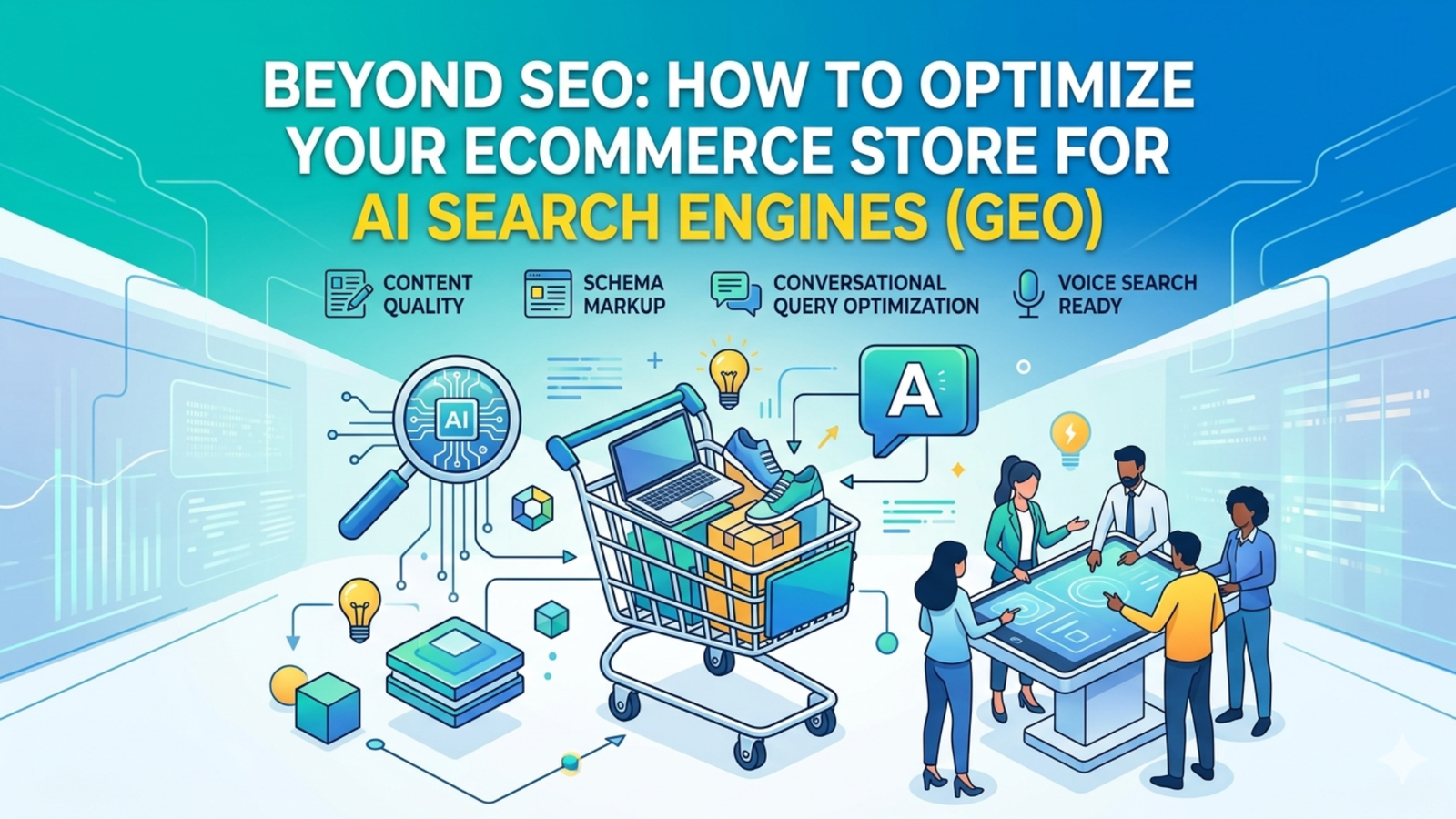
Google ranking was the primary focus of e-commerce companies for many years. Try to rank on the first page of search results by adding the appropriate keywords, creating backlinks, and optimizing pages. Although SEO is still important, most businesses are unaware of how quickly online searches are evolving.
Instead of sifting through countless search results, individuals now consult AI technologies for advice. Users now anticipate prompt responses, product recommendations, and personalized recommendations from ChatGPT, voice assistants, Google’s AI-generated responses, and other AI-powered search tools.
Every company investing in an Ecommerce website development service needs to start looking beyond standard SEO because of this change. Ranking higher is no longer the main goal. Making sure AI search engines can comprehend your website, trust your content, and suggest your products to the appropriate audience is crucial.
GEO, or Generative Engine Optimization, can help with this.
To be honest, a lot of online retailers are still unprepared for it.
What Is GEO and Why Is Everyone Talking About It?
Generative Engine Optimization is referred to as GEO. To put it simply, it means making your website ready for search engines and assistants that are powered by artificial intelligence.
Conventional SEO helps your website appear in search results.
GEO enables AI systems to understand your website well enough to use it as a reliable source when generating responses.
For example, someone may search:
- “Best office chair for long working hours”
- “Affordable skincare products for sensitive skin”
- “Which laptop is best for graphic designers?”
AI search engines now produce direct results by extracting data from reliable websites, rather than just displaying links.
Your products are far more likely to be mentioned in those responses if your online store is reliable, well-organized, and educational.
If not, your competitors will take that visibility instead.
AI Search Is Changing Customer Behavior
The majority of consumers no longer search in the same manner as they did five years ago.
Online conversations are growing in popularity. They ask comprehensive queries rather than entering brief keywords.
Earlier:
- “running shoes men”
Now:
- “What are the best running shoes for beginners with flat feet?”
That might seem like a minor adjustment, but it fundamentally alters how content should be produced for e-commerce websites. AI search engines are trained to comprehend meaning, context, and intent in addition to terms.
So if your product pages only contain:
- short descriptions,
- generic content,
- copied manufacturer text,
- or keyword stuffing,
They’re probably not giving AI enough information to work with.
Because of this, companies now want an Ecommerce website development service that focuses on how AI systems understand website content in addition to design and SEO.
Your Website Structure Matters More Than You Think
An attractive online store is fantastic. However, AI search engines find it difficult to comprehend your website’s structure if it is unclear. Consider your website as a physical store. Customers depart if they enter and are unable to locate the merchandise. AI systems operate similarly. A well-structured e-commerce website should feel straightforward and well-organized.
Clear categories make a difference
For both customers and AI systems to comprehend how your store is set up, your products should be arranged logically.
URLs should actually make sense
A clean URL like:
- /wireless-headphones
is far better than:
- /product?id=84729
because it immediately tells search engines what the page is about.
Internal links help AI connect information
AI search engines gain a deeper understanding of your website when your blogs, category pages, and products naturally link to each other.
Navigation should feel effortless
Poor user experience indications are important in today’s search rankings, and visitors become frustrated if they can’t locate pages with ease.
These days, effective e-commerce development involves more than just aesthetics. The goal is to create a website that both AI and humans can easily navigate.
Product Pages Need More Personality and Depth
Treating product pages like catalogues is one of the most common errors made by online retailers. Most online stores simply upload:
- one image,
- a short description,
- a few specs,
- and a price.
That’s not enough anymore.
Pages that actually assist consumers in making decisions are favored by AI search engines.
Write descriptions like you’re talking to a customer
Describe how the product truly benefits someone rather than just listing its features.
For example, instead of:
“5000mAh battery.”
You could say:
“The large battery easily lasts a full working day without constantly reaching for the charger.”
That feels more human, more useful, and more understandable for AI systems too.
Add FAQs on product pages
Before making a purchase, customers typically ask the same questions. Including FAQs helps:
- improve the trust of the customers who are browsing,
- reduce confusion amongst the customers,
- and increase visibility in conversational searches.
Avoid copied supplier content
AI engines have no reason to give your product description priority if 100 websites use the identical description. Now more than ever, originality is important.
Content Still Matters, But Not the Old Way
Many websites created blogs just to improve their results a few years ago. The outcome? Thousands of generic articles that sounded repetitious and robotic. The ability of AI search algorithms to identify information that exists merely to rank is improving. Because of this, information that is experience-driven and useful now performs better.
Write content that answers real questions
Instead of writing:
- “Top 10 Shoes”
go deeper.
Write:
- “How to Choose Running Shoes if You’re New to Fitness”
That’s the type of content people actually search for.
Share practical insights
Consumers are more likely to trust companies that educate rather than just sell. Buying advice, comparisons, lessons, and helpful guidelines all naturally establish authority.
Make your content feel real
When information sounds artificial intelligence-generated or forced, people can tell right away. Compared to more formal corporate writing, natural language, a personal tone, and straightforward explanations are significantly more effective.
Trust Is Becoming a Huge Ranking Factor
These days, AI search engines scan for more than simply keywords. They search for legitimacy. This means that every aspect of your e-commerce website should feel reliable.
Real reviews matter
Both users and search engines benefit from genuine customer feedback.
Transparent policies help build credibility
It should be simple to locate shipping details, return guidelines, and contact information.
Expertise matters
In AI-driven search, brands with a firm understanding of their niche do better.
For example, a store with just product listings doesn’t seem as trustworthy as a skincare brand that publishes instructional skincare information.
Updated websites perform better
Pages that are out of date quickly lose credibility. Up-to-date information and new content show that your company is reliable and active.
Website Speed Still Impacts Everything
People still dislike slow websites, regardless of how sophisticated AI search gets. Customers will abandon your online store before they have a chance to look at your merchandise if it takes too long to load. Indeed, AI search engines also take note of that.
Faster websites improve user experience
Pages that load quickly boost engagement and lessen frustration.
Mobile optimization is no longer optional
Nowadays, mobile devices account for the majority of e-commerce traffic, so your website needs to function well on all screen sizes.
Heavy websites hurt conversions
Performance can be considerably slowed down by an excessive number of unnecessary plugins, animations, or large graphics. Design and performance should always be balanced in a good Ecommerce website development service. Because a slow-loading, aesthetically pleasing website nevertheless loses visitors.
Conversational Search Is the Future
The way people search is the primary distinction between GEO and regular SEO. AI search is conversational. Asking questions comes naturally to people, almost like conversing with someone. Your content should reflect that.
Use natural headings
Instead of robotic titles, write headings that sound human.
For example:
- “How to Choose the Right Gaming Laptop”
works better than: - “Gaming Laptop Buying Guide 2026”
Answer questions directly
AI engines often pull concise answers from websites. Simple, direct explanations increase your chances of appearing in AI-generated responses.
Think about user intent first
Don’t just ask:
“What keyword should I target?”
Ask:
“What is my customer actually trying to know?”
That shift changes everything.
SEO Is Evolving, Not Dying
There’s a misconception that AI search will replace SEO completely. It won’t. SEO is still extremely important.
But the focus is shifting from:
- manipulating rankings
to:
- creating genuinely useful experiences.
The ecommerce brands that succeed over the next few years will be the ones that:
- build fast and user-friendly websites,
- publish original and useful content,
- create trust,
- optimize for conversational search,
- and focus on helping customers instead of gaming algorithms.
Ironically, the future of SEO feels more human than ever.
Final Thoughts
E-commerce is evolving more quickly than most companies anticipated because of AI-powered search.
Consumers are now requesting recommendations, comparisons, and purchasing guidance from AI technologies rather than merely browsing search results. This implies that your online store must do more than just rank well on Google.
Both humans and AI systems must be able to communicate with it clearly. Because of this, selecting the best Ecommerce website development service is crucial in the modern world. A modern ecommerce website should not only look professional but also support:
- SEO,
- GEO,
- mobile performance,
- fast loading speeds,
- structured content,
- and user trust.
Businesses that embrace AI-driven search optimization early on will have a significant edge in the future. Because ranking higher won’t be the only way to gain attention in the future. It will result from becoming the brand that AI is certain to suggest.
Interesting Reads: