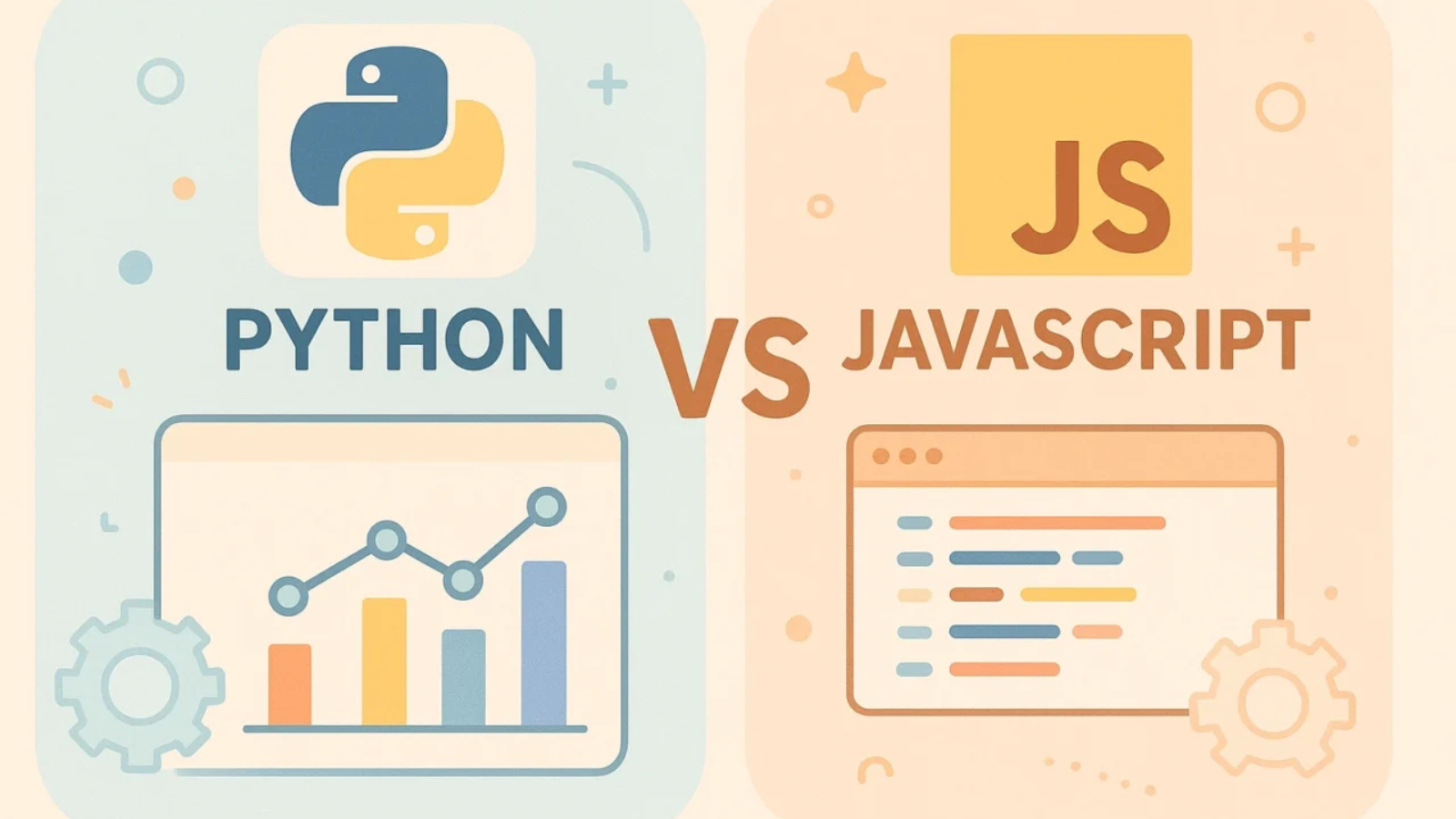
Python vs JavaScript

Python vs JavaScript: Comparison, Use Cases, Pros and Cons

A significant area of discussion within programming revolves around programming languages, especially Python and JavaScript. If we look to the technology sector, we don’t need to look too far to find that both are the most widely utilized programming languages, each with strengths that meet their intended aims. This means that whether you’re a beginning programmer or your organization is seeking to produce the best product, knowing the differences, as well as the pros and cons of each, is crucial.

At a glance both Python and JavaScript look the same in that they are both a high level, interpreted, programming language that are designed to be as simple and flexible as can be, but in practice they are playing different roles in development. Python is typically used for AI (artificial intelligence), data analytics, and as a backend framework, whereas JavaScript is intended to add interactivity in regard to the web, or create mobile applications which dynamically involve user interaction. 

What is Python?

Python​‍​‌‍​‍‌​‍​‌‍​‍‌ is a high-level, general-purpose programming language which emphasizes a clear syntax that is often described as being quite similar to the English language. Its creator, Guido van Rossum, released it in 1991 and the main idea was that the code should be as readable as possible, just like normal English.

As a matter of fact, Python is now the top choice of developers, data scientists, and researchers because of its user-friendly nature and flexibility. The language is basically an all-in-one tool for any idea you have, from setting up servers for websites, to training deep learning models, to even task automation.

What really makes Python stand out from the crowd is the number of libraries it has. Libraries such as Numba, Pandas, TensorFlow, Scikit-learn, and Django offer endless possibilities to developers, anything from doing complex calculations for scientific research to building powerful web apps can be achieved in no time.

In addition, Python encourages quick coding and is very approachable for beginners, which means it is a great selection for people that are just starting out in programming.

Python is best suited for:

  • Data analysis and visualization
  • Machine learning and artificial intelligence
  • Backend web development
  • Automation and scripting
  • Software prototyping

What is JavaScript?

JavaScript is the major force that enables the World Wide Web to function. The language was launched in 1995 by Brendan Eich and after that, it has been constantly improved and extended to the point where it now forms the base of modern software development.

The main purpose of JavaScript when it was first developed was to bring interaction to web pages. Nevertheless, with enhancements like Node.js, React, Angular, and Vue.js, this technology can be employed both on the frontend and backend, thus allowing the creation of complete web applications with a single language.

In distinction from Python which according to the majority of users is meant to be utilized on server-side, JavaScript is executed directly in browsers, thus providing immediate changes and also dynamic user interfaces without the need to load the entire page again. Moreover, it is also the hardest to name besides a few that can do client-side and server-side programming simultaneously, i.e full-stack development.

JavaScript is best suited for:

  • Interactive and dynamic web applications
  • Frontend and full-stack development
  • Real-time applications (like chat systems or streaming apps)
  • Mobile app development (with React Native or Ionic)
  • Browser-based ​‍​‌‍​‍‌​‍​‌‍​‍‌games

Use​‍​‌‍​‍‌​‍​‌‍​‍‌​‍​‌‍​‍‌​‍​‌‍​‍‌ Cases of JavaScript

JavaScript remains the primary means of creating an interactive website, as well as for dynamic front-end development. Most of its utilization can be found in the following areas:

  • Frontend Web Development: JavaScript is the main source of energy for the change of dull user interfaces into interesting ones. Libraries like React, Vue.js, and Angular not only make frontend development easier, but also more efficient.
  • Backend Development with Node.js by using Node.js, JavaScript is transitioned to the server-side, thus full-stack development is achievable, which means that one language can be utilized for the whole application.
  • Mobile App Development Programmers can create cross-platform mobile applications that operate seamlessly on both Android and iOS through the implementation of the React Native framework.
  • Game Development: with the help of such engines as Phaser and Three.js, JavaScript can offer simple games that a user can run in a browser, as well as it can be used for 3D animations and graphics creation.
  • Real-Time Applications: JavaScript’s event-driven architecture is a perfect match for the needs of the apps that are dependent on the latest changes, for instance, a chat app, or a streaming service, where the user interaction is done in real-time.

Pros and Cons of Python

Advantages of Python:

  • It is very simple and extremely easy to understand.
  • Just right for quick development and making prototypes.
  • Which is basically a huge number of libraries for AI, data science, and automation.
  • Having a good number of developers spread all over the globe, its community worldwide is very supportive.
  • Extremely portable and can be easily integrated with other technologies.

Disadvantages of Python:

  • Compared to compiled languages such as C++ or Java, it is slower.
  • Not a very good choice for mobile app development.
  • Also, the support for browser-based applications is very limited.
  • Dynamic typing may sometimes cause runtime errors.

Pros and Cons of JavaScript

Pros of JavaScript:

  • Does not need any other software, and works straight away with browsers, thus enabling interactivity to be done in real-time.
  • Highly adaptable and can be used to create frontend, backend, and even mobile applications.
  • When done with the help of high-quality engines like V8, it is very fast in its performance.
  • Along with a large community, it also has a decent number of frameworks to provide support.
  • Asynchronous programming, which is the key to enabling real-time applications, is something JavaScript is particularly well suited for.

Cons of JavaScript:

  • Security-wise, it can have problems, as it is open on the client-side.
  • At times, it might be very hard to find the location of errors in asynchronous code.
  • Inconsistencies in performances may result from different browsers.
  • Non-strict typing may cause a presence of unfound logical errors. ​‍​‌‍​‍‌​‍​‌‍​‍‌​‍​‌‍​‍‌​‍​‌‍​‍‌

Python​‍​‌‍​‍‌​‍​‌‍​‍‌ vs JavaScript: Performance and Community Support

JavaScript is substantially faster than Python when it comes to performance. This is due to the fact that the engines it uses are optimized for the browser. JavaScript is thus the best candidate for web applications that are interactive and loading fast.

On the other hand, the Python development process is way more convenient and comfortable for logic-heavy types of applications like AI models, financial software, and data processing systems.

As far as community and ecosystem are concerned, the both languages that are being discussed here have strong ones. Python has a better grip on the academic and data science community, while in the web development sector, JavaScript has the leading position.

Which Language Should You Choose First?

When it comes to web development, frontend design, or building real-time apps, your first step should be learning JavaScript. Creating modern websites and apps is where it’s most needed, plus it carries one of the largest developer ecosystems in the world.

On the contrary, if you are attracted to dabbling in data science, automation, backend development, or AI then Python would be the best choice. The language is more user-friendly, simpler for beginners, and provides unlimited possibilities in the future tech fields.

Eventually, the majority of developers make a decision to learn both Python and JavaScript.

These two languages complement each other.

Conclusion: Python vs JavaScript – The Final Verdict

The Python vs JavaScript comparison is not about which is better overall, it is about choosing the most suitable tool for your goal. For instance, intelligent systems are to be built if you desire to automate tasks or analyse large datasets. In that case, Python is the best companion to have around. It not only makes the operations simple, but research-driven development also goes faster.

On the other hand, if your aim is to produce websites that engage visually, interactive dashboards, or real-time web applications, then JavaScript is the language that you must have.

Both Python and JavaScript have given ways to their successors, but still, they will not disappear soon. The brightest option? Getting proficient in both – the combination of Python’s intelligence and JavaScript’s interactivity is a perfect duo that defines present-day ​‍​‌‍​‍‌​‍​‌‍​‍‌technology.


Interesting Reads :

AI Security Posture Strategies for Safer AI Deployment

Computer Vision vs Machine Learning: Key Differences and Use Cases

The Rising Importance of Intelligent Testing in Modern Software Environments


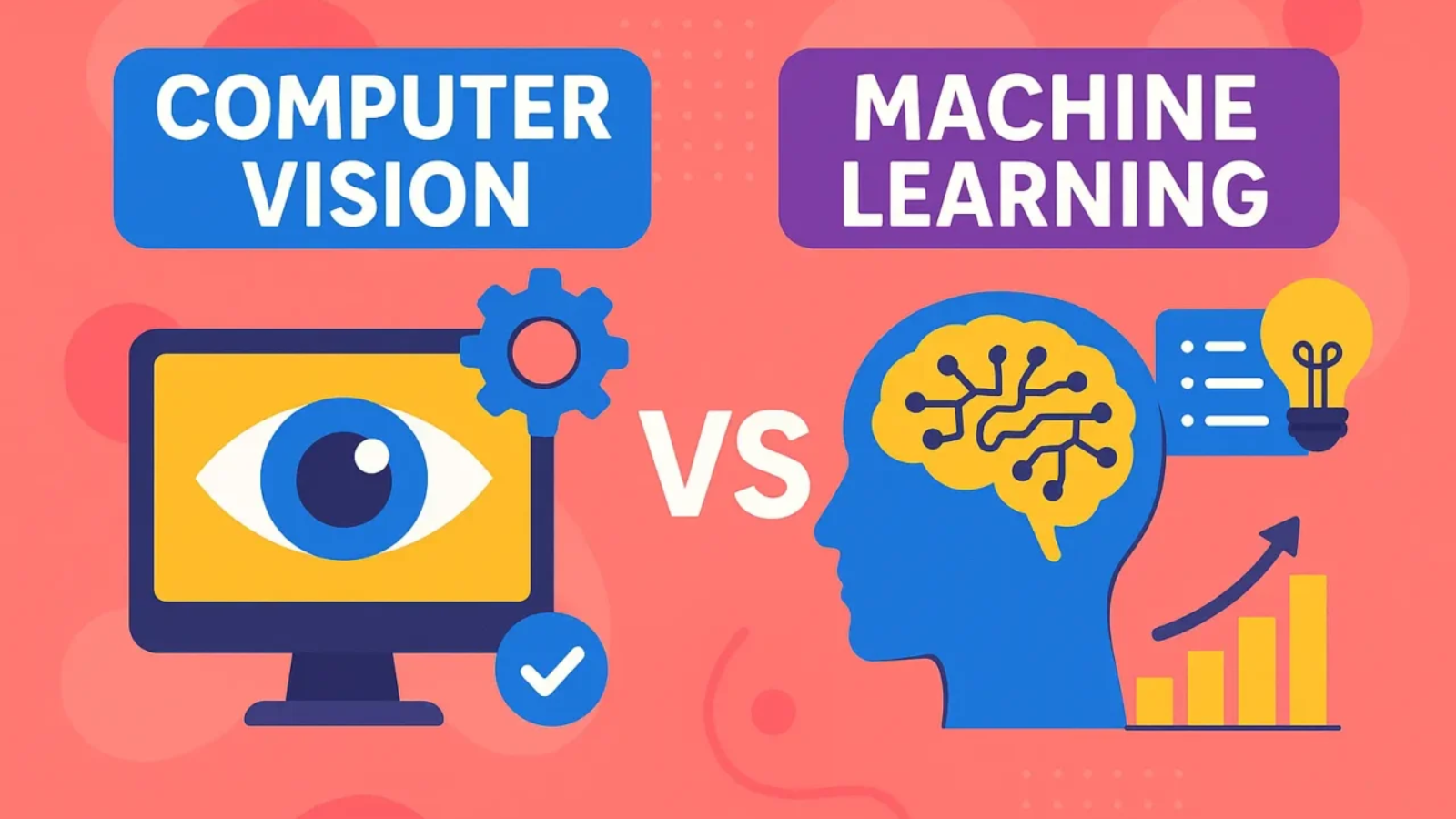
Computer Vision vs Machine Learning

Computer Vision vs Machine Learning: Key Differences and Use Cases

Artificial​‍​‌‍​‍‌​‍​‌‍​‍‌ Intelligence (AI) keeps on changing the different sectors that it can imitate and even improve human intelligence. Two of the most vibrant branches of which are Computer Vision vs Machine Learning which, for their revolutionary contributions to automation, analysis, and intelligent decision-making, stand out. In fact, these are three closely related fields that are usually integrated in modern AI systems, but they have different aims and work in different ways.

Technology wise, computer vision vs machine learning are both to be distinguished as having different roles when it comes to how computers handle information and react in an intelligent manner to the data. They both belong to the domain of artificial intelligence, but they differ in the kind of data they work on, the results they generate, and the methods they employ to reach those results.

What is Machine Learning?

Machine Learning (ML) is a part of Artificial Intelligence that helps systems learn from data without clear-cut programming. ML algorithms look at patterns and make guesses or choices based on what they’ve seen before, rather than following set rules. Think about teaching a computer using thousands of email examples marked as “spam” or “not spam.” As time goes on, it starts to spot the things that set one apart from the other—like fishy words or sender web addresses—and uses this knowledge for future emails.

Main Methods in Machine Learning

  • Supervised Learning – Data with labels trains models. For instance, guessing house prices using location and size.
  • Unsupervised Learning – Models discover hidden trends in data without labels, like putting customers in groups based on what they buy. 
  • Reinforcement Learning-The model gets to learn through making mistakes and successes by receiving rewards or punishments for its actions.

Key Applications of Machine Learning

  • Recommendation Systems: The likes of Netflix, YouTube, and Spotify employ ML to keep your experience unique and personal.
  • Fraud Detection: Financial institutions utilize ML algorithms in spotting transactions that are out of the ordinary.
  • Predictive Analytics: Corporations employ ML models for forecasting sales, demand, or customer churn.
  • Voice Assistants: The use of ML is the main reason behind Alexa and Siri being able to understand human language

To summarize, Machine Learning is what makes AI systems capable of changing, being more efficient, and getting better by using the same principle of data exposure over ​‍​‌‍​‍‌​‍​‌‍​‍‌time.

What is Computer Vision?

Computer Vision focuses on an area of Artificial Intelligence where computers can perceive the world visually, similar to how human eyes and brains perceive and understand vision. This area focuses on teaching computers and machines how to “see.”’. The machines can process the images and videos in a meaningful manner.

For example, smartphones unlocking using facial recognition, and self-driving cars identifying and responding to traffic signs and signals, are all using systems of Computer Vision and in each case visual data recognition is a critical step

Core​‍​‌‍​‍‌​‍​‌‍​‍‌​‍​‌‍​‍‌​‍​‌‍​‍‌​‍​‌‍​‍‌​‍​‌‍​‍‌ Techniques in Computer Vision

  • Image Classification: The most basic understanding of the image, the decision to assign a single label to the entire picture (e.g. one would call “cat” or “dog”).
  • Object Detection: Finding the accurate spots of the different things, visually identifying the items in the given photo.
  • Image Segmentation: Dividing an image into smaller pieces in order to have a more detailed look at it.
  • Feature Extraction: The system learning features of an image such as edges, colours, or shapes.
  • Optical Character Recognition (OCR): Helping the machines to read the text that is printed or handwritten in the photos by changing them into a machine-readable format.

Deep Learning, mainly Convolutional Neural Networks (CNNs), is the major method in this area of Computer Vision, as it basically tries to copy the way the human brain identifies and processes visual ​‍​‌‍​‍‌​‍​‌‍​‍‌​‍​‌‍​‍‌​‍​‌‍​‍‌​‍​‌‍​‍‌​‍​‌‍​‍‌abstractions.

Computer Vision vs Machine Learning: Key Differences

Though​‍​‌‍​‍‌​‍​‌‍​‍‌ Computer Vision and Machine Learning are closely linked, they are two completely different areas that differ in their focus and extent. Let’s look at the detailed descriptions to see how they differ:

1. Purpose and Function

Machine Learning is all about giving machines the ability to figure out patterns from data by themselves and to make decisions that are based on data. The main focus of this area is that of dealing with data, which can be in the form of either numbers, text, or structured data.

Computer Vision, however, is entirely different and focuses exclusively on understanding the world through visuals, i.e. it looks at pixels to get the information from images and videos.

In essence, machine learning is about ”learning from data,” whereas computer vision is about ”seeing and interpreting”.

2. Data Type and Input

Machine Learning models are very flexible when it comes to data that can be used for them since they can be given data in the form of numbers, text, and even audio and images.

At the same time, Computer Vision is very specific in the sense that it only works with data that have a visual character (images or videos).

Thus, an ML program could be used to facilitate the prediction of stock market trends by examining the historical data that would then be given to it, while a Computer Vision system would be in the position to accomplish the task of detecting product defects in the manufacturing industry by looking at the product image.

3. Techniques and Algorithms

Machine Learning comprises a set of algorithms such as Linear Regression, Decision Trees, and Support Vector Machines that are used to find patterns in the data that is provided.

On the contrary, Computer Vision mainly depends on Deep Learning models to achieve their goals, in particular, Convolutional Neural Networks (CNNs) for activities such as image recognition and classification.

Computer vision (CV) is a technology that mainly relies on machine learning and deep learning for its computation. Still, it further complicates the matter by including image processing and feature extraction, which are at another level.

4. Output and Goals

Machine Learning is a method that helps in achieving such results as predictions, classifications, or even recommendations.

Computer Vision is characterized by an output in the form of the visual understanding that can be, for instance, the detection of a face, the recognition of an object, or the identification of the motion of a video.

Even though Machine Learning can play a role in Computer Vision, as CV mostly employs ML techniques to predict images, the final goals of these two areas are still ​‍​‌‍​‍‌​‍​‌‍​‍‌different.

The Role of Machine Learning in Computer Vision

It is important to understand that Computer Vision does not function in a vacuum. Common practice is to develop models with Machine Learning to analyse and classify invisible information.

Here is a quick overview of these processes:

Data Preparation: Images are inspected and labelled.

Model Training: Machine Learning algorithms take these labelled data and learn.

Prediction: Once the model is trained, it can categorize new images it hasn’t seen before.

Machine Learning Benefits:

  • Continuous Learning: Models become smarter over time the more data it sees.
  • So Much Variety: You can apply this skill in every industry-from finance to entertainment.
  • Automation: Machine Learning can automate tasks and increase your efficiency.
  • Prediction: Machine Learning can help organizations predict diagrams of a potential state into the future.

Computer Vision Benefits:

  • Understanding Visuals: Machines can “see” and interpret the world.
  • Accuracy and Precision: Computer Vision can detect details in visuals that may be out of the reach of human detection.
  • Real-Time Processing: It is important to make machine decisions quickly in some industries, such as automation or traffic management.
  • IoT and Robotics Integration: Machine Learning helps IoT devices and robots be smarter.

Conclusion

Computer Vision vs Machine Learning discussion will never be about which will win; it will be about understanding their distinct roles or functions and how they can work together to create capabilities that move artificial intelligence forward.

Machine Learning allows systems to learn from data, and make intelligent predictions, while Computer Vision gives them the understanding of the visual world to be able to see. Altogether and together, they are allowing us and leading us to our next generation of smart technology including: autonomous vehicles, medical imaging, facial recognition, and industrial automation, etc.

As technology and innovation continue to develop and evolve, this intersection of Computer Vision and Machine Learning will define how the machines will see and experience reality. It will transform industries, automate practices, and curate the future of the digital world.


Interesting Reads
Ways Generative AI in E-commerce Enhances Online Sales

How to Create a Mobile App MVP from Idea to Launch

B2B SEO vs B2C SEO Marketing: Key Trends for 2025

Intelligent Testing in Modern Software

The Rising Importance of Intelligent Testing in Modern Software Environments

The​‍​‌‍​‍‌​‍​‌‍​‍‌ software industry in the last ten years has undergone a huge transformation. Applications have not updated or released new versions once or twice a year any more – it is very common to see a new version being rolled out weekly, daily, and sometimes even multiple times within a single day. The speed to develop has posed a big challenge of how to guarantee quality without slowing down the release cycle.

Traditional testing techniques, in particular manual testing, are finding it hard to keep this pace. Even automated testing, which was brought in to alleviate repetition, is often faced with the challenge of continuous script maintenance. Automated test scripts can become broken if a button moves, a layout changes, or a new feature is added and thus require updates. 

Therefore, Intelligent Testing Agents come in to completely change the testing workflow.

These mechanisms do not stop at simple automation. With the help of AI and ML, they monitor the application behaviour, grasp the patterns, carry out the test cases, and even change themselves with the software development. By far, intelligent agents are the ones freeing the QA teams from the burden of rewriting the scripts as they independently adjust to the changes, thus enabling organizations to keep up with a high-quality standard even in fast-moving ​‍​‌‍​‍‌​‍​‌‍​‍‌environments.

Understanding What Intelligent Testing Agents Do

Basically,​‍​‌‍​‍‌​‍​‌‍​‍‌ Intelligent Testing Agents are clever testing partners. They figure out how users interact with a platform, spot those parts which are poorly tested, and generate or change test cases by themselves. Moreover, they keep an eye on the performance of the application, in real time, locate abnormalities, and thus, give the team a warning before the problem turns out to be serious.

They learn from the past records as they are given. The more they get utilized, the more intelligent they become. Eventually, they find defects that repeat, failure patterns, sensitive components, and even inefficient workflows. Hence, the development teams get to focus on the higher-level tasks while the intelligent agents handle the repetitive testing‌ ​‍​‌‍​‍‌​‍​‌‍​‍‌activities.

Key Benefits of Intelligent Testing Agents

1.​‍​‌‍​‍‌​‍​‌‍​‍‌ Significant Reduction in Manual Workload

Reduction of repetitive manual work is one of the most visible enhancements to the testing department. Testers are not required to check the same functionality over multiple builds redundantly. Intelligent agents take over the execution of routine testing tasks and deliver it with a high level of accuracy and consistency. The human testers are now given the freedom to explore the product, creatively design tests, and critically analyse – the areas where a human insight is indispensable.

2. Faster Release Cycles and Higher Productivity

An intelligent testing agent is capable of doing an enormous test suite that would take a huge amount of time for a human to do, in just a small fraction of that time. In this way, the development teams can release updates more frequently and still maintain high quality. The testing is done in a shorter time, hence the feedback comes quicker, fixing of the bugs gets faster, thus the development cycles become smoother.

3. Reduced Human Error and Increased Accuracy

Human testing is based on observation and repetition. Small mistakes may easily slip through the cracks when time is tight, the person is tired or distracted. Intelligent Testing Agents mitigate this risk by always following the test scripts in exactly the same way. 

4. Lower Long-Term Costs

Although the initial adoption of these testing systems may require some investment, the big financial returns achieved over time are worthwhile. Reduced hours of manual testing, decreased post-release defects, faster workflows, and increased product reliability yield substantial cost savings. Companies are now in a position to deliver high-quality software without spending too much of their resources in the process.

5. Adaptation to Software Change

This is one of the unique advantages. In traditional automation environments, a small change in UI could often mean breaking a dozen automated test scripts. The Intelligent Testing Agents, on the other hand, have been engineered to pick out this change and automatically update the test cases. Such adaptability would, therefore, ensure that testing remains robust in even the most dynamically evolving development environments.

6. Broad and Deep Test Coverage

Intelligent agents do not randomly test the application; they choose what to test, based on:

  • user behaviour data
  • previous defects
  • code changes
  • high-risk functionality

This guarantees that testing has meaning, addressing the areas that are deemed most significant rather than just executing long lists of scripted steps.

Use Cases of Intelligent Testing Agent

1. Regression testing for agile development

Whenever a new feature is added, it would need to function correctly with the existing ones. Intelligent Testing Agents continuously run regression tests in an automated fashion to assess the stability of previously developed functionality. This prevents unwanted side effects from keeping company with upgrades and additions.

2. Web and mobile application testing

Application change is accelerated these days—the interface is changing; features are shifting; user experience is changing. Intelligent agents follow these changes and adjust test execution accordingly so that test scripts are not breaking due to the disruption, and testing goes along with development.

3. Performance Testing and Load Testing

User traffic varies naturally, and systems should ideally withstand light and heavy loads. Intelligent Testing Agents mimic the action of large numbers of users, interrogating the system in terms of its reaction and pinpointing performance bottlenecks, thus ensuring real operational reliability before deploying the system.

4. Test Applications with Huge Amounts of Data

Data management is very critical for industries like finance, healthcare, and enterprise software. Intelligent agents generate relevant test data automatically, validate input/output formats, and ensure that data gets successfully traversed across systems.

5. Test Case Optimization and Prioritization

Of course, not all test cases are of equal importance. Intelligent agents could determine which parts of the system most likely have a higher potential for failure or important functionality impact, and prioritize test execution accordingly. All this saves on time and makes sure that really crucial features will get the attention they deserve.

Pros of Using Intelligent Testing Agents

  • Automated manual testing
  • Faster release cycles and increased speed in development
  • Greater accuracy in test execution and error detection
  • Dynamic test scripts that change with the UI and the system
  • Cost savings through effective resource utilization
  • Broader and more meaningful test coverage

Final Thoughts

The future of software development is not just but often dependent on automation. Instead, it will require self-learning, intelligent adaptive systems capable of increasing speed and responsiveness to innovation-without compromising quality. Intelligent Testing Agents are a significant advancement in that direction.

They provide a testing framework that improves with the software itself, learning from behaviour and thus ensuring reliability even in dynamic environments. These are turning to be increasingly significant to organizations that look at becoming far better, improved delivery speed and a competitive advantage.

With the integration of Intelligent Testing Agents into development workflows, quality becomes an aspect of the software, which essentially elevates the overall strategy of delivery. As technology progresses, intelligent testing will undoubtedly be one of the critical contributors to the success of digital transformation.


Interesting Reads

Ways Generative AI in E-commerce Enhances Online Sales

How to Create a Mobile App MVP from Idea to Launch

B2B SEO vs B2C SEO Marketing: Key Trends for 2025

Generative AI in E-commerce

Ways Generative AI in E-commerce Enhances Online Sales

In the rapidly evolving world of online retail, customers are demanding online shopping experiences to be faster, more reliable, and ultimately personalized. Traditional e-commerce platforms often depend on fixed filters, static product pages, and fundamental search features. Moreover, now Generative AI in Ecommerce changes the way online stores operate as well as how customers shop. Generative AI can enable online retailers to automate product content to personalize recommendations to conduct customer support conversations, to improve smarter business decisions with real-time insights.  

Generative AI in e-commerce refers to intelligent algorithms that can create content, make predictions, and enable personalized experiences based on user and customer data, trends, and behaviour. It is an excellent fit for online retailers, D2C brands, marketplaces, and businesses looking to enhance customer experience and increase conversion rates while reducing labour-intensive, manual work.

Online shoppers tend to abandon carts due to a lack of clarifying information about products, low or no product recommendations, unclear product description, and poor customer support. In these scenarios, Generative AI can help by evaluating user behaviours, user engagement, purchase behaviours, patterns, and real-time behaviours. It therefore learns, adapts, and improves the shopping journey. Instead of forcing customers to search endlessly for what they are looking for, the AI is actively guiding them with tailored suggestions based on their preferences.

How Generative AI in E-commerce Enhances Online Sales

1. Customized Product Suggestions

Generative AI looks at what each customer looks at, what they click and add to the wish lists, then creates recommendations that feel personally relevant. 

How this helps:

  • Customers can find products faster
  • Shopping feels more personal fun
  • Store just feels more customer-like
  • You increase the chances of purchase significantly

Personalization isn’t optional any more, customers expect it. Generative AI helps you achieve it at scale. 

2. Automated Product Descriptions and Content 

Writing product descriptions when you have thousands of items to list is tedious. Generative AI can create product descriptions, size guides, comparison highlights, and marketing copy in an instant. 

Benefits:

  • More brand tone consistency and accuracy
  • Faster product launch cycles
  • More SEO optimized descriptions for key search terms 

You are still able to create high quality written content, without the heavy reliance on manual copywriting. 

3. AI-Powered Chatbots and Shopping Assistants 

ChatGPT-powered chatbots don’t behave like scripted bots. They understand consumer questions naturally and reply conversationally while guiding the customer through their shopping journey. 

They Can:

  • Answer product questions
  • Make alternative suggestions
  • Guide customers through checkout and returns
  • Provide real-time customer service 

This helps reduce your support workload while getting customers the answers they are looking for immediately, helping to improve overall satisfaction.

4. Enhanced Search and Visual Search Functionality 

Customers can search using images or voice instead of just text. Generative AI intelligently interprets visual inputs and text requests and presents the most relevant products.

For instance, a customer uploads a picture of shoes and finds the same or similar styles almost immediately, resulting in a streamlined shopping experience that easily flows and feels intuitive to the shopper.

5. Pricing and Promotions Strategy Automation 

Generative AI considers demand, competition, trends, and customer behaviour patterns to suggest dynamic pricing models. It assists in optimizing discounts and promotions that drive improved sales without impacting profitability.

This is especially helpful considering:

  • Holiday sales
  • New product launches
  • Times of competition 

Generative AI considers all of these variables, enabling real-time decision-making that creates efficient balance between competitiveness (i.e., a unique price point) and profitability.

6. Inventory and Demand Forecasting 

Generative AI predicts what products will be in demand and when. It will detect trends early on and help businesses time inventory accordingly.

This prevents:

  • Stock out 
  • Excess and dead inventory 
  • Delays 

Accurate forecasting means consumers can regularly find what they are looking for.

7. Customer Behaviour and Insights for Better Strategy

Generative AI is always learning based on interactions with your customers. This means businesses can learn more about things such as preferences, trends in design/UX, and the effectiveness of marketing strategies.

Insights Available Might Include:

  • Which products have the highest convert
  • Which touchpoints have the most drop-off
  • Which offers have the most engagement

All of these insights make it easier for businesses to make informed decisions rather than guessing.

Benefits of Using Generative AI for E-commerce 

1. Advanced Personalization:

AI can help create highly personalized experiences. This gives customers a much better feeling of understanding and value.

2. Increased Sales Conversions:

AI can provide meaningful and relevant recommendations to customers. This increases the likelihood of making a sale. 

3. Lower Operational Costs:

Automation will reduce the need for creating manual content. In addition, tasks that require repetitive support and manual product listing generation.

4. Faster Decision-Making:

On time information and insight about predicted performance allows your business to move much more quickly to enhance your performance. 

5. Customer Trust and Loyalty:

Information and personalized experiences will create relationships that are much longer lasting and continually translate into sales.

Who Should Use Generative AI in E-commerce?

Generative AI is a good option for:

  • Online retailers with extensive product assortment
  • Fashion, electronics, furniture, beauty, and lifestyle brands
  • Direct-to-consumer brands that want to grow
  • Marketplaces that want to improve customer experience
  • Retailers that are looking to improve costs and operations

If you want your business to increase conversions and provide a better shopping experience, generative AI is a worthwhile investment.

To Sum Up

Generative AI in e-commerce is now more than a trend—it’s a necessity in a consumer-driven market for modern business. It can help with personalization, simplify complex decision-making, automate content creation and create a seamless experience with support. Retailers who undertake AI today, can expect to see an increased competitiveness throughout all aspects of sales, customer experience and brand loyalty.

As e-commerce continues to grow, brands that focus on understanding their customers and personalizing their experience with generative AI will most definitely lead the next stage of digital commerce.


Interesting Reads

AI and ML Development for IT Automation and Smart Operations in Dubai

B2B SEO vs B2C SEO Marketing: Key Trends for 2025

How to Create a Mobile App MVP from Idea to Launch

Mobile App MVP

How to Create a Mobile App MVP from Idea to Launch

Every successful mobile application is first an idea, a solution to a problem, or an improvement that enhances people’s lives. However, the process of transforming an idea into a finished, completely functional app is costly, takes up a lot of time, and is full of uncertainties. A lot of startups do not go bankrupt because their idea is bad, but because they spend money on a large-scale app without discovering whether there is a real market or not. This is exactly when Mobile App MVP (Minimum Viable Product) comes into play and proves necessary.

A Mobile App MVP is the application in its most basic form that only has the main function needed to solve the user problem. It is basically aimed at validating the idea, collecting user opinions, and making it possible to improve the application iteratively without spending a lot of resources first. An MVP is not similar to prototypes or mockups in that it is a real product and has genuine users and the value that users get from it. One of the major benefits of MVP is that it lets you test your assumptions, get to know your users, and do all this in a refined and efficient way.

The Essential Process for Building a Mobile App MVP

Step 1: Validating Your Idea

Before you devote both time and money, it is the validation of your app idea that determines the future of the whole project. This process of making sure that the app is really user-friendly and solves a real problem starts with the thorough knowledge of your target audience. That means, getting to know who they are, what difficulties they encounter and how they cope with these problems at present. Questioning the market is indeed the best way to expose existing solutions’ gaps and the many opportunities that lie within them.

The use of different methods such as surveys, interviews, and/or focus groups to get the feedback straight from the users is recommended. Such direct contact will help you shape the project according to the users’ real expectations.

Additionally, you may set up a landing page which tells about your app idea in order to see the number of potential users who are interested based on the number of email subscriptions or clicks. Besides that, social media and online communities can be very good sources of opinions. You will not only find out what people think about your app but you will also get suggestions for improvement and eventually come up with a better idea even before the start of the development process. Therefore, when done properly, the validation process will eventually cut the risk down, and you will be sure that the MVP touches upon an actual user need.

Step 2: Defining Core Features of Your MVP

The moment your idea gets the green light, it is time to put on the table the core features which constitute the order of the day for your MVP. It is highly recommended to stick to the basic functionality only, and the simplicity is to be the rule of thumb here. As a matter of fact, features are to be sorted out in categories which in turn will facilitate the development:

  • Must-Have Features: These are the functionalities that are absolutely essential for the app to address the biggest issue. The MVP must contain these in order to deliver any value. For instance, a food delivery MVP must let users view restaurants, to order, and to pay.
  • Optional Features: These are features that can be added later on, but that are not absolutely necessary for the first release, eg., Push notifications, Delivery Tracking, User Ratings, etc.
  • Future Features: These are the features that are going to be released after the MVP has been validated, and such features can be personalized depending on the type of customer and the user’s preferences.

Step​‍​‌‍​‍‌ 3: Choosing the Right Technology Stack

It is very important to decide on a proper technology stack to accomplish a scalable, economically, and high- performant MVP. You may go for:

  • Native Development: The use of Swift for iOS or Kotlin for Android offers the best app execution and also the most extended access to features that are specific to the device. This is the case when it is necessary that the app achieves top performance, but the process will take double time and cost twice as much because the codebase is different for each platform.
  • Cross-Platform Development: By means of technologies such as Flutter or React Native it is possible to write a single program that will work on both iOS and Android, and thus it will take less time and the expense will be lowered. This solution is perfect for MVPs as it facilitates the development process and also makes it possible to have the same interface for different platforms.
  • No-Code/Low-Code Platforms: Applications like Bubble, Glide, or Adalo are intended for non-technical entrepreneurs and allow them to produce working MVPs in a very short period of time. Even though they are not as adaptable as fully developed applications, the introduced method is good enough for giving initial tests to ideas before launch.

Whether or not to use the stack is a matter of determining one’s budget, timeline, technical skill, and next-scale requirements. Most of the time, cross-platform frameworks are the right choice for MVPs as they bring about a perfect combination of work accomplishment, low cost, and functionality.

Step 4: Designing a User-Friendly Interface

Even though it is an MVP, design still matters very much. By means of a neat, logical, and straightforward interface that users can find quickly and use without problems, they will execute their tasks effectively and at the same time provide valuable feedback. User experience should be based on the ideas of simplicity, clearness, and usability instead of being visually complicated.

Design Considerations for MVPs:

  • Core User Flow: Make sure that users will be able to do the most important things without any difficulties. Every screen should be used for one thing only.
  • Visual Simplicity: By means of the same colours, fonts, and spaces the users will not have any difficulty of navigation.
  • Ease of Navigation: Users will perform their tasks without difficulty and will have no doubts.
  • Accessibility: Design for every user, keep in mind the text should be easy to read, there should be good contrast, and the buttons should be easy to touch.
  • Wire framing Tools: By means of tools like Figma, Adobe XD, or Sketch, one can get a clear idea of the app structure prior to the phase of programming.

Good UI/UX design enhances the chances that users will interact with the MVP positively and provide actionable feedback.

Step​‍​‌‍​‍‌ 5: Developing and Testing Your MVP

An MVP creation should primarily emphasize efficiency and functionality. With the use of agile methodology, the progress is made hastily through sprints, in which working components are delivered regularly, and continuous testing is ensured. By focusing on the core features only, you keep your process lean and under control.

Testing that is done in parallel with the development is very important if you want to be able to catch bugs, optimize performance, and guarantee a smooth user experience. From the very start, the integration of analytics tools like Firebase should be done for the purpose of tracking user engagement, feature usage, and behaviour patterns. Beta testing with a small user group is very significant once the development is finished.

The use of the product in the real world helps to find out the things that frustrate customers, the functionality problems and the areas that can be improved before the broad release. Testing is a way to ensure that your MVP works, is easy to use, and is ready to be tested by the market.

Step 6: Launching Your Mobile App MVP

MVP launch is the very first moment to see how the app will perform in the real market environment with real users. Instead of a mass release, at first, you might want to do a launch with a limited audience, geographically or by the type of users. At this time, the observation of user metrics like engagement, retention, session length, and feature usage is very important to get the grasp of the user’s behaviour and as a result find the good and bad sides of the app.

Initiate feedback providing channels such as surveys, emails, or in-app prompts through which customers’ satisfaction, pain points, and suggestions for improvements can be made known to you. The analysis of both qualitative and quantitative data allows you to improve your app, pick update tasks, and plan the development roadmap.

Step 7: Iteration and Improvement

Continuous iteration is what really brings value to a Mobile App MVP. By examining user feedback and app analytics, you can ascertain which features users find most valuable, which need to be improved, and which you can simply add to your app later. As your app develops, it can stay relevant to users and market demand. Using quantitative data (such as usage data and retention figures) together with qualitative data (such as survey results or one-on-one interviews) provides more insights to decision makers, hence improves the speed of decisions they make regarding functionality and user satisfaction. With this iterative strategy, your MVP is gradually transformed into a complete app ready for the market, while at the same time the risk is lowered.

Use Cases for Mobile App MVPs

Mobile App MVPs serve the purposes of different industries, the common denominator being the fact that it enables businesses to validate their ideas in a manner that is both time and cost-efficient.

Some of the examples are:

  • E-commerce: Validating a straightforward store layout, checkout system, and payment process first before taking a step to complex product catalogs.
  • Healthcare: Confirming the feasibility of appointment scheduling, telemedicine features, or symptom tracking without fully integrating complex systems.
  • Education (EdTech): Introducing first courses, quizzes, or interactive modules while postponing the development of a full learning platform.
  • Fintech: Allowing a user to experience basic features like payment tracking, budgeting, or simple expense management before fully implementing sophisticated analytics or security measures.
  • Social Networking: Starting with essential profile setup and messaging functionalities and then progressively adding features like feeds, groups, and personalized content.

Any business that uses MVPs can make fast decisions, mitigate the risk of investing, and grow in a smart ​‍​‌‍​‍‌way.

Benefits​‍​‌‍​‍‌​‍​‌‍​‍‌ of a Mobile App MVP

Developing a Mobile App MVP can bring a lot of benefits to you:

  • Faster Time-to-Market: The product can be launched within a short period of time and user feedback can be collected, which is a better option than waiting for a fully-featured product.
  • Cost-Effective Development: Limiting yourself to the core features will help you reduce the development costs at the initial stage.
  • Data-Driven Decisions: User feedback and analytics can be used as a compass for decision-making regarding feature prioritization and improvement.
  • Investor Confidence: A working demo will lead to a higher probability of success, which will consequently attract more investors and thus increase your credibility with them.
  • Reduced Risk: By testing the idea before going to a full-scale, you reduce the risk of both money and resources.

Conclusion

Such benefits make MVP a smart move for both startups and established businesses.

There is no better way than a Mobile App MVP to turn a mere idea into a working product that is ready to hit the market. Your MVP not only proves the idea through core features, an intuitive UI, thorough testing and continual feedback, but it also serves as a roadmap for future development. Even on a worldwide level, apps like Instagram, Uber, and Airbnb didn’t start off as packed-featured apps; rather they were straightforward MVPs. Thus, the essence of these success stories is to start lean, learn fast and iterate wisely. Your MVP need not be flawless—it simply needs to function, make value, and be your guide for the next steps. If you adhere to this strategy, you will be able to bring your app from the idea stage to the market launch with less risk and more user ​‍​‌‍​‍‌​‍​‌‍​‍‌insights.


Interesting Reads

Fraud Detection with AI: A Must-Have for Finance and Payment Systems

Why Predictive Analytics Is the Future of IT Operations (AIOps) in UAE

B2B SEO vs B2C SEO Marketing: Key Trends for 2025

AI and ML in Financial Software

AI and ML in Financial Software: Smarter Fraud Detection and Risk Management

In the rapidly advancing world of finance, fraud prevention and risk mitigation are no longer based solely on human observation. Intelligent automation has made this possible. Financial software with AI and ML is the key factor. Artificial Intelligence (AI) and Machine Learning (ML) are revolutionizing the way that financial institutions identify suspicious activity, forecast risk, and provide compliant documentation from a speed and accuracy perspective that humans alone cannot match.

Today, fraud in finance goes beyond fake checks and stolen cards and is concealed behind multi-faceted digital transactions. Traditional systems are incapable of providing the needed results based on the amount of information created at any given second. AI and ML-enabled financial software can analyse all relevant data in real-time, identify connected abnormalities, and leverage predictive power to bring down both fraud and financial losses.

If you are a banker, professional in the fintech world, or just someone wanting to know how technology is advancing finance for the better, this article is for you. We will explore how AI and ML in financial software is changing how fraud is detected, how risk is mitigated while touching on key advantages and disadvantages, and the outlook on intelligent finance. 

Transforming the Financial Risk Management Landscape

In addition to fraud, AI and ML in financial technology provide immense value in the area of financial risk management.

Traditional processes relied on static data concerning risk assessment and management (e.g. credit score, income statements; a history of financial behaviour). While the processes were useful, they will often fail to account for dynamic factors such as market volatility, changes in behaviour, and systemic shocks in the economy.

AI and ML-enabled risk assessment and management systems can assess and utilize both structured and unstructured data (e.g. financial reports; social media sentiments), to give real-time risk assessment and management capabilities.

Key applications include:

  • Credit Risk Analysis: ML, via analysing historical behavioural data and spending patterns, can more accurately predict the likeliness of a borrower defaulting than a standard credit score.
  • Market Risk Prediction: AI can analyse large amounts of market data to predict market trend volatility and potential dips, thus allowing institutions or investors to take preemptive measures.
  • Operational Risk Management: AI can track systems or performance related to potential breakdowns or inefficiencies before they result in a financial impact.

SAS Risk Management and IBM Watson are both examples of financial software currently in use. They utilize predictive modelling, real-time analytics, and AI to help financial institutions have an upper hand in managing and mitigating risks efficiently.

Advantages of AI and ML in Financial Software

Now, let’s talk about the reasons why all progressive financial companies are using these technologies.

1. Real-Time Decision-Making

AI never sleeps, it analyses data 24/7 (and decisions potentially, blocking a card transaction, may happen in an instant without any human delay).

2. Accuracy and Reduced Human Error

It is unfortunate, but you will make some errors when manually analysing millions of transactions. AI and ML bring accuracy to data-driven decisions and reduce false-positive events, and loser detections.

3. Scalability

The financial data captured today is growing exponentially. AI systems can therefore scale instantaneously and analyse petabytes’ worth of data information across various communication channels seamlessly and without performance degradation.

4. Cost Efficiency

Financial institutions save labour costs and investigative costs (for fraud detection and compliance monitoring) while realizing reduced risks to fraud losses by automating processes and streamlining processes.

5. Regulatory Compliance

AI powered software can track and report suspected transactions without any human oversight, hence ensuring compliance with AML (anti-money laundering) and KYC (know your customer) regulations and decreasing risks related to penalties.

6. Improved User Experience of Trust

AI not only protects against fraudulent transactions, but improves user trust overall. A smart system allows a legitimate transaction to be authorized with minimal customer input or interaction, while the transaction that is fraudulent, is blocked/resisted in the background.

Challenges and Limitations

No technology is without its problems—and AI and ML in financial software is no exception.

1. Data Privacy Concerns

AI systems may require the collection of a significant amount of personal and financial data. The potential for data misuse or data breaches is a risk if there is not a sufficient amount of encryption and compliance.

2. Algorithmic Bias

If the training data is biased, there is the possibility that the AI model will arbitrarily flag a transaction or a person which can create risk of reputational harm.

3. High Implementation Costs

In deploying AI and ML solutions, an organization’s costs can increase, will require significant investment in infrastructure, data storage, and hiring may require hiring talent. For smaller financial firms, this factor may be more challenging at the outset.

4. Regulatory Challenges

The results of an AI based recommendation or prediction or action can be too complex to explain (“black box” problem) and promote risks regarding compliance and audit related issues.

Who Benefits the Most from AI and ML in Financial Software

This technology is not just useful for the bank sector, it has benefits in the broad financial ecosystem.

  • Banks and Credit Unions: For real-time fraud prevention, credit scoring, and compliance monitoring.
  • Fintech Startups: To automate risk checks, and scale faster with secure digital operations.
  • Insurance: To detect fraudulent claims and analyse policy risk.
  • Investment Firms: For predictive market analysis and portfolio optimization.

In short, if your business deals with money, data, or trust, AI and ML can help protect and optimize your business.

The Future of AI and ML in Financial Software

Going forward, AI and ML in financial software will shift from a benefit, to a must-have. As criminals employ enhanced methods of engagement to provide AI-generated deepfakes and synthetic identities, financial institutions will need to counter with a similarly intelligent system.

Explainable AI (XA), which will allow regulators to understand algorithmic decisions, will also grow in popularity. AI integration with blockchain technology will provide added assurance in data integrity and traceability.

The future of finance is ultimately one of automation through trust—AI and ML will be the engines that enable that future.


Interesting Reads

Top Web Development Companies in Dubai to Grow Your Business

Top Shopify Development Services for Online Stores

Best Cloud Hosting Platforms for Dubai Websites