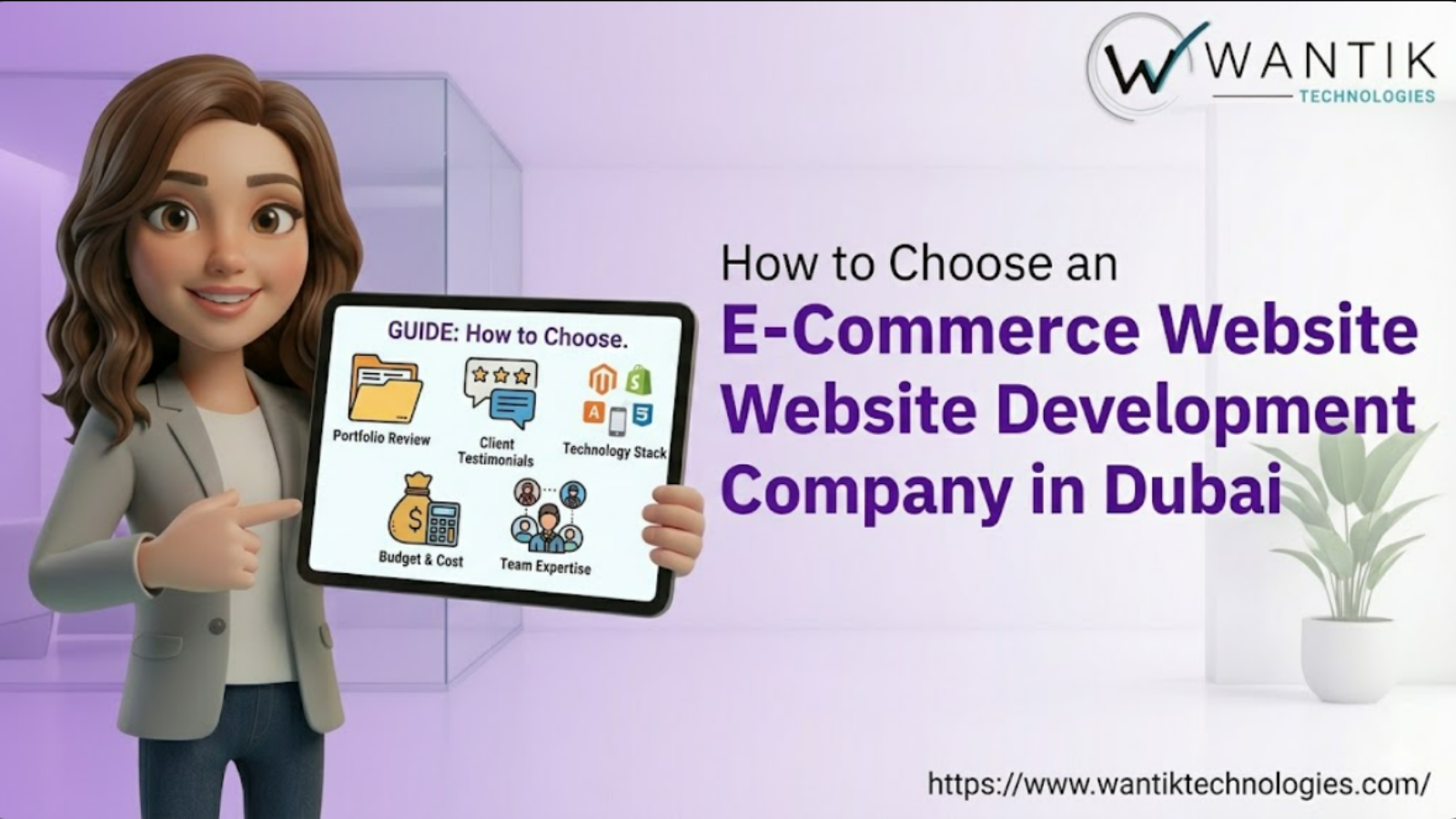
How to Choose an Ecommerce Website Development Company in Dubai

How to Choose an Ecommerce Website Development Company in Dubai

Selecting the best e-commerce website development service is important if you intend to start or grow an online store. Customers use your website to make decisions on whether to trust your brand, purchase your goods, or leave in a matter of seconds. It is more than simply a virtual storefront.

Furthermore, choosing the best development partner involves more than just choosing someone who can create a website in a cutthroat industry like Dubai, where online commerce is expanding quickly. It’s about finding a team that understands your business, your customers, and your long-term growth.

It might be challenging to know where to begin when there are so many companies providing e-commerce solutions and custom web development Dubai services. Many claim to be “the best,” while others emphasize low prices and promise quick delivery. So how do you pick the best one?

Why Choosing the Right Ecommerce Development Company Matters

Treating e-commerce development as a one-time activity is a common mistake made by business owners. Build the website, add merchandise, and start selling. However, actual e-commerce success goes well beyond that.

An effective e-commerce website affects:

  • Your customer experience, as customers anticipate quick, easy, and frustration-free shopping as soon as they visit your website.
  • Your conversion rates, as improved website design and streamlined checkout procedures, have a direct impact on sales.
  • Your scalability as your platform should expand with your business rather than restrict it.
  • Your brand image, as consumers frequently evaluate the quality of your website to assess your credibility.

Slow loading times, challenging navigation, or technical problems that reduce sales are just a few of the challenges that can arise from a badly designed e-commerce website.

Because of this, picking the right development company is crucial from the start.

Understand Your Ecommerce Needs First

Make sure you know exactly what you need before contacting any agency. Not every company requires the same type of e-commerce system.

Ask yourself:

What are you selling?

A supermarket delivery company’s needs are different from those of a fashion retailer. For instance, supermarket stores would require location-based delivery systems, while clothes stores might require size filters and product variations.

How many products will you have?

Managing thousands of SKUs differs greatly from managing a small inventory. The design of your e-commerce system is strongly impacted by the complexity of your inventory.

Do you need custom features?

This is where custom web development Dubai becomes important.

You might require:

  • Subscription systems, as it requires automated account administration and billing, necessary for recurring transactions.
  • Custom product builders, as some companies, offer items that clients can customize before placing an order.
  • Loyalty programs, as it is frequently more profitable to keep consumers than continuously acquiring new ones.
  • Multi-vendor systems, since markets require various dashboards and user responsibilities.

Choosing a provider that suits your business rather than pressuring it to follow their standard procedure is made easier when you are aware of your needs beforehand.

Check Their Ecommerce Experience

Not every web development agency specializes in ecommerce. Some build corporate websites. Some focus on apps. You want a company with actual ecommerce experience.

Look at their portfolio and ask:

Have they built ecommerce stores before?

Experience matters because ecommerce websites have unique challenges like payments, cart systems, inventory syncing, and customer account management.

Have they worked in your industry?

Industry knowledge saves time because they already understand what customers expect. For example, someone who has built food ordering websites will understand delivery flow better than someone who hasn’t.

Can they handle growth?

A good ecommerce website development service should think beyond launch and help you build for scale. Because what works for 50 orders a month may fail at 500 orders a day.

Look at Their Portfolio Carefully

A portfolio tells you a lot. But don’t just look at how the websites look. Go deeper.

Check:

User experience

Does the site feel easy to use?

Sales are impacted if clients have trouble navigating.

Mobile responsiveness

Most online shoppers in Dubai browse on their phones. If a website isn’t mobile-friendly, that’s a major red flag.

Speed

A beautiful website that loads slowly will lose customers quickly. Speed impacts both user experience and SEO.

Checkout flow

Complicated checkout processes lead to more abandoned carts, so the purchasing experience should seem easy and straightforward. A strong portfolio shows both design quality and business thinking.

Ask About Custom Development Capabilities

Templates are fine for some businesses. But if your business has unique requirements, templates can become limiting. That’s where custom web development Dubai services become valuable.

Custom development allows you to:

  • Build around your business model instead of changing your business to fit a template.
  • Add advanced features that improve customer experience.
  • Create unique workflows that competitors may not have.

Ask the agency:

  • Can you build custom functionality?
  • Can you integrate third-party tools?
  • Can you scale features later?
  • Their answers will tell you how flexible they are.

Understand the Technology They Use

Technology affects your website’s future. Ask what platforms they work with:

Shopify

Good for businesses that want faster setup and easier management.

WooCommerce

Good for WordPress users who want flexibility.

Magento

Good for larger businesses with more complex needs.

Custom Frameworks

Ideal for companies that require complete control and distinctive features. A good ecommerce website development service would suggest technologies based on your company’s needs, not their own. That difference matters.

Check Their SEO Knowledge

A great ecommerce website that nobody finds is a problem. SEO should be part of development, not something added later. Ask if they build websites with SEO in mind.

Important SEO elements include:

  • A clear URL structure is preferred by both consumers and search engines.
  • Quick page speed, as site performance influences user retention and rankings.
  • Mobile optimization, as Google gives preference to websites that are optimized for mobile devices.
  • Appropriate schema markup, which improves search engines’ comprehension of your merchandise.
  • Category pages that have been optimized since they frequently get a lot of traffic.

SEO-friendly development gives your website a stronger foundation from the start.

Understand Their Design Approach

Good ecommerce design is not just about making things “look nice.” It’s about guiding customers to buy.

Ask:

  1. Do you create custom UI/UX?
  2. How do you approach customer journeys?
  3. How do you improve conversions?

Strong ecommerce design should:

  • Make product discovery easier because customers should find what they want quickly.
  • Build trust through clean and professional layouts because trust affects buying behavior.
  • Reduce friction during checkout because fewer steps usually lead to higher conversions.

Design directly impacts sales. It’s not just decoration.

Ask About Payment Gateway Integration

Dubai businesses often need multiple payment options.

Your ecommerce website should support:

  • Card payments because many customers prefer fast online transactions.
  • Cash on delivery because it remains popular in many local markets.
  • Wallet integrations because digital payment habits continue growing.
  • Buy now, pay later systems because flexible payment options increase conversion rates.

Ask if they have experience integrating local and international payment gateways. This saves time and avoids future technical issues.

Check Their Support After Launch

Launching is only the beginning. Websites need continuous support. Things break, updates happen, traffic grows.

Ask:

  1. Do you offer maintenance?
  2. What happens if something goes wrong?
  3. How fast is support?

Good post-launch support is important because revenue is directly impacted by ecommerce outages. A business that vanishes after launch can become an expensive issue.

Read Reviews and Testimonials

Reviews often reveal what portfolios don’t.

Look for:

  • Communication quality because projects fail when communication is poor.
  • Delivery timelines because delays can affect business plans.
  • Problem-solving ability because challenges happen in every project.
  • Support quality because ongoing relationships matter.

Try to find detailed reviews, not just star ratings. The details tell the real story.

Compare Pricing the Right Way

Cheaper isn’t always better. And expensive doesn’t always mean better.

Scope

Some companies quote low but leave out important features.

Quality

Good development saves money long term by reducing future fixes.

Support

Support is part of the value.

Scalability A scalable website reduces rebuilding costs later. The cheapest quote often becomes the most expensive later.

Evaluate Communication Style

Your development company should:

  • Understand your goals because building without understanding leads to poor results.
  • Explain things clearly because technical jargon creates confusion.
  • Respond on time because delays in communication slow the project.

If communication feels difficult before the project starts, it usually gets worse later. Select a company that simplifies things.

Ask About Security Standards

Ecommerce websites handle customer data and payments. Security is critical.

Ask about:

  • SSL implementation because customer trust depends on secure browsing.
  • Data protection because customer information must be handled responsibly.
  • Secure payment integration because payment safety affects brand reputation.
  • Regular security updates because threats constantly evolve.

Security should never be treated as optional.

Red Flags to Watch Out For

Here are warning signs:

Unrealistically low pricing

Low prices often mean shortcuts.

No clear process

Professional companies should have a structured workflow.

No ecommerce case studies

Experience should be visible.

Overpromising

Be cautious of agencies promising instant rankings or unrealistic timelines.

Weak support system

Support matters long after launch. Trust your instincts. If something feels off, it usually is.

Questions to Ask Before Hiring

Here are practical questions:

  • What ecommerce platforms do you recommend for my business and why?
  • Can you show similar projects you’ve completed?
  • How do you handle SEO during development?
  • What support do you provide after launch?
  • Can you build custom features if needed?
  • How do you handle website security?
  • What happens if I want to scale later?

Their answers will tell you a lot.

Final Thoughts

Finding the biggest agency or the lowest price is not the only factor in selecting the best ecommerce development company in Dubai. Finding the ideal fit is key.

An effective ecommerce website development service will comprehend your company’s objectives, design with expansion in mind, and produce an online purchasing experience that genuinely turns visitors into buyers.

Additionally, investing in custom web development Dubai can provide you with the flexibility and competitive advantage you require if your company requires something more than conventional templates.

Take your time, ask questions, review their work, and think long term.

Because the right ecommerce partner won’t just build your website. They’ll help build your business.

Top 10 AI & Chatbot Development Trends in Dubai for 2026 A Guide for Scaling Businesses

Top 10 AI & Chatbot Development Trends in Dubai for 2026: A Guide for Scaling Businesses

Instead of “adopting” AI, Dubai is constructing its future around it. Artificial intelligence is already important to how organizations function and expand, from intelligent government services to highly customized consumer experiences. Because of this, more businesses are actively searching for the best chatbot development company to create solutions that not only automate processes but also drive growth.

Knowing where AI and chatbot technology are headed is a competitive advantage if you intend to grow in 2026. Understanding these patterns will enable you to make more informed investment choices, whether you’re working with a custom software development company in Dubai.

Why AI & Chatbots Are Becoming Non-Negotiable

A few years ago, chatbots were a “nice to have.” Now? They’re becoming essential.

Businesses are using them to:

  • Respond instantly to customers
  • Handle hundreds of conversations at once
  • Reduce workload on teams

And the largest change? AI is already helping businesses operate more effectively rather than just supporting them.

For this reason, rather than employing generic tools, more businesses are now collaborating with the best chatbot development company or a custom software development company in Dubai to create something customized.

1. Chatbots Are Turning Into Smart Assistants (Not Just Reply Machines)

Chatbots were simple in the past. They respond when you ask them a question. That’s all.
Right now? They are genuinely capable of doing things.

We are discussing systems that are capable of:

  • Process orders
  • Book appointments
  • Handle complaints from start to finish

Thus, the chatbot addresses the issue rather than only responding to a query.

2. Businesses Are Starting Conversations First

This is a significant one.

In 2026, chatbots will actively seek out customers rather than waiting for them to do so.

For example:

  • Reminding someone about an abandoned cart
  • Sending a follow-up after a service
  • Notifying about offers based on past behavior

It feels more like an intelligent assistant who understands your needs than “customer support.”

3. Personalization Is Becoming the Standard

Generic responses are irritating.

“Hello user, how can I help you?” doesn’t cut it anymore.

Modern AI systems are now:

  • Remembering user preferences
  • Suggesting relevant products or services
  • Adapting tone and responses

As a result, every encounter feels more intimate, directly affecting conversions.

4. WhatsApp Is Leading the Way

If your company isn’t using WhatsApp in Dubai, you’re already behind.

Because it’s quick, simple, and familiar, customers prefer it.

That’s why businesses are now building chatbots that:

  • Work directly on WhatsApp
  • Sync with Instagram and websites
  • Keep conversations consistent everywhere

Meeting customers where they are is the key.

5. AI That Understands Arabic (Properly)

Despite Dubai’s diversity, Arabic is still widely used for communication.

AI has had trouble with this in the past. It’s improving significantly now.

Chatbots in 2026 can:

  • Understand Arabic dialects
  • Switch between languages smoothly
  • Even handle voice interactions

For local users, this results in a much more natural experience.

6. Smarter Answers With Real Data (No Guessing)

One concern that people had about AI? incorrect responses.

Businesses are now addressing this by directly integrating chatbots with their data.

So instead of “guessing,” the chatbot:

  • Pulls real information from systems
  • Gives accurate, up-to-date responses
  • Reduces confusion for customers

This is especially important in fields where precision is crucial.

7. Chatbots Are Helping Teams Make Decisions

Interestingly, chatbots are no longer limited to consumers.

Additionally, they support internal teams.

Imagine asking:

  • “What were our sales last week?”
  • “Which product is performing best?”

And getting an instant answer.

AI is moving in the direction of making data simpler, not harder, to access.

8. AI Is Becoming Easier to Build

Building AI systems used to be costly and difficult.
It’s getting easier to access now.

With newer tools:

  • Development is faster
  • Costs are lower
  • Updates are easier

This is great news for startups and growing businesses in Dubai who want to scale without huge upfront investments.

9. Humans + AI = Better Together

A widespread concern is that people will be replaced by AI.

The finest solutions actually incorporate both.

Chatbots handle:

  • FAQs
  • Basic support
  • Repetitive tasks

Humans step in for:

  • Complex issues
  • Sensitive conversations
  • Decision-making

This balance actually improves both efficiency and customer satisfaction.

10. Businesses Are Taking AI Ethics Seriously

Businesses are growing increasingly cautious as AI gains strength.

A greater emphasis is placed on:

  • Data privacy
  • Transparent systems
  • Fair and unbiased responses

Particularly in Dubai, businesses are using technology to establish trust and comply with rules.

What This Means for Your Business

Let’s simplify all of this.

If you’re planning to scale, AI and chatbots can help you:

Save Time

Automate repetitive duties so that your staff can concentrate on more important tasks.

Reduce Costs

Manage more clients without adding additional staff.

Improve Customer Experience

Faster responses, better personalization.

Grow Without Limits

Serve 10,000 clients or just 10 without overloading your system.

For this reason, instead of using simple, off-the-shelf solutions, companies are now investing in a custom software development company in Dubai.

How to Choose the Right Chatbot Partner

If you’re thinking about getting started, choosing the right partner matters a lot.

Here’s what you should look for:

  • Someone who understands your business (not just tech)
  • Ability to customize the solution
  • Experience with integrations (CRM, website, apps)
  • Ongoing support after launch

The best chatbot development company doesn’t just build your bot, they help your business grow with it.

Where AI Chatbots Are Already Making an Impact

Across Dubai, businesses are already seeing results.

  • Retail → Better product recommendations & faster support
  • Restaurants & Cafes → Order automation & quick responses
  • Healthcare → Appointment booking & patient queries
  • Real Estate → Instant property inquiries

It’s not limited to one industry anymore; AI is everywhere.

Final Thoughts

In Dubai, AI is accelerating rather than slowing down.

Additionally, the difference between companies that use AI effectively and those that don’t will only widen.

The good news? You don’t have to do everything at once.

Begin modestly. Pay attention to how AI can genuinely impact your company. and proceed from there.

Because in 2026, scaling means working smarter rather than just harder.

Web Development Companies in Dubai

Scaling Your Vision: What to Look for in Web Development Companies in Dubai

The objective is rarely “having a website” when a company chooses to develop or update its website. The majority of businesses seek a platform that fosters expansion, draws clients, and changes as the company grows. Because of this, picking the best partner from numerous web development companies in Dubai is more important than most people realize.

The business environment in Dubai is dynamic. Customers expect seamless online experiences, existing businesses are digitizing their services, and new startups are emerging every day. A website that functions well now can require performance enhancements, additional features, or integrations in the future. A competent development partner is crucial in this situation.

The top development teams do more than just write code. They assist companies in considering user experience, scalability, and digital strategy. Working with the appropriate custom application development company might mean the difference between a temporary fix and a digital asset that expands with your company, whether you’re going to launch a new platform or modernize an old one.

The key factors to consider while selecting a web development partner in Dubai are broken down in this guide.

Why Businesses in Dubai Are Investing More in Web Development

One of the world’s most digitally linked markets is now Dubai. Consumers expect quick, mobile-friendly experiences, use websites to book services, and conduct online business research.

As a result, websites have developed into effective commercial tools from basic online brochures. These days, businesses use their platforms to:

  • Generate leads
  • Sell products
  • Manage bookings
  • Connect internal systems
  • Improve customer experience

These days, the core of many businesses’ activities is their website or web application. The growth of web development firms in Dubai nowadays can be linked to the increasing demand for digital services. But picking the appropriate partner requires considerable thought because there are so many alternatives

Think Beyond a Website, Think About Scalability

Focusing solely on the launch is one of the biggest mistakes made by businesses.

When a website launches, it may look fantastic, but what happens if your company expands?

You might need to:

  • Add new services
  • Handle more website visitors
  • Integrate new tools
  • Expand to new markets
  • Launch mobile applications

These modifications may become costly and complex if the initial system wasn’t built to scale.

From the beginning, a strong development partner makes strategies for expansion. They create platforms that can change as your company does.

What a Modern Development Partner Actually Does

A common misconception is that developers only create pages and link them to a server. Modern web development actually entails a lot more.

A reliable custom application development company helps businesses with:

  • Platform architecture planning
  • User experience design
  • Backend system development
  • API integrations
  • Performance optimization
  • Security implementation
  • Ongoing improvements

In other words, they assist in transforming business concepts into effective digital systems.

Key Things to Look for in a Web Development Company

Timeliness and cost are not the only considerations when selecting a development partner. It’s about finding a team that can create a platform that supports your objectives.

Here are the most important things to consider.

1. A Clear Understanding of Your Business Goals

The best development teams start by asking questions.

They want to understand:

  • What problem does your platform solve?
  • Who are your customers?
  • How will the website generate value?
  • What growth do you expect in the future?

It’s always a warning sign if a business starts pricing without first talking about your objectives.

Instead of thinking like a contractor, a competent developer thinks like a partner.

2. Strong Portfolio and Real Project Experience

Look over a development company’s prior work before hiring them.

Look for projects that show:

  • Different types of platforms
  • Complex functionality
  • Clean and modern design
  • Fast loading speeds

A diverse portfolio frequently demonstrates that the team has expertise in resolving actual business issues rather than merely building simple websites.

3. Custom Development Capabilities

Simple websites can benefit from templates, but most expanding companies eventually want greater flexibility.

Working with a custom application development company becomes beneficial in this situation.

Custom solutions allow businesses to:

  • Build unique user experiences
  • Automate internal workflows
  • Integrate multiple business systems
  • Launch specialized digital services

Instead of adapting your business to fit a platform, custom development allows the platform to fit your business.

4. Focus on User Experience

A website might look visually impressive but still frustrate users.

Excellent development teams prioritize usability. They consider how users engage with the platform and how simple it is for them to accomplish their objectives.

Strong user experience includes:

  • Clear navigation
  • Fast loading times
  • Mobile-friendly design
  • Simple forms and checkout processes

When websites are easy to use, customers are more likely to stay, engage, and convert.

5. Mobile-First Thinking

In Dubai, most users browse the internet through their phones. If a website doesn’t work well on mobile devices, it will quickly lose visitors.

Top web development companies in Dubai prioritize mobile performance from the start.

This includes:

  • Responsive layouts
  • Optimized images
  • Fast mobile loading speeds
  • Touch-friendly navigation

Mobile-first design ensures your platform performs well across all devices.

6. Integration Capabilities

Most businesses use multiple tools to run their operations.

These might include:

  • CRM systems
  • Payment gateways
  • Marketing platforms
  • Inventory management software
  • Customer support tools

These systems must frequently interface with your website.

To keep your digital ecosystem connected, a skilled development team makes sure these integrations function properly.

7. Security and Data Protection

One area where taking shortcuts can be quite expensive is security.

Security is built right into the platform by a professional development team.

Important security features include:

  • Secure authentication systems
  • Data encryption
  • Regular updates and monitoring
  • Protection against common cyber threats

This is particularly crucial for websites that handle sensitive corporate information, payments, or personal data.

8. Transparent Communication

Clear and regular communication is essential to the success of technology projects.

A good development partner will:

  • Explain technical decisions in simple terms
  • Provide regular project updates
  • Set realistic timelines
  • Involve you in key decisions

This collaborative approach guarantees that the finished product reflects your vision.

9. Long-Term Support

A website launch is not the end of the journey.

Over time, you will likely need:

  • Security updates
  • Performance improvements
  • New features
  • Bug fixes
  • System upgrades

Reliable web development companies in Dubai offer long-term support to keep platforms running smoothly as technology evolves.

Common Mistakes Businesses Make When Hiring Developers

Selecting a development partner can be difficult, particularly for companies creating their first digital platform.

Some common mistakes include:

Making a decision solely on price

Higher long-term expenditures are frequently the result of less expensive alternatives.

Rushing the decision

Considering your alternatives carefully will help you avoid serious problems down the road.

Ignoring scalability

Platforms designed solely for temporary use frequently need to be rebuilt at great expense.

Overlooking communication

Project delays can nevertheless result from a technically proficient team that communicates poorly.

Businesses can save a lot of time and money by avoiding these errors.

The Real Value of the Right Development Partner

The benefit of working with the right team goes well beyond the launch of a website.

Experienced web development companies in Dubai help businesses:

  • Improve customer experiences
  • Streamline internal operations
  • Launch new digital services
  • Expand into new markets

A strong custom application development company develops into a long-term technological partner that supports companies’ expansion and adaptation in a quickly evolving digital environment.

Final Thoughts

For any business, creating a digital platform is an important first step. A well-designed website or application can enhance client connections, boost productivity, and open up new business prospects.

However, the platform’s development staff plays a major role in its success.

The top partners among the numerous web development companies in Dubai concentrate on comprehending your objectives, developing scalable systems, and developing platforms that provide genuine value over time.

Spend some time assessing technical proficiency, communication style, experience, and long-term support skills. When you find the right custom application development company, you’re not just hiring developers, you’re building a partnership that helps bring your digital vision to life.

AI and ML Together Improve Cloud Computing Efficiency

How AI and ML Together Improve Cloud Computing Efficiency

AI and ML are at the forefront of making cloud computing more intelligent, faster and more reliable. These technologies allow for the optimization of resources, workload forecasting, security improvement, operational automation, and better overall cloud performance. This pairing is a perfect match for businesses, enterprises, and startups who are looking to reduce cloud spending and increase speed, the overall customer experience, and scalable digital operations without continuous manual monitoring.

Cloud computing is becoming the backbone of modern digital systems. Whether you look at a global enterprise, a SaaS company, a healthcare platform, a financial technology app, or an e-commerce brand, they all rely on cloud infrastructure to deliver services. However, as cloud use is on the rise, so are its challenges with unpredictable workloads, growing cloud bills, performance bottlenecks, security threats, and inefficient resource use. 

This is where AI and ML come in to convert traditional cloud systems into intelligent, self-optimizing systems in the cloud (such as the “cloud of the future”). AI starts to automate human decision-making, and ML starts to learn from large datasets and discover patterns in data humans cannot assess in real-time. Therefore, with AI and ML, organizations can now realize cloud automation, predictive analytics, cloud and resource management and enhanced security to maximize cloud efficiency.

How AI and ML Improve Cloud Computing Efficiency

AI and ML allow cloud computing to be more efficient by anticipating resource requirements, automating routine operations, increasing security, improving application performance, lowering cloud costs, providing people with smarter data analytics, enabling self-healing systems and making DevOps pipelines quicker and more reliable for deployments.

1. Predictive Resource Management

Predicting resource needs is one of the key reasons AI and ML are becoming critical capabilities in cloud computing. Most of the traditional cloud capabilities are based on humans estimating resource needs, which usually leads to either over-provisioning and/or under-provisioning. Over-provisioning is a waste of money. Under-provisioning leads to slowdowns or even outages as there is not enough storage, memory or compute power, or bandwidth, etc.

AI and ML take the guesswork out of the equation by evaluating historical usage data, fluctuations in real-time traffic, variability in application behavior, and periodicity of seasonal demand. The AI or machine learning system can process all of this data and accurately predict how much storage, memory, compute power or bandwidth is required at any given time. The cloud automatically scales up or down without any human input whenever the demands hit.

For instance, an e-commerce business that is going through a month-end sales event does not require human oversight anymore. AI models can forecast volumes of traffic, while ML can aid in identifying purchasing behaviors and acknowledge that the business has the necessary cloud resources in place to manage traffic peaks. Predictive resource management like this allows the business to pivot and continue service; even during induced peak events.

2. Intelligent Automation for Cloud Operations

Cloud environments require constant maintenance and monitoring; log analysis, application updates, patch management, backups, health checks, and instance tuning are all time-consuming tasks when performed manually, and error rates are high.

AI and ML usher in an entirely different style of intelligent cloudOps where most of these processes will execute automatically. Machine Learning behaviours exhibited by the cloud system will be analyzed by Machine Learning, it will recognize repetitive or routine type tasks. AI will determine the best course of action to take, either a security patch, database query optimization, or restarting the instance that is slowing down.

This usage of automation means that businesses can continue with some degree of operational consistency as the process backs off human capability for downtime, speed, and maintenance in an operational effort that runs non-stop; many IT departments will not have enough technical resources to properly manage an application with the amount of cloud resources required, intelligent automation also accommodates scaling of applications where a hundred servers will require review from a pristine service standpoint.

3. Reinforced Security on the Cloud and In-Cloud Threat Detection

Cloud security remains one of the most troubling issues any organization is bound to deal with. Some of the traditional systems that have been put in place to enhance security very much depend on rule-based methods, manually created firewalls, and human monitoring. Today, however, the cyber threat landscape has evolved to be more complex and continuous, thus making it obsolete to employ different security practices manually.

By integrating AI and ML into one security combination, the enterprises can strengthen cloud security, as these AI and ML algorithms can continuously analyze network activity, login behavior, and access patterns. The ML models learn from past incidents and can then identify unusual activities that may indicate a threat. For example, if a user logs in from a place that is not usual for them or tries to access files that have not been authorized for them, then this is flagged immediately by our system.

What AI does is continue the chain, making real-time decisions, such as blocking suspicious users, preventing malware from spreading, isolating the affected servers, or alerting the security team. This proactive method stands to reduce incidents of data breaches, ransomware attacks, and insider threats. Over the years, such intelligent systems only continue to become smarter, learning from any incident they encounter.

4. Improved Threat Detection and Protection in the Cloud

Cloud security is one of the most serious risks for any organization. In a traditional environment, security operations are based on rule-based systems with the use of manually created firewalls and human monitoring. However, today’s cyber threats are more sophisticated and continually evolving, making a manual review of security policies obsolete.

Through the continuous assessment of activity across the network, access patterns, and login behaviour, innovation in Artificial Intelligence (AI) and Machine Learning (ML) can significantly improve Cloud security. ML models can continuously learn from previous incidents and detect any abnormal activity that might indicate a security risk. For example, if a user logged in from an abnormal location or tried to access files they did not have permission to access, the system would then pick up this activity immediately.

AI improves on this functionality by being able to mitigate risk in near-real time by blocking the user who is suspected to pose a risk, stopping any malware from spreading, isolating the compromised server, and alerting the security team. This proactive approach is designed to decrease the likelihood of all sorts of security incidents, such as data breaches, ransomware incidents, and insider threats. As time goes by, intelligent systems will continue to learn, continually becoming smarter with each new incident.

5.​‍​‌‍​‍‌​‍​‌‍​‍‌ Cost Optimization and Reduction of Cloud Waste

The leading one of such advantages is cost optimization. It happens that a great number of businesses pay sprees for cloud services turn out to be overpayments. Among wastes commonly found within the cloud resources are idle instances, oversized VMs, duplicate storage, unnecessary bandwidth, and unused databases, which altogether can become a serious issue of a great waste of money.

AI evaluates the overall usage of cloud services in a certain company and helps to disclose a good amount of the business that is “hidden” behind the usage. ML then can unearth the regularity in under-utilization, power wastage, storage inefficiency, or unnecessary resources.

The cloud after that automatically resizes the servers that have been detected as oversized, rids the system of the resources that are not in use, and changes the location of the work to another cheaper machine or stage if possible to cost-effectively recommend the user strategies. Slowly but surely, this cuts down the cloud bills of startups that are only beginning to grow as well as of enterprises that are running large-scale workloads.

6. Smarter Data Management and Real-Time Analytics

Data has become a very valuable resource for any company. Still, without proper processing, even the most competitive data strategy is nothing but digital litter of files in the cloud. AI and ML are critical enablers to open doors to data stored in the cloud.

ML algorithms churn through, in fact, enormous datasets to do classification, sorting, and analysis, and that too at a pace that may not be possible just by human work. By utilizing this knowledge, AI can also be referred to as a decision-maker, e.g. customer behavior prediction, operational weak points understanding, or market trends discovery.

Such intelligent data handling is evident across sectors: in the medical field, AI supports doctors in analyzing patient records, while in the finance sector, ML predicts market risk. Cloud service providers take this a step further by embedding the same technology into their analytics engines, making queries much faster, enabling smarter recommendations, and delivering better results that drive business success.

7. Self-Healing Cloud Infrastructure

One of the more ambitious, yet plausible, aspects of AI and ML enabled cloud computing is the idea of eventually self-repairing systems. This, in fact, means that the cloud goes through its own troubleshooting and mending cycles, no assistance from humans required.

ML powered agents are on a constant vigil of the health of various cloud parts. They can even spot the less-than-stellar performance and the very first symptoms of failure that come up such as memory leaks, slow response times, or overheating hardware and hence, the system predicts potential breakdowns. In such situations, AI decides what the next step would be, e.g. restarts the services, gives the stores of resources a new lease of life or removes the problematic part.

This feature not only minimizes the time that the service is offline, but it also guarantees the highest possible availability thereby, e.g., backup systems for critical industries like banking, telecom, and public services have an added layer of security due to it. Besides, the reduced workload to DevOps teams, thus no burnout occurrences, better overall efficiency is the positive side as well.

8. Optimized DevOps and CI/CD Pipelines Centered

The present software development is heavily reliant on continuous integration and continuous delivery (CI/CD). Owing to the fact that teams are on a spree of releasing updates, the cloud has to be in a position to support fast automation, testing, and deployment.

Through the use of AI and ML, the DevOps team’s tasks are made easier as the system can detect the errors involved in the code pipelines, forecast deployment issues, advice on supporting container orchestration for quicker releases, as well as good release cycles. Defect identification is done in an automated fashion by AI-driven testing instruments, while the ML models get better at looking into historical deployments as they can figure out in which updates the performance can be compromised.

This, in turn, leads to the doubling of the developers’ work speed and the stability of the releases is also ensured. Besides that, monitoring gets better, and the team members get to collaborate more ​‍​‌‍​‍‌​‍​‌‍​‍‌efficiently.

Major​‍​‌‍​‍‌​‍​‌‍​‍‌ Use Cases of AI and ML in Cloud Computing

AI and ML-powered cloud solutions are the drivers of innovative health, finance, retail, manufacturing, and IT industries. Here are some examples of how different sectors implement these technologies:

  • Among them, Healthcare is a leader in using ML-based diagnostics and AI-driven patient data systems.
  • The financial sector is composed of intelligent fraud detection and real-time analytics.
  • Retail is on the forefront of predictive inventory and personalized product recommendations technologies.
  • Manufacturing has embraced predictive maintenance IoT data processing to stay competitive.
  • IT and SaaS companies get the most out of their businesses through scalable hosting, automated support systems, and efficient resource allocation.

Pros of Using AI and ML in Cloud Computing

  • By defining bottlenecks in real time, they contribute to performance improvement of the cloud.
  • One of the main worries about the cloud is security. Intelligence threat detection, however, by AI/ML in the cloud can significantly alleviate such worries.
  • Without AI and ML that remove unnecessary expenditure and ensure that resources are used in the best way, the cloud costs will not be reduced.
  • AI and ML are doing most of the work automatically, and they find it very easy to automate routine tasks, thereby hardly requiring human intervention.
  • They allow organizations to be more responsive to change by providing them with predictive insights based on real-time data.
  • By reducing periods of service unavailability, self-healing features contribute to improved cloud uptime.

Conclusion

When combined, AI and ML are changing the way cloud computing works by converting it from a mere reactive system into a smart, self-sufficient, and highly effective system. The incorporation of predictive analytics, automation, security, and optimization of performance is the recipe for success that led to such an improvement in the cloud computing efficiency.

Employing AI and ML in a cloud strategy has become a necessity for businesses aiming at scaling, reducing costs, or streamlining operations. It is the next big step toward faster, smarter, and future-ready digital ​‍​‌‍​‍‌​‍​‌‍​‍‌ecosystems.


Interesting Reads

AI-Powered Smart City Innovations Transforming Dubai

AI Business Solutions Blueprint for Smarter Innovation in 2025

Python vs JavaScript: Comparison, Use Cases, Pros and Cons

AI-Powered Smart City

AI-Powered Smart City Innovations Transforming Dubai

Dubai has always had a reputation for pushing boundaries, but the advanced city today is beginning an entirely new era – an era driven by artificial intelligence and intelligent automation. Dubai is progressing toward an AI-Powered Smart City, and life in the city is clearly smoother, safer and far more efficient than most metropolitan settings. What distinguishes Dubai is not only the scale of adoption, but the way it is all integrated into daily engagement. Artificial intelligence has a powerful, yet invisible presence in daily life, which functions endlessly in the background improving everything from mobility and safety, to tourism and governance.

An AI-Powered Smart City deploys artificial intelligence, sensors, data analytics, and automated systems to provide urban services more efficiently than has previously been possible. This includes human-managed service systems for traffic control, building management, public safety surveillance, citizen services, and healthcare processes.

The intent is simple. Create a city that responds to people, rather than requiring the people to respond to the city.

In cities that embrace this model, we will see faster service delivery, smarter mobility, enhanced safety, and sustainable use of resources. And there are few countries in the world today that are taking on this model quite as boldly as the Emirate of Dubai.

Top AI-Powered Smart City Innovations Transforming Dubai in 2025

Below are the most impactful advancements reshaping Dubai’s urban future, each supported by real-world use cases and results.

1. AI-Driven Traffic Systems and Intelligent Mobility

Traffic is frequently the major stress point in many cities. However, Dubai does this differently. Roads in Dubai feel almost alive; it is as if they are always watching, learning, and adjusting so that traffic can flow more easily.

AI-driven cameras and road sensors monitor real-time vehicle movement. These systems understand when traffic is likely to begin to build and adjust traffic lights accordingly to prevent this. When an accident happens, city officials get an alert within seconds so they can reduce traffic flow and get assistance on the way.

In addition, autonomous taxis and shuttle transports are operating all over major districts, all directed by navigation systems and AI communications. They can react to the road’s dynamics, avoid sudden obstacles and communicate directly with the smart traffic communication systems.

This creates an experience that is smoother, more predictable and overall far less stressful. When a city is capable of managing traffic so intelligently, you really can feel the presence of a digital brain.

2. AI-Enhanced Public Safety and Predictive Security

Dubai’s safety strategy is among the top smart city achievements. Rather than using manual surveillance alone, Dubai uses AI quickly to monitor public spaces for unusual behaviours.

Using high-resolution smart cameras, the city analyses crowd behaviour, identifies abandoned items, and evaluates potential threats in real time. There are also AI-based drones in helicopters that review events and the coastline, providing an aerial view that gives visibility and helps the response not just with time, but quickly in general.

Predictive security systems utilize the historical data to help determine where incidents are more likely in the city, and can then use police presence to strengthen areas that are more risky — proactively, not reactively, if there is an event.

The presence of safety feels so natural because the experience of safety feels normal. People walk through spaces confidently, as it is the environment that is smartly designed to protect them.

3. Smart Buildings and AI-Optimized Energy Management

Dubai’s well-known skyline is becoming “smarter” with facilities operating nearly as intelligent organisms. The buildings implement an AI framework to sense occupancy, manage energy and chillers applications, and predict maintenance.

When entering a new building, the temperature begins adjusting automatically. The lighting reacts to the level of natural sunlight. The lifts begin to cluster themselves according to usage patterns to minimize wait time.

AI surveys energy usage on each floor and makes adjustments to energy systems in real time to minimize waste. Predictive maintenance systems can cure defects in real time before they become problems, which minimizes downtime and reduces operational costs.

In a city where energy usage is high, the innovations in intelligent buildings provide sustainability without sacrificing comfort. 

4. AI-Powered Digital Governance and Automated Public Services

The government services offered in Dubai are positioned to be some of the most sophisticated in the world based on automation, AI and zero-paper transactions. The government anticipates a model where the majority of the processes take place in the background, often with no human interaction.

Through apps like Dubai Now, citizens can complete hundreds of activities like renewing a driving licence, paying utility bills, checking for visa status, etc. in a matter of minutes. The app utilizes AI to interface the user based on previous activity of recommended next steps.

AI chat assistants respond immediately to requests and all but eliminate the necessary overhead of sitting for extended periods in a physical service centre. Verification of documents, scanning, and verification of forms, a process requiring human approvals, are handled automatically through the monitoring of multiple machine learning systems to streamline the process.

The complete governance model was implemented for your efficiency and convenience, and you often feel as if the entire city was designed for on-the-go convenience, not designed to make your life difficult. 

5. Personalized Tourism Through AI and Smart Technology

Tourism is among Dubai’s strongest industries in Dubai, and AI takes it a step further. When tourists arrive, smart tourism applications and websites collect the interests of vacationers and suggest attractions and activities based on their interest (e.g. luxury shopping, culture, adventure, or food).

Hotels are also using AI to help guests check in by providing facial recognition to enter a room. Guests have access to virtual assistants that help them with the information about attractions, transportation and events.

AI translation tools integrated around touristic zones allows international travellers to communicate effectively with ease, and helps them feel safe and informed about their surroundings.

Ultimately, Dubai is a personal travel guide for international and local travellers, and allows a personal experience for each visitor.

6. AI-Powered Healthcare and Predictive Medicine

Healthcare is growing in Dubai through these AI-based tools that provide speed, accuracy, and reliability. Hospitals using AI-based technologies can diagnose disease earlier than before by viewing a medical image in seconds.

Wearable health devices are counselling patients and monitoring vital signs. They send a message to the user’s doctor when a patient’s abnormal vital sign occurs.

Robotic-assisted surgeries are increasing precision and decreasing the time the patients must stay in the hospital or operating room.

Additionally, predictive analytics can now alert healthcare providers to the potential of an outbreak, and a snapshot of patient needs along with developing individualized plans of care.

This moves healthcare from reactive-to-preventative; one of the strongest advancements to date in patient health. 

7. Intelligent Waste Management and Smart Sustainability Systems

AI is also improving waste management systems in Dubai. Smart bins installed throughout the city alert officials when they are full, thereby avoiding unnecessary trips to pick up garbage and cleaning up the city.

AI has been implemented to analyse waste trends to optimize recycling; they can help the city to better manage resources more sustainably. In addition, robots are sorting items that can be recycled more accurately, thus reducing the amount of manual labour and speeding up the processing time.

Sensors also monitor water flow and can detect leaks early, reducing the volume of wasted water in millions of litres each year.

Sustainability is becoming a priority for many organizations and individuals, and many of the AI systems work behind the scenes. 

8. AI-Augmented Retail and Smart Shopping Experiences

Shopping experiences in Dubai are more effortless than before with AI analytics and automated businesses and services providing a seamless shopping experience, especially Malls with enhanced and intuitive navigation features to guide and assist shoppers in getting to the store or product desired.

Other shopping, retail, and big box stores have stories of a full cashierless checkout experience where customers simply pick up what they need and leave while the money for the product is transacted entirely with AI capabilities.

Retailers leverage customer behaviour data to better understand their customers to make personalized product recommendations and targeted promotions based on that customer data.

The end result is that shopping is quicker, smarter, and enhanced overall.

The Pros of Dubai’s AI Smart City Innovation

1. Unparalleled Efficient

AI handles mundane and repetitive activities while enhancing efficiency, government processes, traffic flow and overall management of a city. 

2. Enhanced Safety and Predictive Protection

Smart cities are designed for enhanced public safety through intelligent surveillance and early recognition of threats.

3. Improved Quality of Life

Efficiency for citizens through quick services (governed by AI) for location, mobility, consulting and communication, etc., personalized experiences, and cleaner landscapes.

4. Strong focus on Sustainability

AI contributes to decreasing energy waste, improving recycling, and managing sustainable outputs accurately.

5. International Investment

Investing into the smart city ecosystem presents an unprecedented opportunity for global technology companies, startups, and innovators. 

Conclusion

The transformation of Dubai into an AI-Powered Smart City is not just an upgrade in technology, it is a transformation in how the city thinks, acts, and serves its people. Each system is interconnected, each service is optimized, and each process has been made more intuitive.

Dubai demonstrates how, when AI is employed thoughtfully, the city can be not only more efficient, but also more sustainable and human-centric.


Interesting Reads

AI Business Solutions Blueprint for Smarter Innovation 

Top Lead Generation Tool for Dubai Businesses in 2025

Python vs JavaScript: Comparison, Use Cases, Pros and Cons

Top Lead Generation Tool

Top Lead Generation Tool for Dubai Businesses in 2025

The digital landscape in Dubai is advancing quickly. From small businesses in Downtown Dubai to large companies in Business Bay, everyone is trying to find smarter, faster, and more efficient ways to reach customers. One underlying factor in all of this growth is lead generation.

If you’re advertising, emailing, or optimizing your website and still have a problem converting visitors into customers, you need to look into what a Lead Generation Tool can do for you. They help you automate or systematize how businesses find, attract, and nurture leads, and they’re essential in today’s marketplace.

What is a Lead Generation Tool?

A Lead Generation Tool is a software product that is developed to locate, capture, and help convert leads into potential clients for your business. Whether you are managing a real estate agency, a digital marketing agency, or an e-commerce site in Dubai, these tools help you find your high-quality leads through automating outreach, tracking engagement, and qualifying leads.  

Most lead generation tools can integrate with and/or enhance your existing website, CRM, or social media platforms, and let your team concentrate on what matters the most — turning interest into sales.  

In other words, you will spend significantly less time looking for contacts or sending mass messages, and in many cases, the lead generating tool will do most of the work for you.

Why Dubai Businesses Should Have a Lead Generation Tool

Dubai has a business environment based on innovation and technological usage. With the increasing number of companies in the market, the challenge is not being seen more, it is the ability to keep building consistent connections to the right people.

Here is the reason a Lead Generation Tool for Dubai Businesses is a necessity, not an option:

1. Highly Competitive in All Industries

Industries such as real estate, e-commerce, hospitality, and professional services are rapidly digitizing. Lead generation tools allow businesses to identify the right clients sooner and in a more cost-effective way.

2. Cultural Diversity in the Market

The Dubai market is multicultural with different preferences and purchasing behaviour. These tools offer the ability to segment audiences for personalized campaigns and reach potential clients where they prefer.

3. Change to Digital Transformation

With AI and automation leading the way, lead generation tools provide analytics, automation, and targeting capabilities that you cannot accomplish with manual marketing.

4. Real-Time Data Insights

A good tool can track user behaviour and daily engagement patterns, allowing you to optimize campaign results immediately.

The Best Lead Generation Tool for Dubai Organizations: HubSpot

Among the hundreds of Lead Generation tools available in the market today, HubSpot remains the best Lead Generation tool for Dubai organizations — and for good reason.

HubSpot is not simply a CRM. It is a full inbound marketing and sales platform that enables organizations to manage contacts, track leads, automate their marketing activities, and assess performance in one place.

What’s so powerful? Let’s break it down.

What HubSpot does (and who is it best for?)

HubSpot’s Lead Generation system provides Dubai organizations the ability to get in front of the right audience through many channels, including forms, landing pages, live chat, email marketing, and automation workflows.

Best For:

  • Small to mid-sized organizations looking to automate their marketing and sales process.
  • Agencies and service providers who are targeting long-term relationship nurturing.
  • Enterprises that need an integrated CRM with advanced analytics and reporting capabilities.

Use Cases:

  • Real Estate Agencies can capture property leads via landing pages and automatically trigger personalized emails to follow up.
  • E-commerce Stores can track behaviour, recover cart abandonment, and reach out with product recommendations.
  • B2B Organizations can automate outreach and track the lead through the first touch and the conversion.

Key Features That Make HubSpot the Best Lead Generation Tool

1. All-in-One Marketing and Sales Platform

HubSpot combines lead capture forms, email automation, CRM, tracking of social media, and analytics into one easy-to-use system.

2. Smart Leads Tracking

It allows you to learn who is visiting your website, what pages they have looked at, and how they are interacting with your content — making it easy to know which leads need our attention.

3. Automated Workflows

Whether it is a welcome email or a drip campaign, HubSpot’s automation makes your life easier while still allowing the user to have a personalized experience.

4. Landing Page Builder

Quickly create responsive and high-converting landing pages in minutes without requiring a coding background.

5. CRM Integration

The CRM automatically records lead data and interactions to ensure you do not lose any prospects’ valuable information.

6. Live Chat & Chatbots

Instantly connect with visitors using automated chat, or a live customer service agent — great for Dubai businesses that receive inquiries 24/7.

7. Advanced Analytics & Reporting

HubSpot has great reporting on performance at every stage of your funnel, helping ensure you can make the right decision.

Benefits of HubSpot as a Lead Generation Tool

  1. Easily Integrates – Works seamlessly with Google Ads, Facebook, LinkedIn, Shopify, and WordPress.
  2. User Friendly Experience – Very easy to navigate, even for someone who has never used CRMs, marketing apps, or analytics tools before.
  3. Scale Automation – HubSpot eliminates repetitive every-day tasks, all while maintaining or possibly even optimizing the conversion rate.
  4. AI Analysis – Smart led scoring, and predictive analytics, identify leads who are most likely to convert.
  5. Global Application – A great fit for Dubai’s enterprise market.

How HubSpot Supports Dubai Business Needs

Dubai’s dynamic enterprise landscape demands solutions that are fast, scalable, and adaptable to its client needs. HubSpot addresses each of these precise requirements through both localized marketing automation and analytics based strategies.

1. Multi-Language and Multi-Currency Support:

The Dubai market comprises Arabic and also English speakers. HubSpot takes this into account and is a multi-language implementation, and supports many regions’ currencies to specifically engage a dominant consumer base.

2. Integration with Local CRMs and Tools:

HubSpot seamlessly integrates with other commonly used tools in the region such as Zoho, Salesforce, or WhatsApp Business API, allowing businesses to centralize and streamline communication.

3. AI Personalization:

Ultimately, HubSpot uses AI behavioural and demographic suggestions to personalize emails, ads, and landing pages items which is a great way to target and engage Dubai’s diverse consumers.

4. Support for Remote Work and Hybrid Work:

As more businesses pivot to hybrid work cultures, HubSpot’s cloud-based dashboard enables companies to manage their leads from anywhere in their UAE offices.

How to get started with HubSpot in Dubai

A lead generation tool like HubSpot can be implemented by companies in Dubai without needing a technology degree. Just follow these simple steps and you’ll be on your way:

Sign up for HubSpot’s Free CRM Plan

Download the free version so you can get a feel for contact management, live chat, and email tracking.

Integrate the Platforms You Currently Use

Link your website, email, and social media accounts to connect all your channels into one space where you can sync everything.

Create Lead Forms and Landing Pages

Create attractive landing pages with highly optimized call-to-actions aimed at your audience in Dubai.

Set Up Automate Workflows

Automate your follow-ups and nurture campaigns for quicker conversion timelines.

Track and Analyse Performance

Use HubSpot’s analytics dashboard, to check which leads are coming from which campaigns.

Other Popular Tools for Lead Generation

While HubSpot is the best option, and often the best platform for many, here are two other platforms who excel at metrics specifically for businesses in Dubai:

  • Zoho CRM – A great option for smaller businesses, affordability, and customization.
  • LinkedIn Sales Navigator – A great option for B2B lead generation and prospecting outreach.
  • Pipedrive – A visual CRM that works well for tracking the stage of a deal
  • Salesforce – A true heavyweight enterprise solution that offers comprehensive analytics for large-scale operations.

Each tool has its advantages, but HubSpot is simply better in terms of its ability to combine usability, automation, and performance tracking than most of its competitors.

Conclusion

Lead generation is not only about collecting leads, it is also about relationship building, majoring your data, and automating meaningful engagement for your business. For companies in Dubai operating in a fast-paced digital landscape, investing in the right Lead Generation Tool can be the difference between growth and stagnation.

While there are many tools out there, HubSpot for sure is the leading lead generation tool for businesses in Dubai, that offers anything from advanced CRM integration to the power of insights driven by AI, to automation, and analytics.


Interesting Reads

AI Security Posture Strategies for Safer AI Deployment

Python vs JavaScript: Comparison, Use Cases, Pros and Cons

Computer Vision vs Machine Learning: Key Differences and Use Cases