If you’re a business owner in Dubai, you’ve undoubtedly had the experience of searching for your own service on Google and wondering why your rivals consistently appear before you.
Perhaps you run a restaurant in Business Bay, a real estate firm in Marina, or a service provider looking to draw in more local clients. Businesses that are visible on Google Maps are the first to be seen, regardless of the industry.
People don’t prefer going through search pages looking for a service. They usually get in touch with one of the companies they see on the map, compare ratings, and see the reviews. Local SEO has become crucial because of this.
Many entrepreneurs believe that ranking on Google Maps needs a hidden technique that is only known by SEO specialists. The actual situation is far less thrilling. While everyone else ignores them, the majority of companies that rank highly are just doing the basics regularly.
Knowing local SEO is a terrific place to start if you’ve been looking for SEO services nearby or the top digital marketing firm in Dubai to increase your online presence.
Let’s go over a useful checklist that can increase the number of local clients that find your company.
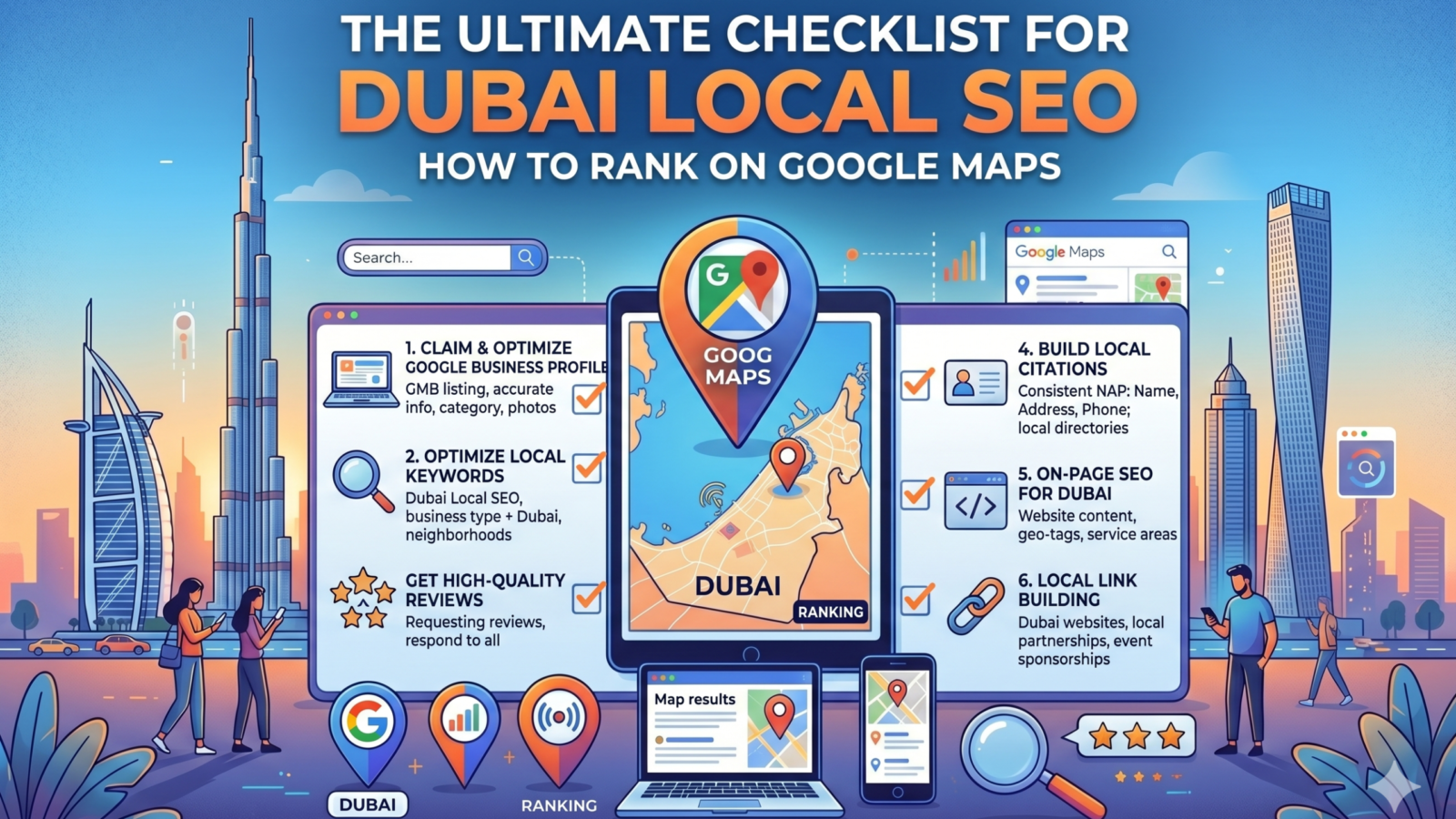
Claim Your Google Business Profile (And Actually Complete It)
You would think this would be clear, but you would be shocked to learn how many companies have either not claimed their Google Business Profile or have only provided half of the necessary information.
Google is making an effort to suggest trustworthy companies to its users. Google finds it more difficult to believe information that is absent from your profile. Spend some time examining your profile from the viewpoint of a potential customer.
-
- Can they locate your phone number fast?
-
- Are they aware of the services you provide?
-
- Are your opening hours correct?
-
- Based on what they see, would they feel comfortable getting in touch with you?
There is space for improvement if the response to any of the questions is “not really.” A comprehensive profile builds a solid basis for everything else you’ll do in local SEO, but it won’t instantly push you to the top.
Reviews Matter More Than Most Businesses Think
When was the last time you made a reservation without first reading the reviews? Many individuals don’t. Reviews have evolved into contemporary word-of-mouth advertising. The change is that consumers are asking Google for recommendations rather than a friend.
One thing is typically shared by companies that routinely score highly on Google Maps: they are being discussed. You don’t have to get hundreds of reviews tomorrow. Start by getting feedback from satisfied clients after you’ve finished a task, fulfilled an order, or given them a service they truly appreciate. Because happy consumers are typically prepared to assist, a straightforward request frequently works better than people believe, you simply need to ask.
Additionally, reply to reviews that are left. Not because Google instructs you to, but because potential clients are reading those answers.
Upload Photos People Actually Want to See
Using actual images is one of the easiest methods to increase your company’s credibility, not stock photos, not internet-sourced, generic workplace images. Display your team, your work area, your goods, and the tasks you’ve finished.
Before a conversation ever begins, genuine photographs help establish a sense of comfort with the company that people choose to do business with.
Consider it from the consumer’s perspective. Which company do you trust more?
-
- Three blurry pictures that were uploaded four years ago?
-
- Or one with current photos of actual people and actual work?
The solution is rather clear.
Don’t Ignore Your Website
Businesses frequently make the error of concentrating solely on Google Maps while ignoring their website.
In practice, your Google Business Profile and your website work together. Google frequently looks for other indications on your website when determining whether to suggest your company.
Make sure the following are clearly displayed on your website:
-
- Details about the services you offer so that guests know what you do right away.
-
- Your company’s location and service areas so that clients are aware of whether you provide services in their area.
-
- Contact details that are readily available without requiring users to look for them.
-
- An About Us page that fosters confidence and trust among prospective clients.
Everything you do with local SEO is strengthened by a strong website.
Create Content That Speaks to Local Customers
Producing material that is truly relevant to Dubai residents is one of the simplest ways to stand out. Numerous companies produce generic blog entries that are applicable to any city worldwide. The issue is that generic content rarely makes an impression. Rather, concentrate on issues that your local audience is actually interested in.
For instance:
-
- Instead of writing about general industry themes with no local relevance, write about trends impacting firms in Dubai.
-
- Talk about your own experiences dealing with clients in the UAE market.
-
- Write guidelines that answer frequently asked questions on the internet by Dubai residents.
-
- Discuss regional advancements, occasions, or difficulties that are significant to your sector.
Content is most effective when it is relatable, detailed, and helpful.
Make Sure Your Website Works Well on Mobile
Mobile phones are used for the majority of local searches. While shopping, traveling, commuting, or attending client meetings, people are looking. They demand prompt responses.
Visitors will abandon your website before they even see what you have to offer if it loads slowly or is challenging to use on a mobile device. A positive mobile experience means:
-
- Pages load fast to prevent visitors from having to wait and pressing the back button.
-
- It is simple to read text without having to zoom in and out.
-
- Contact buttons are easily tapped with a finger and are clearly visible.
-
- Users may locate what they need in a matter of seconds due to the navigation’s simplicity.
These days, having a mobile-friendly website is not a luxury. It’s to be planned for.
Build Local Trust Beyond Google
Google looks at what other websites have to say about your company. For this reason, backlinks and local mentions are still important. Hundreds of links from unrelated websites are not necessary. Quantity is not nearly as significant as quality.
Among the favorable opportunities are:
-
- Listing your company in respectable local directories that are actually used by customers.
-
- Becoming a member of business associations and associations with an online presence.
-
- Working together with neighborhood companies and community projects that organically generate attention.
-
- When possibilities present themselves, offering knowledge to local company websites or industry publications.
Consider each reputable reference to your company as an additional reference.
Keep Your Profile Active
Google prefers active businesses, which is something that many entrepreneurs overlook.
Who do you think Google is more likely to trust if you haven’t updated your profile in a year and your competitors are uploading photographs and updates on a regular basis?
Attempt to:
-
- To keep your profile seeming up to date and lively, add new pictures regularly.
-
- Every time you introduce a new service or have anything worthwhile to contribute, post an update.
-
- Keep an eye on customer feedback and inquiries rather than ignoring them.
-
- Check your profile regularly to ensure that all the information is still correct.
It is not necessary to update it daily, but displaying indications of activity is undoubtedly beneficial.
How Long Does Local SEO Take?
Every business owner typically asks this question. To be honest, local SEO takes time.
Certain changes can yield results really fast, particularly if your profile was previously inadequate or poorly optimized. However, it frequently takes several months to establish authority, get reviews, and raise rankings in competitive businesses.
Companies that succeed with local SEO are the ones that stay consistent.
FAQ
What is GEO and how is it different from SEO?
Most people know SEO — it’s what gets your website showing up in Google when someone types in a search. GEO is the next layer of that. It stands for Generative Engine Optimization, and it’s about making sure AI tools like ChatGPT, Google’s AI Overviews, and Perplexity actually mention your store when someone asks them for a recommendation.
The easiest way to think about it: SEO gets your product on the shelf. GEO gets the shop assistant to personally recommend it to the customer walking in. Two very different things, and right now most ecommerce stores are only doing one of them.
Which AI search engines should my ecommerce store actually care about?
The ones that matter most right now are Google AI Overviews, ChatGPT, Perplexity, and Microsoft Copilot. Voice assistants like Siri and Google Assistant also pull from web content for shopping-related queries, so they’re worth keeping in mind too.
Each platform works a bit differently under the hood, but what they all have in common is this — they trust content that’s clear, well-structured, genuinely helpful, and comes from a source that looks credible. Get those things right and you’re covering most of them at once.
Will GEO replace SEO? Do I need to choose between them?
Honestly? No, and no. Anyone telling you SEO is dead hasn’t looked at the traffic data. Traditional search still sends the most visitors to ecommerce stores by a wide margin. GEO is an add-on, not a swap.
The businesses doing well right now are the ones running both in parallel — keeping their technical SEO solid while also writing content in a way that AI systems can actually understand and reference. It’s not as complicated as it sounds. A lot of good SEO practice already overlaps with what GEO needs.
How do I know if my store is ready for AI search right now?
Here’s a simple test you can do today. Open ChatGPT or Perplexity and ask a question the way your ideal customer would — something like “what’s the best [your product] for [their situation]?” See if your store comes up anywhere in the answer.
If it doesn’t, that’s your starting point. It usually means your content isn’t detailed enough, your product pages are too thin, or your site doesn’t have enough authority signals for AI to feel confident recommending you. Adding proper FAQs, writing real buying guides, and getting your structured data in order are usually the first places to start.
Can Wantik Technologies help with this for my store in Dubai?
Yes, this is something we work on with ecommerce clients regularly. We help businesses across Dubai and the UAE set up their websites so they perform well in both traditional Google search and AI-powered search tools — covering everything from the technical side to content structure and schema markup.
If you want to know where your store currently stands and what the biggest gaps are, just get in touch. We’ll walk you through it without any jargon, and the first consultation is free.
Final Thoughts
Ranking on Google Maps isn’t about finding a secret hack. It’s about building trust. Trust with Google, your customers, and through consistency.
Businesses that frequently show up in local search results are typically performing the easy things well. They post helpful content, get real reviews, update their information, and maintain an active online presence.
Over time, those small actions can make a big difference in a city as competitive as Dubai.
Increasing your Google Maps presence is one of the best investments you can make if you’re serious about drawing in more local clients. Additionally, even though local SEO requires patience, the long-term benefits are frequently well worth the work.
At Wantik Technologies, we help businesses strengthen their online presence through practical SEO strategies that focus on real growth, not shortcuts. Because at the end of the day, ranking higher only matters if it helps you connect with more customers and grow your business