
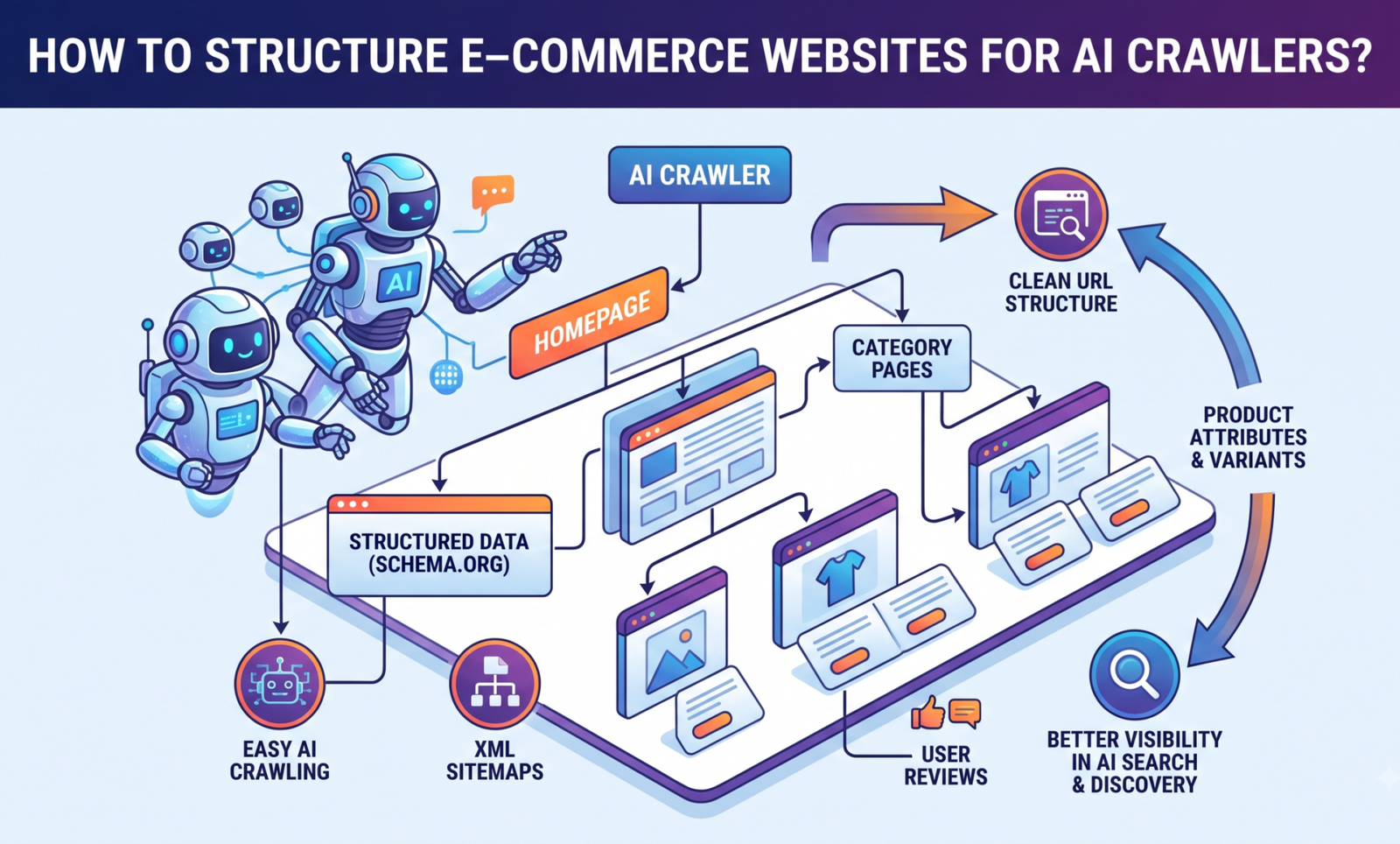
Try this: ask Perplexity or ChatGPT to suggest a decent pair of running shoes for less than $100, and observe how many of the retailers you actually visit appear. There are not many. When an AI tool answers a search instead of a search results page, your product pages may appear prominently in Google rankings but remain completely unseen. Many store owners have yet to come to terms with this difficult reality. The simple explanation of why: Instead of the JavaScript-heavy, image-first layouts that are the foundation of most online retailers, AI crawlers require clear, plain-text, server-rendered content and structured data that they can actually read. If you want your catalog to show up when AI tools answer shopping questions, this is what needs to change, and it starts at the code level, not the copywriting level.
Why AI Crawlers Don’t See Your Site the Way Google Does
For many years, “SEO” essentially meant making Googlebot happy. Additionally, Googlebot has become rather adept at handling messy websites; it renders JavaScript, is patient, and has decades of infrastructure built to understand a page’s meaning even when the code is a little messy.
AI crawlers may have different crawling and rendering constraints than traditional search crawlers. To feed a language model that requires hard information quickly, such as pricing, stock status, specs, return policy, and customer reviews, bots such as GPTBot, ClaudeBot, and PerplexityBot are gathering content. The bot doesn’t wait around if that information appears only after three API calls have finished loading inside a React component. It either ignores the page or uses whatever fragments it was able to obtain, neither of which is beneficial to you.
Another issue that most people overlook is timing. Compared to Google, AI crawlers often have shorter timeouts. Google may finally index a page that takes a few more seconds to fully render because everything is loading client-side, but an AI bot that scans thousands of pages every hour won’t stay for it. To be honest, this is most likely the main cause of a well-ranked store performing worse than anticipated in AI-generated responses. The content that matters is literally never seen by the crawler.
Get the Technical Foundation Right First
Although it’s the less glamorous aspect, this is where the true difference is formed.
Don’t approach organised data as optional; instead, start with it. Product, Offer, AggregateRating, Review, and BreadcrumbList must all have the appropriate Schema.org markup in JSON-LD. It used to be “nice for SEO” stuff. These days, it’s arguably the simplest method to give an AI system precise information, such as price, currency, availability, brand, SKU, and rating, without having it make assumptions based on text that is close by.
Additionally, server-side rendering is far more important now than it was. A significant portion of AI crawlers won’t see your prices or product listings if they only show up once JavaScript takes over and retrieves data client-side. The product name, price, and description are included in the raw HTML as soon as the page loads, before a single script is executed, thanks to server-side rendering, also known as static generation. One of the first things we look for when clients come to us for e-commerce website development services is whether the first bit of HTML that loads has the important information or if it’s just an empty shell waiting for JavaScript to fill it in.
URL structure counts too, more than people expect. Something like /category/subcategory/product-name tells both a human and a machine something about hierarchy and context. URLs that are just tracking parameters and long numeric IDs strip that signal away completely.
Additionally, go read your robots.txt file. As a basic security step, many websites have general rules that prevent “unknown” bots, which may end up blocking GPTBot or ClaudeBot in addition to the scrapers you were originally attempting to stop. If you care about AI visibility, choose carefully which bots to allow through rather than automatically blocking them all.
Structure Your Content So an AI Model Can Actually Use It
It takes more than just getting the crawler to the page. The actual material must be arranged so that it flows naturally into a response.
Make use of actual headings, such as an H1 for the product name and H2s for sections such as “Features,” “Specifications,” “Shipping & Returns,” and “Customer Reviews.” An actual heading tag, not bold text that has been formatted to resemble a heading. For a crawler, the structure functions similarly to a map. If you remove it and replace it with styled <div>s, the crawler is left to guess at the structure of your page based only on layout, which is, to be honest, not great.
Compose descriptions that make a point. “Premium quality, best in class, a must-have” conveys exactly nothing to an AI model or a consumer. What kind of material is it? What are the measurements? Are iOS and Android chargers compatible with it? Is it able to support 15 kg? In addition to being better copy, these details provide a model with something tangible to work from when constructing an answer. Turns out writing for machines and writing well for people converge more than you’d think.
Include FAQs that are actually helpful. Because question-and-answer format material matches almost exactly how individuals formulate their enquiries in the first place, AI systems significantly rely on it. The simple two-sentence response to the question, “Does this blender handle frozen fruit?” does more work than you may anticipate.
Additionally, don’t conceal the crucial information behind a click. Reviews that only show up after an endless scroll trigger and specs placed behind a tab that loads only upon interaction—many crawlers never mimic that kind of interaction, so to them, the content might as well not exist. Price, size, materials, and return policy are examples of important information that should be on the static page rather than behind an interaction.
The Mistakes That Quietly Sink Stores
A handful of patterns come up again and again when we audit sites, and they’re worth naming directly:
-
- Infinite scroll with no pagination fallback. Feels great to use, but most crawlers never trigger a scroll event, so pair it with a paginated URL option like ?page=2 so the whole catalog stays reachable.
-
- Pricing loaded only through a third-party widget or a currency script. If the price only shows up after a script fetches a live exchange rate, plenty of bots see no price at all.
-
- A pile of near-duplicate pages for every color and size variant with no canonical tag pointing to the “real” one, confusing for search engines, and just as confusing for an AI trying to figure out which page is authoritative.
-
- Thin or missing brand information. No clear About page, no visible return policy, nothing that reads as a real, accountable business, this quietly hurts trust signals, and AI systems increasingly weigh source credibility when deciding what to recommend.
-
- Spec sheets that are actually just images. A beautifully designed .jpg table of dimensions looks great to a human and is completely unreadable to a crawler.
None of these are unusual or rare mistakes. They’re the natural result of building for conversions and visual polish first, which made total sense five or six years ago, back when “machine-readable” wasn’t really part of the conversation. It’s part of the conversation now.
FAQs
Do I need to redesign my whole website to be AI-crawler friendly?
Not necessarily. Most of this is fixable without touching your design, it’s about how content is rendered and marked up underneath it, not how it looks. A site can keep its exact look and feel and still move from invisible to fully readable once the rendering and schema are sorted out.
Will optimizing for AI crawlers hurt my regular Google SEO?
No, if anything, it usually helps. Server-side rendering, clean semantic HTML, and proper structured data are things Google has rewarded for years. You’re not choosing between the two; the changes largely overlap.
How do I know if AI bots are even visiting my site right now?
Check your server logs for user agents like GPTBot, ClaudeBot, PerplexityBot, or Google-Extended. If you’re not seeing them at all, that’s often a robots.txt or firewall issue worth investigating before anything else.
Does this only matter for large stores with thousands of products?
No, smaller catalogs actually have an easier time fixing this properly, since there’s less to audit and rebuild. The principles are the same whether you’ve got 20 SKUs or 20,000.
How long does it usually take to see a difference?
It can take weeks for traditional SEO crawling and re-indexing. The truth is that it depends on how frequently the particular tool re-crawls and how competitive your product category is, but AI-driven response engines may update their sources more quickly.
Conclusion
Alongside traditional search, AI crawlers are already influencing how consumers locate and assess things, so they are no longer a peripheral, future issue. Organising your store for them is a part of both good SEO and good user experience. Clean semantic HTML, server-rendered content that doesn’t conceal itself behind JavaScript, precise structured data, and product writing that genuinely addresses the subject rather than filling the page with adjectives are all examples of the same discipline applied with greater caution.
There’s a good probability you’re now losing visibility without realising it if your store was constructed quickly or a few years ago. This is precisely the type of audit-and-rebuild work that Wantik Technologies’ e-commerce website development service does, ensuring that your catalogue is truly readable by both humans and machines without sacrificing the speed and design that your consumers truly value. It’s an excellent place to start if you’re unsure of your store’s current position on any of them. Get in touch with us, and we’ll walk you through the specifics of an AI-ready structure for your catalogue.
Read More: https://www.wantiktechnologies.com/how-to-optimize-your-ecommerce-store-for-ai-search-engines-geo/