
 Every second pitch deck in Dubai seems to have “AI-powered” stamped somewhere on the cover slide. If you’re a business owner trying to figure out whether AI app development in Dubai is worth the investment, and how actually to get it right, here’s the honest answer: it’s less about the technology and much more about how clearly you define the problem, who you hire to build it, and how seriously you take data and compliance from the start. That’s really the whole story. The rest is just working out how to apply it to your situation, so let’s do that.
Dubai has genuinely leaned into this. Between the Dubai AI Campus, the UAE’s National AI Strategy 2031, and the steady stream of government initiatives pushing AI adoption across industries, the momentum here isn’t just marketing. Clinics want AI help with diagnoses, retailers want smarter personalisation, logistics companies want to anticipate delays before they happen, and real estate companies want chatbots that can qualify a lead at midnight without a human ever waking up. There is a genuine demand. In my experience speaking with business owners about this, it’s less evident what they truly need as opposed to what they believe they need. And money silently disappears in that space.
“AI App” Isn’t One Thing, And That’s Where People Get Stuck
Here’s something worth sitting with before you approach any developer: “AI app” is a bit of a catch-all term, and it hides a lot of very different builds underneath it.
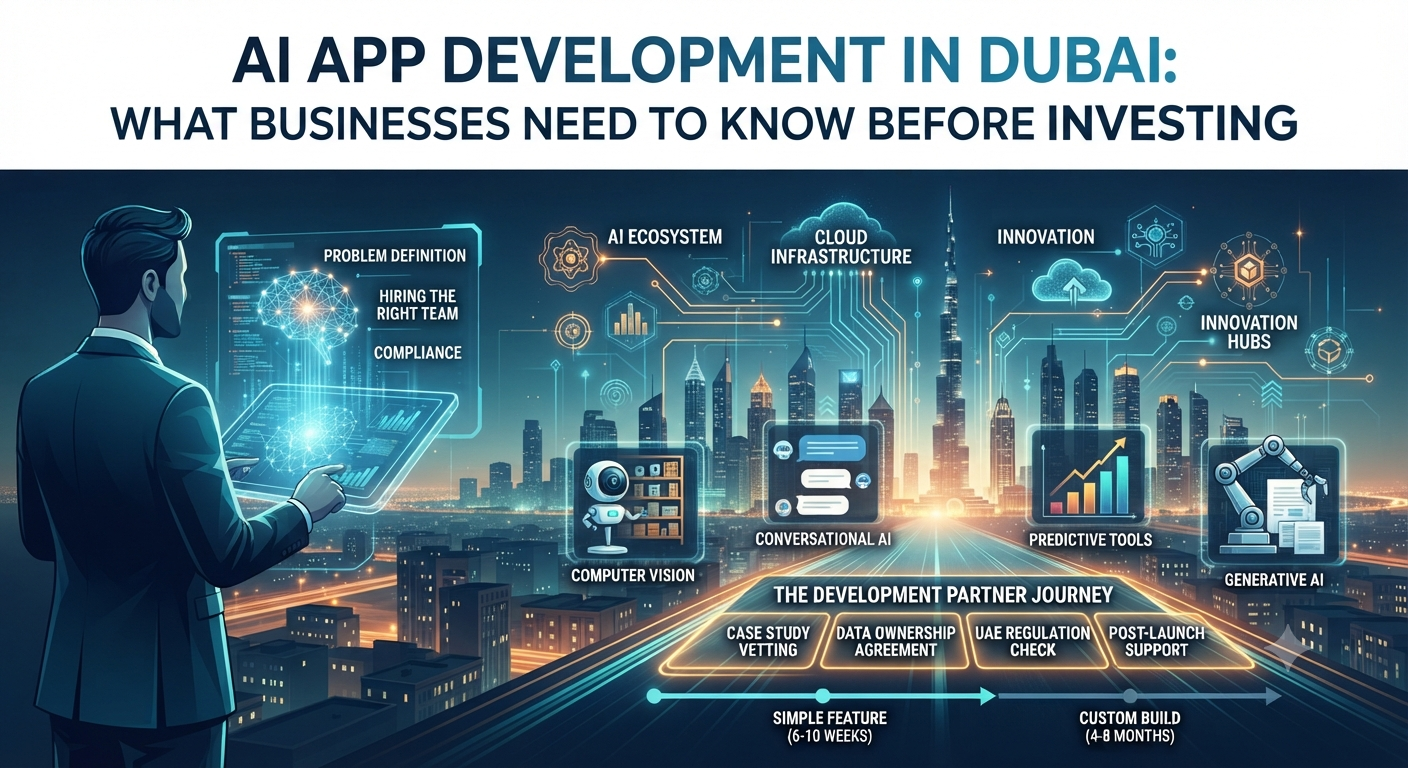
Some businesses need predictive tools, something that looks at historical data and forecasts demand, churn, or maintenance issues before they become expensive problems. Others need conversational AI, the chatbots and voice assistants that sit on top of large language models and get trained on your specific business knowledge. Some need computer vision, cameras that can spot an empty shelf, flag a safety violation on a construction site, or recognize a repeat customer walking through the door. Others want generative AI: tools that draft content, assist with design, or act as an internal assistant that actually knows your company’s documents. And a lot of the time, what a business really needs is quieter than all of that, AI simply embedded into existing software to handle small decisions automatically, like flagging a suspicious invoice before it gets paid.
The mistake I see most often is a business walking into a meeting and saying “we want an AI app” without knowing which of these they’re actually asking for. A developer worth working with should slow that conversation down. If someone starts quoting you a price before asking what outcome you’re actually trying to achieve, that’s worth noticing.
Why Dubai Is a Strong Market for This, With a Few Catches?
There’s a lot going for Dubai as a place to build AI products. With local or regional data centers operated by AWS, Azure, and Google Cloud, the cloud infrastructure is strong. This is important when considering the physical location of your data. AI engineers from India, Eastern Europe, and the Gulf have been drawn to the rapidly expanding talent pool. Additionally, there’s a good chance that government-backed initiatives can expedite approvals or ease your route if you work in fintech, logistics, or healthcare.
The catch is regulation, and it’s not a small one. The UAE’s data protection law takes privacy seriously, and depending on your sector, banking and healthcare especially, there are additional layers on top of that. Businesses coming from markets with looser data rules are often caught off guard by how much documentation, consent handling, and access control needs to be built in before an AI app can legally go live. That’s not a reason to hold off on Dubai. It’s a reason to build compliance into the project plan from week one instead of scrambling to patch it in right before launch.
There’s also a quieter trap worth mentioning: because Dubai markets itself so aggressively as an innovation hub, people sometimes assume that anyone offering AI development services here must genuinely know what they’re doing. That’s not always true. Plenty of agencies are doing perfectly ordinary app development and slapping “AI-powered” on the label because it sells better. Vetting matters here just as much as anywhere.
Where the Money Actually Goes (And Where Budgets Get Blown)
Everyone asks about cost first, understandably. A simple AI feature, a chatbot trained on your knowledge base, can start somewhere in the tens of thousands of dirhams. A custom computer vision system running in real time, or a predictive engine trained on your own proprietary data, can climb into the hundreds of thousands depending on how much data you’re working with and how complex the infrastructure needs to be.
But here’s the thing most people don’t expect: the AI model itself is rarely the expensive part. Most teams build on top of established models rather than inventing one from scratch. What actually eats the budget is everything around the model.
Your data readiness matters more than almost anything else. If your business information is scattered across five different systems, half-updated, or simply doesn’t exist in a usable form yet, a big chunk of your budget is going to go toward cleaning and organizing that before any real AI work can begin. Integration is another quiet cost driver, connecting the AI feature to your existing CRM, ERP, or point-of-sale system is often harder and more time-consuming than building the AI part itself. Then there’s ongoing maintenance, which people tend to forget entirely. AI models aren’t a “build it once and walk away” thing. They drift. Behavior changes. Data changes. Budget for retraining, or you’ll be paying for it later anyway, just with more frustration attached. And finally, compliance and security work, encryption, access logs, audit trails, adds real engineering hours that a lazy quote will often just leave out.
If a proposal looks suspiciously cheap, it’s worth asking directly what’s missing. Nine times out of ten, it’s data preparation or post-launch support that quietly got left off the page.
How to Actually Pick the Right Development Partner
This decision matters more than anything else in this article. Before you sign anything, I would really advise you to check a few things:
Ask for real case studies, not polished concepts. Anyone can put together a nice-looking mockup. Ask what actually changed after launch, fewer support tickets, faster lead response, less wasted inventory, and if you can, talk to a past client directly.
Find out who owns the data and the model once it’s built. Ideally, that’s you, not a vendor’s proprietary platform that quietly locks you in. Get this written down clearly before you sign.
Check whether they already understand UAE data regulations, or whether they’ll be learning the rules on your dime. A team that’s done this before will save you months.
Ask what happens six months after launch, not just what happens at launch. And be a little skeptical of vague answers. If someone can’t clearly tell you which model or approach they’re using and why it fits your specific problem, there’s a decent chance “AI” is doing more work in their marketing than in their product.
Timelines and Return on Investment, Realistically
A simple AI feature bolted onto an existing app can be live in six to ten weeks. A genuinely custom AI application, particularly one that needs training on your own data, more realistically takes four to eight months once you factor in data preparation, testing, and regulatory review. If someone promises you a sophisticated custom build in a few weeks, either the scope has been quietly simplified, or corners are being cut that you’ll notice later.
As for return on investment, the businesses that actually see results tend to be the ones who started small and specific, cutting response times, reducing manual data entry, catching fraud faster, rather than chasing a vague idea of “having AI.” Start narrow, prove it works, then expand. It’s a less exciting pitch than “let’s build the whole thing at once,” but it’s the one that tends to actually pay off.
Final Thoughts
The infrastructure is available, talent is developing quickly, and the regulatory framework, while strict, actually encourages companies to build things carefully rather than carelessly. AI app development in Dubai is a real opportunity, not just hype. It’s not always the fastest-moving businesses that succeed here. They are the ones who take the time to accurately describe the issue, make an honest budget for the less glamorous aspects like data and compliance, and select a partner who poses more challenging questions than they were able to address during the initial meeting.
The staff at Wantik Technologies is pleased to help you through the process if you’re considering an AI investment and want a clear, concise assessment of what’s feasible for your company in terms of cost, schedule, and technical approach. Get in touch with us for a consultation, and we’ll provide you with an accurate assessment of what this will truly entail for your company.