
AI App Development for UAE Healthcare: Use Cases and Compliance

AI App Development for UAE Healthcare: Use Cases and Compliance

AI App Development for UAE Healthcare: Use Cases and ComplianceIf you ask someone who has spent an evening in a packed clinic in Dubai what’s wrong with healthcare, they won’t respond, “not enough technology.” They’ll complain that the doctor appears worn out, the paperwork never stops, and the wait is excessively lengthy. The real opportunity for AI app development in UAE healthcare is to free doctors from time-consuming, repetitive tasks rather than replace them.

Can it be done well here? Yes. However, the apps that end up in actual hospitals have one thing in common: they were created with UAE regulations in mind from the very beginning, rather than being fixed before release. Patient consent must be obtained appropriately, health data must typically remain within the nation, and each emirate has its own regulator and standards. If you don’t do that preparation, you’ll have a nice demo that no one can utilise.

We go over where AI is making an impact, what the compliance side entails, and how to steer clear of the most typical blunders below.

Why the UAE Is Such a Good Place to Build This

For some time now, the UAE has taken AI seriously. Abu Dhabi and Dubai have both released guidelines regarding the application of AI in healthcare. There is also the plumbing. Patient records are more integrated in Dubai than in many other markets because of the NABIDH health information exchange and Malaffi in Abu Dhabi.

This is important since the usefulness of an AI tool depends on the data it can access.

Building for it is similarly challenging. More than 200 different nationalities make up the patient population. While the patient recounts their symptoms in Arabic, Urdu, Hindi, or Tagalog, the doctor may chart in English. Insurance sits behind almost every visit. Therefore, AI app development in Dubai rarely entails taking a product that was created in the US or the UK and changing the currency. The way it must function is altered by the local specifics.

Use Cases Worth Your Budget

Plenty of AI ideas sound brilliant in a boardroom and fall flat on a ward. These are the ones that tend to hold up.

Reading scans faster

Radiologists can prioritise urgent patients by using computer vision to identify worrisome spots on X-rays, CT scans, and eye images. Support is the key term. The good tools leave the decision to the physician and present the AI’s findings as a second opinion with a confidence level. It’s not only excellent design. As we’ll discuss later, it also affects how a regulator will categorise your program.

Triage before the appointment

An assistant can ask a patient a few sensible questions ahead of a visit, suggest the right specialty, and give the doctor a summary. It sounds simple, but it’s easy to get wrong. People don’t describe pain in textbook terms; many will want to type in Arabic, and the tool has to know when to stop and say “please see someone now.”

Forecasting what the hospital will need

No-shows, bed occupancy, readmission risk, and emergency department surges can all be predicted using historical data. These tools have less regulatory weight because they don’t deal with diagnosis, and they frequently pay for themselves through improved scheduling.

Supporting patients with long-term conditions

Diabetes and heart disease are major health priorities in the UAE. An app can identify issues before they become admissions by reading data from a glucose monitor or smartwatch, prompting the patient when appropriate, and alerting the care team when values start to slip.

The boring stuff that saves the most money

Medical coding, prior authorisations, claim checks, note transcription. Nobody puts these on a conference slide, but this is often where clinics see the fastest return. Claims in Abu Dhabi go through Shafafiya and in Dubai through eClaimLink, so integrating with those platforms is a big part of the value. Cut the rejection rate and the finance team will notice quickly.

Getting Your Head Around UAE Healthcare AI Compliance

This is where projects live or die, and the difficulty is that the rules come in layers that overlap.

At the federal level, the main one is Federal Law No. 2 of 2019 on the use of ICT in health fields, usually called the ICT Health Law. It covers how health data is collected, stored, and shared. The part that catches most teams out is data localisation: health data generally must be stored and processed inside the UAE, with limited exceptions set out in later ministerial decisions. It also sets long minimum retention periods for health records. Alongside it sits the Personal Data Protection Law (Federal Decree-Law No. 45 of 2021), which treats health information as sensitive personal data and raises the bar on consent and security.

Then each emirate adds its own layer:

    • Dubai Health Authority (DHA): publishes a policy on AI in healthcare and sets the rules for connecting to NABIDH.

    • Department of Health, Abu Dhabi (DoH): has its own AI policy, the ADHICS cybersecurity standard, and expects Malaffi integration.

    • MOHAP: the federal Ministry of Health and Prevention, which oversees the northern emirates and federal-level matters.

One more thing to settle early: whether your software counts as a medical device. If it influences diagnosis or treatment, it may need to be registered before clinical use. It depends on what the feature is meant to do, so ask the question in week one, not after launch.

A fair warning. This area moves quickly, and policies get revised. Treat this article as a map, not legal advice, and check the current position with the relevant authority and a UAE healthcare lawyer before you build or go live.

Building Compliance In From the Start

Teams prefer to regard compliance as a checklist. Successful ones approach it as a design constraint, much like screen size or budget. In reality, that entails a few routines.

Keep the data here. Use on-site hosting or cloud regions located in the United Arab Emirates. Additionally, you can set limits. You can be in violation without realising it if a third-party API quietly transmits identifying patient data overseas. A locally hosted model is frequently the safer option for anything involving actual patient records.

Collect only what you need. Every extra data field is extra risk. Where you can, train and test on anonymised data.

Make consent understandable. Patients should be told in plain language, ideally their own words, how their data will be used. It should be recorded and easy to withdraw.

Leave the doctor in charge. For clinical features, build a clear way to override the AI and keep a log of what it suggested and what the clinician chose.

Check for bias. Many models are trained mostly on Western data and can be less accurate for Middle Eastern and South Asian patients. Test on data that looks like your actual users.

Take security seriously. Encryption, role-based access, penetration testing, and proper logging are the baseline. ADHICS spells much of this out for Abu Dhabi providers.

Choosing the Right Development Partner

If you’re comparing teams for AI app development in Dubai, don’t be won over by the demo. Demos are easy to polish. Better to ask:

    • Have they built against NABIDH, Malaffi, or the e-claim platforms before?

    • Can they tell you exactly where your data will sit and which models will touch it?

    • Do they ask how your clinic actually runs before they suggest technology?

    • What happens after launch? Who watches for the model getting worse over time?

    • Will they tell you when AI isn’t the answer?

That last question is the one we’d weigh most heavily. Sometimes a cleaner workflow or a simple set of rules solves the problem faster, cheaper, and with far less regulatory baggage. A partner who admits that is worth keeping.

From Idea to Launch

Most projects that work follow a similar path.

    • Pick one problem and state it sharply. “Cut chest X-ray reporting time” is a project. “Use AI in our hospital” is a hope.

    • Sort out the regulatory route early. Is it clinical or administrative? Which authorities are involved?

    • Pilot in one department. Prove it works somewhere small before rolling it out.

    • Get clinicians involved from day one. If an app ignores how nurses and doctors really work, they’ll stop using it, however accurate the model is.

    • Keep watching after launch. Equipment, patient mix, and clinical practice all change, and models drift with them.

Conclusion

AI app development in the UAE has real potential, from quicker diagnostics to hospitals that run a bit more smoothly. The teams getting results aren’t the ones with the flashiest technology. They’re the ones who took compliance, clinical trust, and local context seriously from the beginning.

If you’re weighing up an AI healthcare product, Wantik Technologies can help you test whether the idea is feasible, map the regulations that apply to your use case, and build a pilot your clinicians will actually want to use. Talk to our team and tell us what you’re trying to solve.
AI App Development in Dubai: What Businesses Need to Know Before Investing

AI App Development in Dubai: What Businesses Need to Know Before Investing

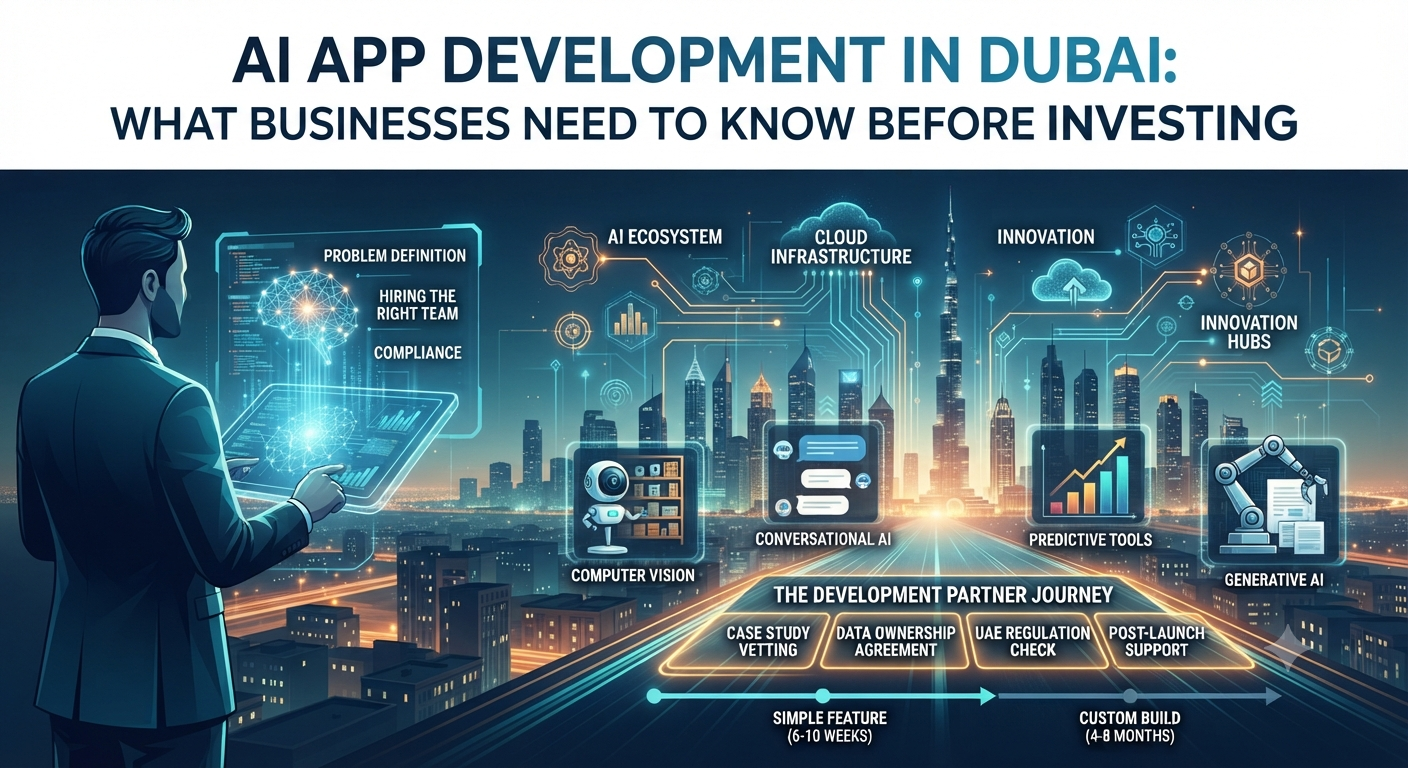
AI App Development in Dubai: What Businesses Need to Know Before InvestingEvery second pitch deck in Dubai seems to have “AI-powered” stamped somewhere on the cover slide. If you’re a business owner trying to figure out whether AI app development in Dubai is worth the investment, and how actually to get it right, here’s the honest answer: it’s less about the technology and much more about how clearly you define the problem, who you hire to build it, and how seriously you take data and compliance from the start. That’s really the whole story. The rest is just working out how to apply it to your situation, so let’s do that.

Dubai has genuinely leaned into this. Between the Dubai AI Campus, the UAE’s National AI Strategy 2031, and the steady stream of government initiatives pushing AI adoption across industries, the momentum here isn’t just marketing. Clinics want AI help with diagnoses, retailers want smarter personalisation, logistics companies want to anticipate delays before they happen, and real estate companies want chatbots that can qualify a lead at midnight without a human ever waking up. There is a genuine demand. In my experience speaking with business owners about this, it’s less evident what they truly need as opposed to what they believe they need. And money silently disappears in that space.

“AI App” Isn’t One Thing, And That’s Where People Get Stuck   

Here’s something worth sitting with before you approach any developer: “AI app” is a bit of a catch-all term, and it hides a lot of very different builds underneath it.

Some businesses need predictive tools, something that looks at historical data and forecasts demand, churn, or maintenance issues before they become expensive problems. Others need conversational AI, the chatbots and voice assistants that sit on top of large language models and get trained on your specific business knowledge. Some need computer vision, cameras that can spot an empty shelf, flag a safety violation on a construction site, or recognize a repeat customer walking through the door. Others want generative AI: tools that draft content, assist with design, or act as an internal assistant that actually knows your company’s documents. And a lot of the time, what a business really needs is quieter than all of that, AI simply embedded into existing software to handle small decisions automatically, like flagging a suspicious invoice before it gets paid.

The mistake I see most often is a business walking into a meeting and saying “we want an AI app” without knowing which of these they’re actually asking for. A developer worth working with should slow that conversation down. If someone starts quoting you a price before asking what outcome you’re actually trying to achieve, that’s worth noticing.

Why Dubai Is a Strong Market for This, With a Few Catches?

There’s a lot going for Dubai as a place to build AI products. With local or regional data centers operated by AWS, Azure, and Google Cloud, the cloud infrastructure is strong. This is important when considering the physical location of your data. AI engineers from India, Eastern Europe, and the Gulf have been drawn to the rapidly expanding talent pool. Additionally, there’s a good chance that government-backed initiatives can expedite approvals or ease your route if you work in fintech, logistics, or healthcare.

The catch is regulation, and it’s not a small one. The UAE’s data protection law takes privacy seriously, and depending on your sector, banking and healthcare especially, there are additional layers on top of that. Businesses coming from markets with looser data rules are often caught off guard by how much documentation, consent handling, and access control needs to be built in before an AI app can legally go live. That’s not a reason to hold off on Dubai. It’s a reason to build compliance into the project plan from week one instead of scrambling to patch it in right before launch.

There’s also a quieter trap worth mentioning: because Dubai markets itself so aggressively as an innovation hub, people sometimes assume that anyone offering AI development services here must genuinely know what they’re doing. That’s not always true. Plenty of agencies are doing perfectly ordinary app development and slapping “AI-powered” on the label because it sells better. Vetting matters here just as much as anywhere.

Where the Money Actually Goes (And Where Budgets Get Blown)

Everyone asks about cost first, understandably. A simple AI feature, a chatbot trained on your knowledge base, can start somewhere in the tens of thousands of dirhams. A custom computer vision system running in real time, or a predictive engine trained on your own proprietary data, can climb into the hundreds of thousands depending on how much data you’re working with and how complex the infrastructure needs to be.

But here’s the thing most people don’t expect: the AI model itself is rarely the expensive part. Most teams build on top of established models rather than inventing one from scratch. What actually eats the budget is everything around the model.

Your data readiness matters more than almost anything else. If your business information is scattered across five different systems, half-updated, or simply doesn’t exist in a usable form yet, a big chunk of your budget is going to go toward cleaning and organizing that before any real AI work can begin. Integration is another quiet cost driver, connecting the AI feature to your existing CRM, ERP, or point-of-sale system is often harder and more time-consuming than building the AI part itself. Then there’s ongoing maintenance, which people tend to forget entirely. AI models aren’t a “build it once and walk away” thing. They drift. Behavior changes. Data changes. Budget for retraining, or you’ll be paying for it later anyway, just with more frustration attached. And finally, compliance and security work, encryption, access logs, audit trails, adds real engineering hours that a lazy quote will often just leave out.

If a proposal looks suspiciously cheap, it’s worth asking directly what’s missing. Nine times out of ten, it’s data preparation or post-launch support that quietly got left off the page.

How to Actually Pick the Right Development Partner

This decision matters more than anything else in this article. Before you sign anything, I would really advise you to check a few things:

Ask for real case studies, not polished concepts. Anyone can put together a nice-looking mockup. Ask what actually changed after launch, fewer support tickets, faster lead response, less wasted inventory, and if you can, talk to a past client directly.

Find out who owns the data and the model once it’s built. Ideally, that’s you, not a vendor’s proprietary platform that quietly locks you in. Get this written down clearly before you sign.

Check whether they already understand UAE data regulations, or whether they’ll be learning the rules on your dime. A team that’s done this before will save you months.

Ask what happens six months after launch, not just what happens at launch. And be a little skeptical of vague answers. If someone can’t clearly tell you which model or approach they’re using and why it fits your specific problem, there’s a decent chance “AI” is doing more work in their marketing than in their product.

Timelines and Return on Investment, Realistically

A simple AI feature bolted onto an existing app can be live in six to ten weeks. A genuinely custom AI application, particularly one that needs training on your own data, more realistically takes four to eight months once you factor in data preparation, testing, and regulatory review. If someone promises you a sophisticated custom build in a few weeks, either the scope has been quietly simplified, or corners are being cut that you’ll notice later.

As for return on investment, the businesses that actually see results tend to be the ones who started small and specific, cutting response times, reducing manual data entry, catching fraud faster, rather than chasing a vague idea of “having AI.” Start narrow, prove it works, then expand. It’s a less exciting pitch than “let’s build the whole thing at once,” but it’s the one that tends to actually pay off.

Final Thoughts

The infrastructure is available, talent is developing quickly, and the regulatory framework, while strict, actually encourages companies to build things carefully rather than carelessly. AI app development in Dubai is a real opportunity, not just hype. It’s not always the fastest-moving businesses that succeed here. They are the ones who take the time to accurately describe the issue, make an honest budget for the less glamorous aspects like data and compliance, and select a partner who poses more challenging questions than they were able to address during the initial meeting.

The staff at Wantik Technologies is pleased to help you through the process if you’re considering an AI investment and want a clear, concise assessment of what’s feasible for your company in terms of cost, schedule, and technical approach. Get in touch with us for a consultation, and we’ll provide you with an accurate assessment of what this will truly entail for your company.

AI Chatbot Wantik Blog

AI-Powered Chatbots: Revolutionizing Customer Service in the Digital Age

In today’s fast-paced digital landscape, businesses are constantly seeking innovative ways to enhance customer experiences while maximizing operational efficiency. One technology that has emerged as a game-changer in achieving these goals is AI-powered chatbots. These intelligent virtual assistants are revolutionizing customer service by providing instant support, personalized interactions, and seamless engagement, all while reducing costs and boosting productivity.