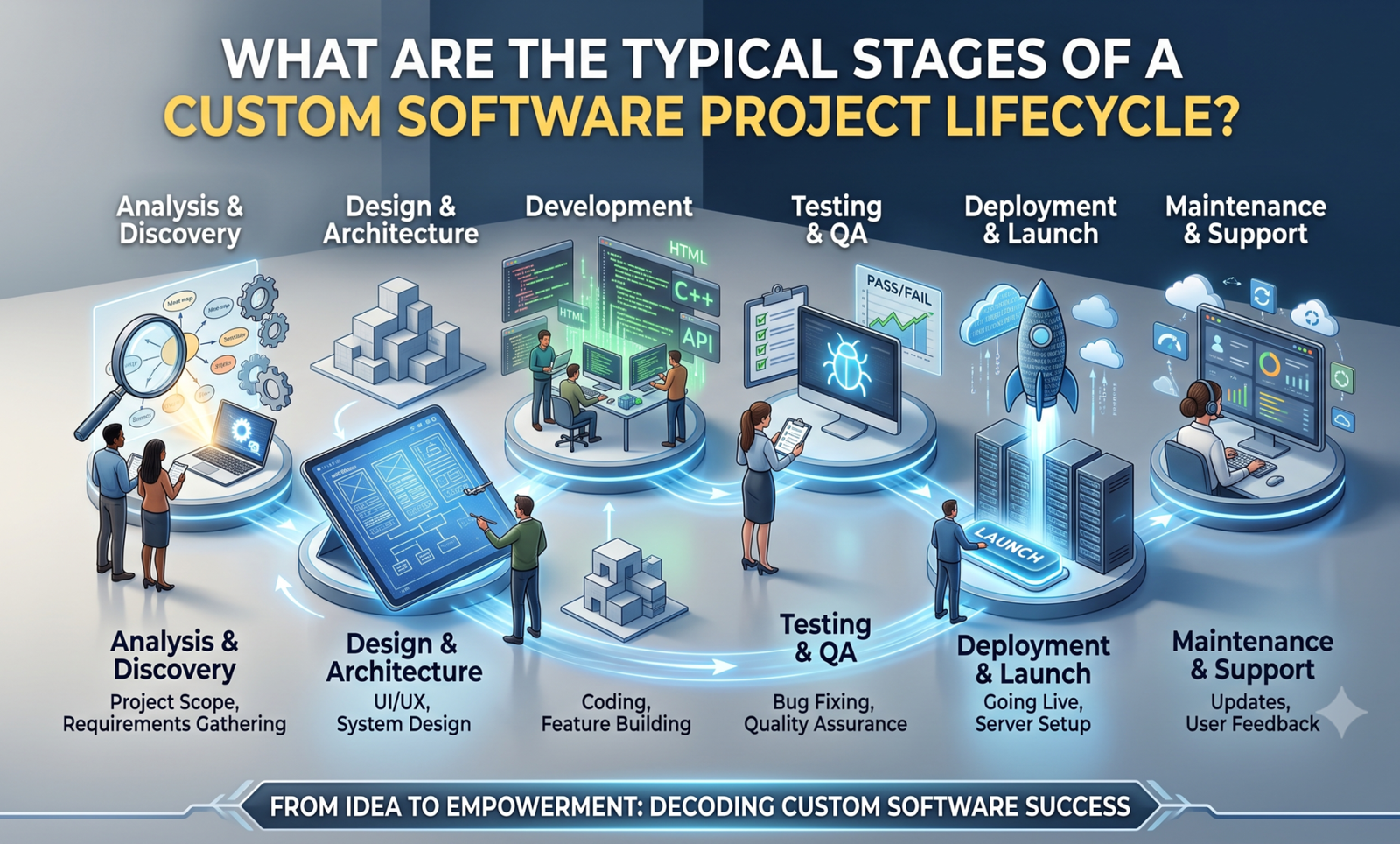
What Are the Typical Stages of a Custom Software Project Lifecycle?

What Are the Typical Stages of a Custom Software Project Lifecycle?

What Are the Typical Stages of a Custom Software Project Lifecycle?

You’ve decided off-the-shelf tools aren’t cutting it anymore, and you’re ready to talk to a custom software development company. Okay, but it’s important to understand what you’re really signing up for before you sign anything. A custom build goes through a predetermined series of steps, each with its own choices, risks, and checkpoints where things frequently go wrong. It is not a single deliverable that arrives in your inbox one day.

We’ve gone through this process enough times at Wantik Technologies to know where projects typically stall: unclear requirements, a hurried design phase to “save time,” or a launch that forgoes adequate testing due to an impending deadline. The seven steps that any custom software project actually goes through are described in this article, along with what to look out for at each level.

Stage 1: Discovery and Requirements Gathering

People are more tempted to hurry at this phase, which also decides whether or not everything proceeds as planned.

Discovery is more than just one meeting where you pitch your idea to a developer and get their approval. When done correctly, it entails multiple meetings with the real users of the program, not simply the executive who approved the budget.  A logistics company we worked with in Jebel Ali thought they needed a simple dispatch tracker; three discovery sessions later, it turned out the real bottleneck was how dispatchers reconciled fuel receipts against trip logs by hand. The program they ultimately developed was different from what they had first requested, and it resolved the issue that had really cost them money.

At this point, a capable team is enquiring:

    • What issue is this resolving, and how is it currently being addressed (using spreadsheets, a legacy system, or manual processes)?

    • Who are the real end users and how comfortable are they with technology?

    • Which current systems, your accounting program, a payment gateway, or a CRM, does this need to communicate with?

    • What distinguishes nice-to-haves from non-negotiables?

Instead of a verbal understanding, the outcome should be a written requirements document. It is worthwhile to enquire if a vendor wishes to proceed directly to a proposal without doing this.

Stage 2: Planning, Scoping, and Choosing an Approach

Once you know what you’re building, the next question is how, and how much it’ll cost and take.

This is where scope gets defined properly, usually broken into a minimum viable product (MVP) and a longer list of features for later phases. It’s tempting to want everything in version one, but a phased approach gets something usable in front of real users faster, and lets you course-correct before you’ve spent the full budget on features nobody ends up needing.

The development methodology is also settled at this stage. Instead of using a strict Waterfall model where nothing is visible until the very end, the majority of teams in modern custom software development companies operate in Agile sprints, working in two-to four-week cycles with frequent check-ins. Agile is more than just a catchphrase in this context; it implies you won’t have to wait four months to see if the final result is what you had in mind. A more organised Waterfall or hybrid approach may still be appropriate for projects with highly specific, well-defined objectives (certain compliance-driven systems, for example). How much the requirements are likely to change after actual users become engaged will determine the appropriate decision.

You should walk away from this stage with a project timeline, a cost estimate broken down by phase, and a clear list of what’s in the MVP versus what’s deferred.

Stage 3: UI/UX Design and Technical Architecture

Two things happen in parallel here, and both matter more than most clients expect.

Before creating a single line of production code, we develop wireframes, higher-fidelity prototypes, and test them with actual users. This insurance is less expensive than it might seem because it just takes a few days to rewrite a complicated workflow in a clickable prototype, but it takes weeks to do so once development is complete. This is also where local user expectations and multilingual interface requirements (Arabic and English, including right-to-left layout compatibility) are integrated from the beginning rather than added after the fact for any company operating in the United Arab Emirates.

Technically speaking, architects make the fundamental decisions that are difficult to undo later, such as which programming languages and frameworks are appropriate for the task, how the database is organised, whether it is built on-premises or in the cloud, and how it will expand if usage triples in the second year. This is also where security architecture and data protection regulations, such as UAE PDPL compliance, are incorporated, rather than added after a launch, for companies that handle consumer data.

One of the more costly errors we observe is skipping or hurrying this step. When the system needs to grow, and the underlying structure is unable to support it without an expensive rebuild, a weak architecture typically breaks the software eighteen months later.

Stage 4: Development

This is the stage most people picture when they think of “building software”, and it’s usually the longest one, though not necessarily the riskiest, if the earlier stages were done properly.

Developers work through the sprint cycles defined in planning, building features incrementally rather than disappearing for months and reappearing with a finished product. You should be seeing working increments regularly: a functioning login flow, then a working dashboard, then integrated reporting, not just status updates in a meeting. This regular visibility is what actually lets you catch a misunderstanding early, while it’s a small fix, instead of at the end, when it’s a rebuild.

Good practice here also includes code reviews, version control, and documentation as the product is built, not retrofitted at the end because a client asked for it. If you ever need to bring in a different developer or team later, undocumented code makes that far more expensive than it needs to be.

Stage 5: Testing and Quality Assurance

Testing isn’t a single pass at the end, it should be happening throughout development, but it intensifies into its own dedicated phase before launch.

This typically covers several layers: functional testing (does each feature do what it’s supposed to), integration testing (do the pieces work together, your new system talking to your existing payment processor or accounting platform, for example), performance testing (does it hold up under real load, not just a demo with three users), security testing, and finally user acceptance testing (UAT), where the actual people who’ll use the software daily try to break it before it goes live.

UAT is the step that gets compressed most often when timelines slip, and it’s the one that shouldn’t be. A bug caught by your QA team costs a fix. The same bug caught by a customer after launch costs a fix, an apology, and sometimes a lost customer.

Stage 6: Deployment and Go-Live

Launch day looks simple from the outside, the software goes live, but there’s real groundwork behind it: setting up production infrastructure, migrating existing data without losing or corrupting it, configuring backups, and often running a soft launch with a small user group before a full rollout.

If you’re replacing an existing system, data migration needs special consideration. Accurately transferring years’ worth of customer records, transaction history, or inventory data is often underestimated in terms of both time and complexity. One of the most frequent reasons for a difficult launch week is a hurried relocation.

Stage 7: Post-Launch Support, Maintenance, and Growth

Here’s what a lot of first-time buyers get wrong: they treat launch as the finish line. It isn’t. It’s closer to the starting line for the software’s actual working life.

Once real users are in the system, you’ll get feedback that no amount of discovery work could have predicted, plus bugs that only surface under real-world conditions. There are security patches to apply, operating system and dependency updates to keep pace with, and, if the software is doing its job, new feature requests as your business grows and the software needs to grow with it.

This is also the point at which picking an experienced partner truly pays off. A team that built your system and is familiar with its architecture can resolve problems and deliver improvements far more quickly than someone who is just viewing your codebase for the first time. Rather than re-tendering the work every time something needs to be updated, it’s one of the more obvious reasons why companies typically keep with the same development partner throughout the software’s lifetime.

Conclusion

A custom software project goes through several stages, including discovery, planning, design and architecture, development, testing, deployment, and ongoing support. If any of these steps are skipped or rushed, it usually results in costs later on, such as a missed requirement, a security flaw, or a system that isn’t scalable when you need it to.

When assessing a custom software development company in Dubai for a future project, find out exactly how they manage each of these phases, not just what they’ll create, but how they’ll get there. Because software that truly fits your business requires more than just good code, it requires a methodology designed to identify issues before they become costly ones, we at Wantik Technologies guide each client through this process from the initial discovery meeting to long beyond launch.

Are you considering a custom software project and would like a better idea of its scope and cost before committing? Get in contact with the Wantik Technologies team for a straightforward discussion about what your project will truly entail. There is no commitment.

Related Reading: Custom Web Application Development Company vs. Off-the-Shelf Templates: The Scalability Debate
Top 10 AI & Chatbot Development Trends in Dubai for 2026

Top 10 AI & Chatbot Development Trends in Dubai for 2026: A Guide for Scaling Businesses

Instead of “adopting” AI, Dubai is constructing its future around it. Artificial intelligence is already important to how organizations function and expand, from intelligent government services to highly customized consumer experiences. Because of this, more businesses are actively searching for the best chatbot development company to create solutions that not only automate processes but also drive growth.

Knowing where AI and chatbot technology are headed is a competitive advantage if you intend to grow in 2026. Understanding these patterns will enable you to make more informed investment choices, whether you’re working with a custom software development company in Dubai.

Why AI & Chatbots Are Becoming Non-Negotiable

A few years ago, chatbots were a “nice to have.” Now? They’re becoming essential.

Businesses are using them to:

  • Respond instantly to customers
  • Handle hundreds of conversations at once
  • Reduce workload on teams

And the largest change? AI is already helping businesses operate more effectively rather than just supporting them.

For this reason, rather than employing generic tools, more businesses are now collaborating with the best chatbot development company or a custom software development company in Dubai to create something customized.

1. Chatbots Are Turning Into Smart Assistants (Not Just Reply Machines)

Chatbots were simple in the past. They respond when you ask them a question. That’s all.
Right now? They are genuinely capable of doing things.

We are discussing systems that are capable of:

  • Process orders
  • Book appointments
  • Handle complaints from start to finish

Thus, the chatbot addresses the issue rather than only responding to a query.

2. Businesses Are Starting Conversations First

This is a significant one.

In 2026, chatbots will actively seek out customers rather than waiting for them to do so.

For example:

  • Reminding someone about an abandoned cart
  • Sending a follow-up after a service
  • Notifying about offers based on past behavior

It feels more like an intelligent assistant who understands your needs than “customer support.”

3. Personalization Is Becoming the Standard

Generic responses are irritating.

“Hello user, how can I help you?” doesn’t cut it anymore.

Modern AI systems are now:

  • Remembering user preferences
  • Suggesting relevant products or services
  • Adapting tone and responses

As a result, every encounter feels more intimate, directly affecting conversions.

4. WhatsApp Is Leading the Way

If your company isn’t using WhatsApp in Dubai, you’re already behind.

Because it’s quick, simple, and familiar, customers prefer it.

That’s why businesses are now building chatbots that:

  • Work directly on WhatsApp
  • Sync with Instagram and websites
  • Keep conversations consistent everywhere

Meeting customers where they are is the key.

5. AI That Understands Arabic (Properly)

Despite Dubai’s diversity, Arabic is still widely used for communication.

AI has had trouble with this in the past. It’s improving significantly now.

Chatbots in 2026 can:

  • Understand Arabic dialects
  • Switch between languages smoothly
  • Even handle voice interactions

For local users, this results in a much more natural experience.

6. Smarter Answers With Real Data (No Guessing)

One concern that people had about AI? incorrect responses.

Businesses are now addressing this by directly integrating chatbots with their data.

So instead of “guessing,” the chatbot:

  • Pulls real information from systems
  • Gives accurate, up-to-date responses
  • Reduces confusion for customers

This is especially important in fields where precision is crucial.

7. Chatbots Are Helping Teams Make Decisions

Interestingly, chatbots are no longer limited to consumers.

Additionally, they support internal teams.

Imagine asking:

  • “What were our sales last week?”
  • “Which product is performing best?”

And getting an instant answer.

AI is moving in the direction of making data simpler, not harder, to access.

8. AI Is Becoming Easier to Build

Building AI systems used to be costly and difficult.
It’s getting easier to access now.

With newer tools:

  • Development is faster
  • Costs are lower
  • Updates are easier

This is great news for startups and growing businesses in Dubai who want to scale without huge upfront investments.

9. Humans + AI = Better Together

A widespread concern is that people will be replaced by AI.

The finest solutions actually incorporate both.

Chatbots handle:

  • FAQs
  • Basic support
  • Repetitive tasks

Humans step in for:

  • Complex issues
  • Sensitive conversations
  • Decision-making

This balance actually improves both efficiency and customer satisfaction.

10. Businesses Are Taking AI Ethics Seriously

Businesses are growing increasingly cautious as AI gains strength.

A greater emphasis is placed on:

  • Data privacy
  • Transparent systems
  • Fair and unbiased responses

Particularly in Dubai, businesses are using technology to establish trust and comply with rules.

What This Means for Your Business

Let’s simplify all of this.

If you’re planning to scale, AI and chatbots can help you:

Save Time

Automate repetitive duties so that your staff can concentrate on more important tasks.

Reduce Costs

Manage more clients without adding additional staff.

Improve Customer Experience

Faster responses, better personalization.

Grow Without Limits

Serve 10,000 clients or just 10 without overloading your system.

For this reason, instead of using simple, off-the-shelf solutions, companies are now investing in a custom software development company in Dubai.

How to Choose the Right Chatbot Partner

If you’re thinking about getting started, choosing the right partner matters a lot.

Here’s what you should look for:

  • Someone who understands your business (not just tech)
  • Ability to customize the solution
  • Experience with integrations (CRM, website, apps)
  • Ongoing support after launch

The best chatbot development company doesn’t just build your bot, they help your business grow with it.

Where AI Chatbots Are Already Making an Impact

Across Dubai, businesses are already seeing results.

  • Retail → Better product recommendations & faster support
  • Restaurants & Cafes → Order automation & quick responses
  • Healthcare → Appointment booking & patient queries
  • Real Estate → Instant property inquiries

It’s not limited to one industry anymore; AI is everywhere.

Final Thoughts

In Dubai, AI is accelerating rather than slowing down.

Additionally, the difference between companies that use AI effectively and those that don’t will only widen.

The good news? You don’t have to do everything at once.

Begin modestly. Pay attention to how AI can genuinely impact your company. and proceed from there.

Because in 2026, scaling means working smarter rather than just harder.

Custom Software Development Companies

Top Custom Software Development Companies in 2026

In today’s increasingly fast-paced digital environment, businesses require more than off-the-shelf software products. Businesses must have systems built specifically around their processes, goals, and customers. This is the role of a software development company. A software company will develop, design, and maintain custom software that will help companies get the most out of the business, improve the customer experience, and help the company remain competitive in their industry.

Whatever your needs are; a new startup launching the first app, or a more established business creating a roadmap to modernize its legacy systems, the future of the business could depend on finding the right custom software development company. There are numerous companies out there, all claiming to be innovative, scalable, and reliable. This may lead you in the wrong direction trying to filter through the options available. We did the work of looking for great companies, because it’s important to find the right strategic partner. We have put together this guide not just to highlight a shortlist of great companies, but also to provide some insight as to the technical capability of the companies, client satisfaction projects and some kind of innovation. 

What Do Software Development Firms Do?

Software development firms specialize in building, testing, and maintaining software applications for specific business purposes. Unlike off-the-shelf programs, which can be purchased in store, custom software solutions are developed from the ground up based on customer specifications. A software development company can manage each step in the software development life cycle from brainstorming, to design, to development and deployment, and all the future support of that software.

General services might include:

  • Custom software development (desktop, mobile, and web apps)
  • UI/UX design for user experience
  • Software integration and migration
  • Cloud-based application development
  • Quality assurance and testing
  • Software maintenance and support

Companies across industries, including healthcare, fintech, eCommerce, logistics, and education, rely heavily on these services so they can operate efficiently, securely, and competitively.

Use Cases of Custom Software Development

It’s no longer a luxury, but a requirement for companies focused on growth, custom software development. A few use cases from the real world that explain why companies are hiring software development companies include:

  • E-commerce automation: Custom inventory management and CRM systems, both of which reduce manual tasks.

  • Fintech platforms: Work on secure digital payment transactions and trading platforms, with real-time analytics and status as well.

  • Healthcare management: Design HIPAA-compliant patient management and telemedicine software.

  • Enterprise solutions: Simplifying workflows with ERP and/or HR management software.

  • Education technology: Develop e-learning platforms and virtual classrooms for online education.

Custom software ensures scalability, flexibility, and total control of data/user experience, and you can fill in the blanks with out-of-the-box applications.

Top Custom Software Development Companies

1. Wantik Technologies

Wantik Technologies is an up-and-coming custom software development company that provides customized solutions that combine innovation, security, and scalability. They create web and mobile applications, as well as enterprise and cloud-based software, that are specifically aligned with the clients’ strategic goals. Wantik is known for its modern technology stack, agile development methodology, and effort to create a seamless user experience. 

Best for:

Businesses and startups seeking a scalable, data-rich, and user-friendly digital transformation. Wantik is a perfect fit for an organization that is seeking a trusted technology partner that does product development from planning, design, developing, supporting, deploying and maintaining the product. 

2. Esferasoft Solutions

Esferasoft Solutions is a custom software and digital product engineering company that focuses on helping companies across the world leverage technology to create modern scalable and secure software systems to enhance customer experience. The company has extensive experience in providing enterprise level solutions, Ecommerce solutions, mobile application development, AI based systems, and UI/UX engineering. The company’s focus on business performance and customer satisfaction, is combined with deep technical knowledge of enterprise systems to produce performance-based solutions that drive business value.

Best For:

Businesses who want to implement or create enterprise systems, build robust mobile applications, or develop a comprehensive digital transformation strategy that focuses on customer experience and business impact.

3. Apptunix

Apptunix is an award-winning mobile and web application development company that builds innovative, attractive and performance-driven applications. Also known for their ability to deliver innovative applications for clients in a variety of industries from food delivery and Healthcare to Mobility and Logistics. Apptunix has partnered with a number of organizations to successfully deliver hundreds of innovative applications to customers. With an extensive team of designers, developers and strategists, Apptunix places an emphasis on building intuitive end user experiences, supported by scalable and secure architecture.

Best For:

SMEs and Startups who want to develop mobile apps and MVPs quickly and affordably.

4.​‍​‌‍​‍‌​‍​‌‍​‍‌ SoluLab

SoluLab is a software development company known worldwide, which excels in blockchain, AI, IoT, and next-gen digital products. As a company, SoluLab engineers state-of-the-art solutions and hence, is the choice of collaboration of enterprises, startups, and Fortune 500 companies. The breadth of their knowledge and experience in dApps, automation platforms, and intelligent systems are the reasons why they become the band of tech leaders’ partners in whom innovation and digital transformation are the ultimate goal.

Best For: 

Companies with the primary focus on the use of cutting-edge technologies like blockchain, AI automation, smart contracts, or enterprise-grade digital transformation projects.

5. Daffodil Software

Daffodil Software is a trusted tech partner that provides custom software development, digital transformation, cloud solutions, and AI-powered systems services. Having a large team of talented engineers and a rich experience of many years, Daffodil is known for creating high-performing, secure, and scalable systems that are suitable in healthcare, fintech, retail, and enterprise industries. Their approach is a mix of innovation and long-term maintainability, which provides a room for solutions to grow alongside business needs.

Best For:

Large-scale businesses that require dependable development supported by rigorous R&D, sound engineering, and scalable cloud-native architecture. Perfect for companies that want advanced integrations, analytics-driven systems, or digital ​‍​‌‍​‍‌​‍​‌‍​‍‌modernization.

Final Thoughts

In a business world that is driven by technology, software development organizations play an important role in supporting companies in building several customized, effective, and scalable digital solutions. Software development companies empower organizations to remain competitive in a constantly changing digital environment, including automation of workflows or creating interactive customer experiences to drive engagement.

An essential part of success is selecting an appropriate partner to help you develop without compromising your timeline and budget, but who also shares similar visions and goals. Enabling businesses to build products, support transforming legacy systems, or have a viable path to new technologies, will not only allow the software to effectively pursue its design but will also enable the software to grow with the company over time.


Interesting Reads

The Role of Prompt Engineering in Building Next-Gen AI Systems

How AI and ML Together Improve Cloud Computing Efficiency

AI-Powered Smart City Innovations Transforming Dubai