Custom Web Application Development Company vs. Off-the-Shelf

Custom Web Application Development Company vs. Off-the-Shelf Templates: The Scalability Debate

Custom Web Application Development Company vs. Off-the-Shelf

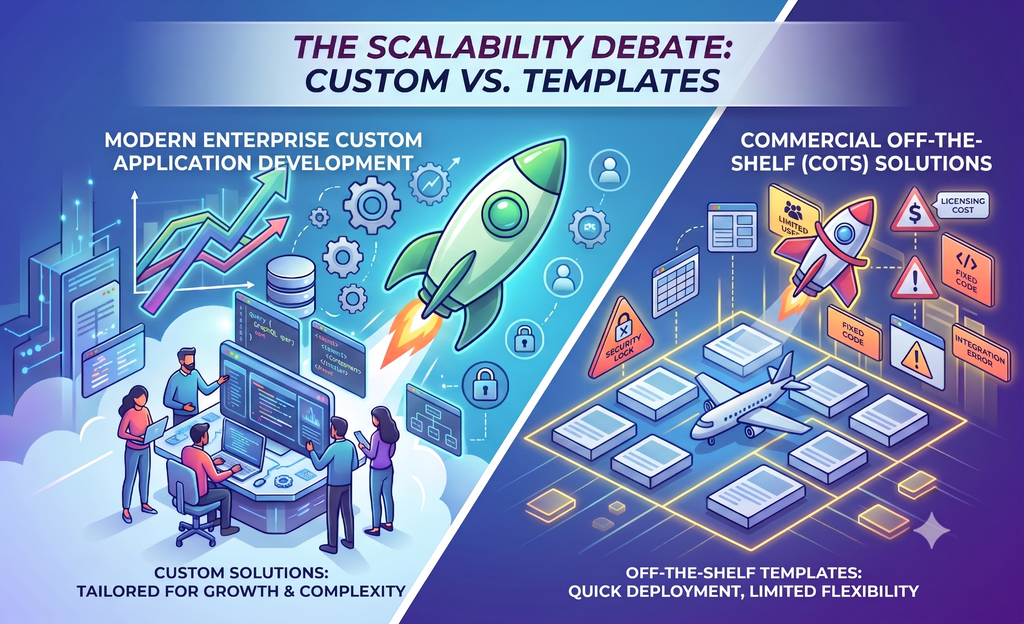
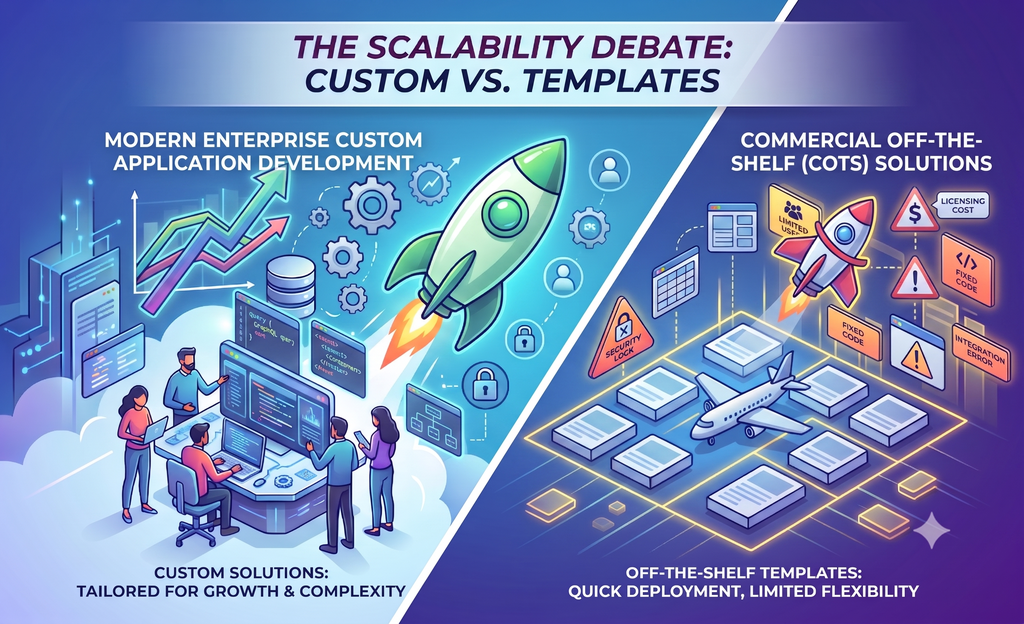
Custom web application development means building software from scratch around your business’s exact workflows, rather than adapting a pre-built template. It costs more upfront, but it scales without a rebuild — which is the whole reason this debate exists in the first place.

Here’s a scenario we see all the time. A business launches on a template, everything looks great for the first few months, and then growth happens, more products, more users, a new feature the business actually needs, and suddenly the template can’t keep up. That’s usually the point where people start looking for a custom web application development company, often after they’ve already sunk months into something they now have to unwind.

So let’s just answer the question up front: if you want something online this week and your needs are simple, a template will do the job. But if you’re planning to grow, or you already know your business doesn’t run like everyone else’s, custom development is going to save you a lot of pain later. Here’s why, in plain terms.

What’s Actually Different Between the Two

A template is built to work reasonably well for thousands of unrelated businesses. That’s the entire business model behind WordPress themes, Shopify layouts, and drag-and-drop builders, one product, sold to everyone. Which is exactly why it rarely fits any one business perfectly.

Custom development works the opposite way. Nobody’s starting with a pre-made shell and squeezing their business into it. The build starts with how your business actually operates, and the code follows from there.

A few things worth knowing before you pick a side:

  • Templates are simple to modify until you encounter an issue that falls outside the builder’s boundaries, at which point you have to either pay for a remedy or put up with the restriction.
  • Bloat is the root cause of many template performance problems. Everything slows down because you’re carrying code for features you’ll never use.
  • You don’t truly own your setup when you use a template. Since you are renting space on someone else’s platform, you will have to deal with any price changes or feature terminations.
  • It is typically more difficult than necessary to connect a template to the actual technologies your company uses, such as a CRM, inventory system, or regional payment gateway. Those relationships are taken into consideration when creating custom apps.
  • Once a business outgrows a template, it usually requires a complete rebuild. The purpose of custom applications is to expand, not to replace them.

None of this makes templates a bad choice, to be clear. They’re built for a certain job, and for a lot of small sites, that job is done well. The problem shows up when a business grows past what the template can handle, and by then, switching usually costs more than building custom would have in the first place.

Where Templates Actually Fall Apart

“Scalability” gets used loosely, so let’s be precise. It’s not just about handling more site visitors. The real question is whether the underlying system — database, logic, code — can handle your business’s growing complexity over time.

This is usually where templates start to show cracks:

  • The database structure and layout are predetermined. You’re not developing it correctly when you need a functionality that the template was not designed for; instead, you’re avoiding the restriction.
  • Plugin dependency increases quickly, particularly with WordPress. Every plugin you add increases the likelihood that it will malfunction, interfere with other programs, or reveal a security flaw you were unaware of.
  • Your data was not the focus of the database’s design. By definition, it’s general. At low volume, that’s acceptable, but as your catalog, users, or transactions start to accumulate, it becomes a serious issue.
  • Role-based access, approval chains, tiered pricing, and other custom business logic simply don’t fit well in a template. The workarounds are often brittle and break over time.
  • The platform you are working on is not under your control. You have no control over the firm that makes your template if they change the price or remove a feature that you rely on. It has previously occurred multiple times with popular page builders.

The majority of this is avoided by a well-designed custom application since scale is built in from the beginning rather than being added after things start to slow down. Because of this, many expanding companies and even smaller startups with genuine aspirations end up contacting a custom web application development company rather than attempting to push a template farther than it was intended to go.

What You’re Actually Paying For With Custom Development

Custom building involves more than just “code instead of a template.” It’s a completely different approach, and to be honest, the difference is evident even before a single line of code is produced.

A development partner worth working with will usually:

  • Before creating your feature list, inquire about your company. In the beginning, it’s more important to consider what you’re building, who it’s for, and where it’s going than what buttons you want on the homepage.
  • Create an architecture that accommodates expansion from the start, including the appropriate tech stack, a planned database rather than a generic one, and hosting that won’t collapse under future traffic increases.
  • Instead of introducing security after something goes wrong, incorporate it from the beginning. This entails encryption, access controls, and checks that are tailored to your industry’s real needs.
  • Take proper care of integrations. Payment gateways, ERPs, and CRMs whichever platform your business currently uses connect without requiring several fragile plugins.
  • Stay after the launch. Templates are set up once and then forgotten. As your organization evolves, custom builds typically include continuous support, monitoring, and updates.

Working with individuals who are familiar with your market has advantages as well. If your company is headquartered in the United Arab Emirates, one of the leading web development companies in Dubai will already be familiar with local payment preferences, compliance regulations, bilingual Arabic-English requirements, and the pace of work here. This really reduces the amount of back-and-forth that you would otherwise have to deal with.

Template or Custom, How Do You Actually Decide?

Here, there isn’t just one correct response. It actually depends on where your company is at the moment and, more importantly, where it is headed. Before making a decision, consider these sincere questions:

  • Is your business model likely to shift much over the next year or two? If there’s a real chance it will, a template’s probably going to need a rebuild sooner than you’d like.
  • Do you need to connect with specialized systems, logistics, local payment providers, or tools your team already relies on? Custom handles this far more cleanly.
  • Are you expecting meaningful growth in users or traffic? Templates tend to hit a wall that custom-built systems are made to avoid entirely.
  • Does your business run on processes a standard template just wasn’t built for, multi-step approvals, custom dashboards, unusual pricing tiers?
  • Is getting online fast your main priority right now, without big plans beyond that? If so, a template might genuinely be the smarter move for the moment.

If most of your answers lean toward growth or complexity, it’s worth having a conversation with a development team early, before you’ve spent time and money on something you’ll likely outgrow anyway.

Picking the Right Team in Dubai

Not every agency that says they can build for scale actually can, no matter how good their portfolio looks. If you’re comparing options for the best web development company in Dubai, skip the case studies for a second and ask about how they actually work:

  • Do they inquire about your long-term objectives, or do they simply start constructing based on your feature list?
  • Are they able to identify applications that they have contributed to growing over time, rather than just projects they started but abandoned?
  • Do they actually have backend, security, and design expertise in-house, or is a significant portion of it contracted out?
  • Are they honest about expenses, schedules, and the nature of assistance after the site goes live?
  • Do they actually comprehend the local market, including how people pay, what is controlled, and what UAE users expect from a website?

Those answers tell you far more than any polished portfolio will.

Wrapping This Up

You can get online quickly using a template, and sometimes that’s precisely what you need. However, it rarely expands alongside your company as you would like. Even while it may be more expensive initially, working with an experienced custom web application development business is typically the better option if scalability, security, and long-term flexibility truly matter to you.

Wantik Technologies has built web applications for UAE-based companies that are designed to grow with them rather than get replaced in a year or two. If you’re torn between a quick template and a proper custom build, let’s talk about what fits your situation — get in touch for a free consultation.

Frequently Asked Questions

1. Is custom development actually worth the extra cost over a template? 

Yes, it is more expensive up front. However, many companies wind up spending just as much, if not more, on resolving plugin conflicts, managing slowdowns, or ultimately rebuilding an outgrown template. Custom tends to even out or come out ahead over time.

2. How long does a custom web application usually take to build? 

The duration of most projects, which include exploration, design, development, testing, and launch, ranges from six to more than twenty weeks, depending on what you’re building. Once they know what you really need, anyone worth employing will give you a reasonable schedule.

3. Can I just move my template site over to a custom platform later? 

You can, but it usually requires more effort than beginning from scratch. Rather than just copying over, your data, integrations, and workflows frequently need to be rebuilt. If you anticipate growth, it’s better to prepare for it now rather than deal with it later.

4. What’s the real benefit of choosing a Dubai-based team over an international one? 

Mostly experience with UAE legislation, bilingual support requirements, local payment channels, and how quickly things move here. During development, that local context typically eliminates a lot of back-and-forth that you would otherwise have to deal with.

5. How do I know if my business needs custom development, or if a template’s fine? 

A template can really help you if your workflows are generally conventional and you don’t anticipate significant change. However, custom is typically the better option in the long run if you have special procedures, intend to grow, or require integrations that templates can’t manage well.

The Rise of 3D and Immersive UI Design in Digital Experiences (3)

The Rise of 3D and Immersive UI Design in Digital Experiences

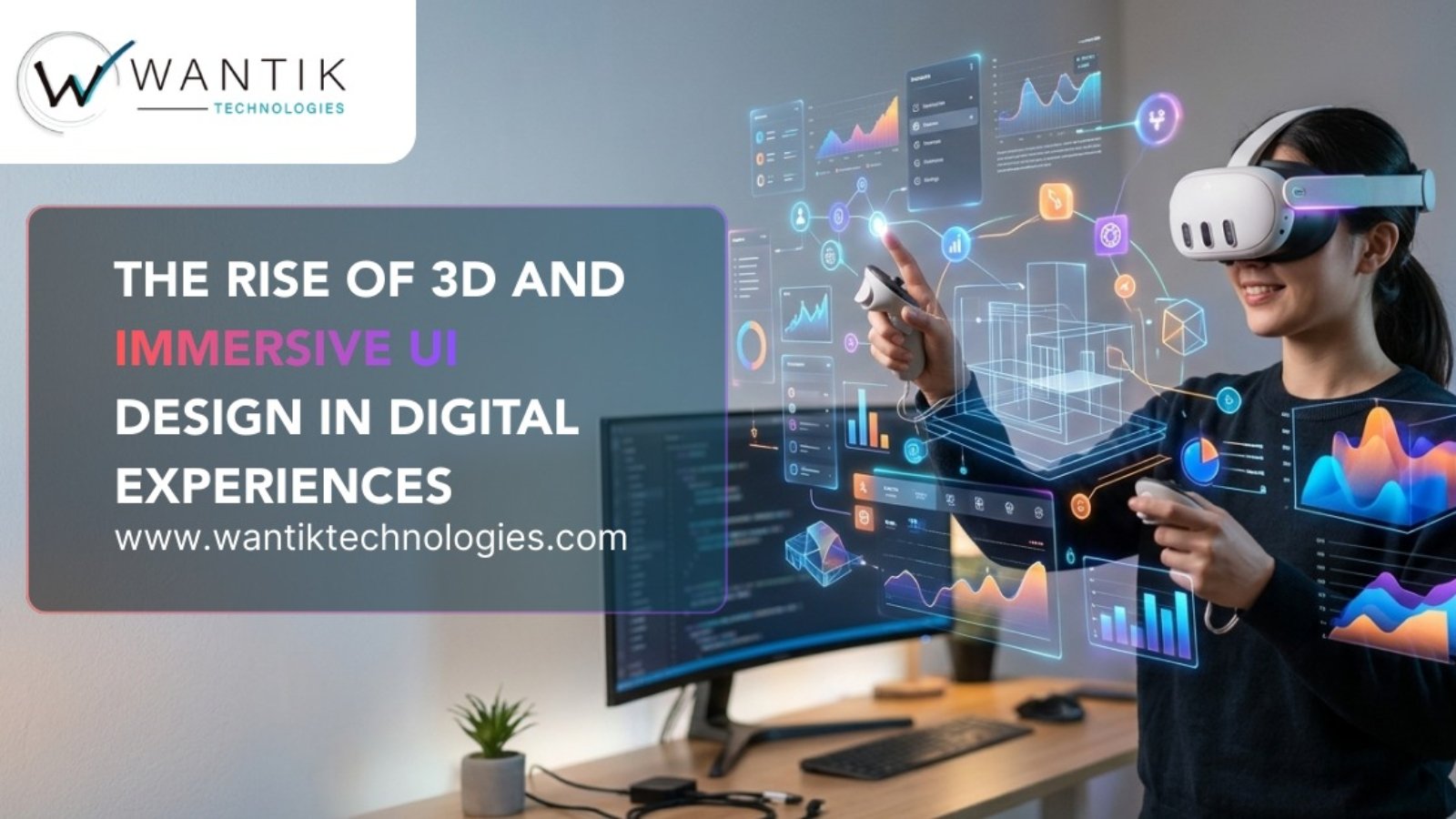
3D​‍​‌‍​‍‌​‍​‌‍​‍‌ and Immersive UI Design is revolutionizing how users work with digital products by changing the interface layer and adding visual features of depth, interactivity, and realism. It basically changes the environment of flat and static displays into worlds with layered visuals and motion-based experiences which can provide users with the respective natural feel. This design approach can be helpful to brands, product designers, startups, and digital marketers who want to differentiate themselves from users, increase user engagement and create valuable digital experiences—especially if their industry is e-commerce, gaming, education, real estate, or technology.

Why 3D and Immersive UI Design Has Become Indispensable?

If you have been observing recent examples of websites, apps, or product demos, it will hardly escape your notice that something has changed. The interfaces seem to be more alive. You see the buttons with the extra dimension of a response. The product visuals respond to your movement and thus can rotate, zoom, or even change. This is certainly not merely a design fad, but a major shift in the use of 3D and Immersive UI Design as the basis.

Essentially, 3D and Immersive UI Design are intended to develop applications or environments that look appealing, interactive, and even feel real. This experience of digital reality being at a user’s fingertips goes beyond just seeing what is on the screen, allowing the user to extend their interaction with digital materials exponentially. The need for brands to realize that a lack of flat design cannot be counterbalanced with increased usage comes with ever-decreasing attention spans and the increasing competition for users’ attention.

On the one hand, an immersive UI gives a better understanding of the product while allowing the user to navigate through the complex information in a much easier way. On the other hand, it provides the viewer with the grounds for an emotional connection to the digital experience. The perfect mix of both usability and storytelling is the reason this design approach is becoming more plentiful in different sectors.

What does a 3D and Immersive UI Design Mean?

3D and Immersive UI Design is about bringing the third dimension into digital user interfaces by utilising 3D models, animations, and spatial audio that creates the depth perception. It moves the traditional flat-screen concept portraying the content in different layouts or using animations into interfaces which simulate the real-world depth and can be considered more natural and engaging.

Major features:

  • Layouts based on depth that determine the hierarchy of visual elements
  • Three-dimensional interactive objects animated by the user’s actions appropriately
  • Motion and micro-interactions used for directing attention
  • Spatial navigation that is instinctive rather than sequential

There is no implication in this statement that designers should unnecessarily overstimulate the users with an abundance of spectacular effects. Actually, if done correctly, immersive design can help users better understand the content and usability of the product/service, assist them in reducing cognitive load and improve overall user-friendliness of the applications.

Why​‍​‌‍​‍‌​‍​‌‍​‍‌ 3D and Immersive UI Design Are Becoming So Popular

The main reasons for the shift towards immersive interfaces are numerous and go well beyond mere aesthetics.

Technological Advancements

The latest browsers, GPUs, and toolkits like WebGL and Three.js have lifted many limitations on the addition of 3D elements. At the same time, the user experience can be maintained or even improved. Along with this, higher internet speeds are allowing for the delivery of more visually rich content.

User Expectations Have Changed

After exposure to high-quality visuals through gaming, social media, and streaming services, users increasingly expect the same of everyday websites and apps. Hence, low-quality flat and static interfaces tend to feel old and outdated.

Better Engagement Metrics

Immersive UI gets visitors to websites or apps to spend more time and interact more with the content, which leads to conversions. When users love the experience, they tend to stay longer.

Competitive Differentiation

3D and Immersive UI Design in the hands of brands is an efficient tool to set them apart from the masses. An interface that sticks in the mind can be an irresistible weapon for the competition.

Core Elements of Effective Immersive UI Design

There are many 3D interfaces; some are good, while some are not functional at all. The most successful ones share some principles.

Understanding of Space

Depth and layering are considered in the design of the interfaces so that the users can comprehend their location and the next steps.

Meaningful Motion

Animations should lead users, but not divert their attention. Every change assists the user in getting the work done.

True-to-Life Interaction

Buttons, cards, and objects give the same feedback that is expected if they were real-world items.

Performance Optimization

Making the interface a well-oiled machine is of great importance. A delay or heavy loading can put an end to an immersive experience very fast.

Real-World Use Cases of 3D and Immersive UI Design

3D and Immersive UI Design are now far from being restricted to just experimental projects or luxurious games. In fact, they are currently determining the new ways users interact with digital products in different sectors. When used wisely, immersive interfaces are a win-win for the users: they solve their problems and at the same time increase engagement and usability.

E-Commerce and Product Showcases

One of the most significant obstacles for online shopping is the issue of customers not being able to touch or inspect products physically. This is exactly where 3D and Immersive UI Design come to the rescue. With the help of dynamic and visually rich product representations, immersive design can, at least, eliminate customers’ doubts and in a way, establish a relationship of trust.

Instead of purely looking at the standard pictures of the products, the visitors can get to know the items as if they were holding them in their hands: they can see the product from every single side; they can zoom into the details; and finally, they can see whether the product looks or works well in the situations they are imagining. This deeper engagement results in a more rational buying decision.

Some examples of the use of the technology are:

  • 3D models of products that can be rotated and examined up close from every angle
  • Virtual fitting rooms for apparel, accessories, and spectacles
  • Interactive product configuration in terms of colours, materials, and features

Therefore, the customers are more likely to make the right choices for them, and this is the major contributor to product returns going down and satisfaction level being ​‍​‌‍​‍‌​‍​‌‍​‍‌high.

Education​‍​‌‍​‍‌​‍​‌‍​‍‌ and E-Learning Platforms

Visualizing what they learn is one of the most effective ways for students to understand the material better rather than just reading it. One of the biggest changes in education by immersive UI is making concepts that are either too abstract or too complicated simple and easy to grasp by transforming them into interactive experiences.

Learners interact with the material through spatial interaction and visual exploration so they are not only absorbing passively. This method caters to various types of learners and facilitates long-term memory retention.

Common educational tools are:

  • 3D models, e.g., for biology, anatomy, and chemistry
  • Interactive simulations to understand engineering and physics concepts
  • Virtual learning environments that can be used for the practice of real-world situations

Immersive UI enables students to comprehend learning more naturally and makes the whole process more fun and more effective.

Real Estate and Architecture

Previously, the primary sources of facts for real estate and architectural design decisions had been physical site inspections and blueprints. However, Immersive UI has made it entirely possible to get a real feel of any space digitally before it is even built or without having to be physically present there.

What users do through virtual tours is that they can thoroughly check out property details, figure out the layouts of the spaces, and see the designs from the floor to the ceiling. As a result, they are confident about their choices and the entire process is considerably faster.

  • Virtual walk-throughs that mimic actual movement
  • Interactive floor plans with room-by-room exploration;
  • 3D neighbourhood previews to show surroundings and amenities

It benefits both the buyers and the sellers in terms of saving time and also leading to a better-quality property evaluation.

Gaming and Entertainment

For a very long time, gaming, and entertainment have been the leaders in the use of immersive design, thus creating high expectations of interactivity, realism, and responsiveness in users. The demonstration of these industries is that immersive UI is capable of creating emotionally engaging experiences that users will find natural and intuitive.

Immersive interfaces in gaming are concerned with the cooperation that will always be there and that will be so deeply engaging, therefore, users will have the feeling of being there.

Mainly, it is used in:

  • Spatial menus that feel integrated into the environment
  • Interactive storytelling driven by user choices
  • Real-time 3D environments that respond dynamically to actions

The gaming industry’s reliance on immersive UI has led to the spreading of such methods to other industries.

Corporate Websites and Branding

Nowadays, for brands, having a highly interactive and immersive online presence has become more important than simply providing generic information. 3D and Immersive UI Design makes it possible for companies to communicate through stories, demonstrate their innovativeness, and generate deep emotional connections with their users.

The advantage of immersive corporate sites is that they are not limited to regular page-by-page navigation, but rather provide interactive journeys that help brands communicate their value more efficiently.

Common branding ideas are:

  • Interactive brand stories that guide users through a narrative
  • Product launches featuring 3D demonstrations
  • Data visualization presented in three-dimensional formats

People tend to remember these moments, and therefore it is a very effective way of reinforcing one’s brand trustworthiness.

Pros of 3D and Immersive UI Design

When 3D and Immersive UI Design are done properly, they bring significant benefits not only to users but also to businesses. Their worth is not limited to just making things look good, which is what most people think of them, but they actually enhance engagement and comprehension.

Here are a few key benefits:

  • The user engagement levels are raised by interfaces becoming lively and eye-catching
  • Understanding of very sophisticated objects and information is enhanced
  • Memorable brand experiences are generated, which result in increased brand loyalty
  • More users lead to long sessions and repeat visits
  • Motion, visual depth, and spatial design work together to enable effective storytelling
  • Assist in brand differentiation, especially in the case of digitally saturated ​‍​‌‍​‍‌​‍​‌‍​‍‌markets

Challenges​‍​‌‍​‍‌​‍​‌‍​‍‌ Designers Must Be Aware Of

Immersive UIs are pretty great, but yes, they also have drawbacks that design professionals need to be aware of and solve properly.

Performance Concerns

Unoptimized heavy 3D models and animations may slow down loading times, thereby resulting in negative impacts on performance. It is highly recommended to always stay on top of your game and avoid causing nuisances to the end users.

Accessibility Issues

There is no doubt that visually immersive elements will still be usable by people with different disabilities as well as those utilizing company help for their tech. Accessibility is definitely a money-paying thing and should be planned for in the design phase.

Learning Curve

Educational programs and materials for training have to include exceptional support, so the users can understand the ideas of immersive designs, become proficient in the use of the new set of tools, and also comprehend the new workflows and thinking techniques necessary for this type of new skill.

Overuse Risk

Repeated use of 3D visuals may lead to sensory overload and, as such, may be regarded as a source of distraction from the primary functionality. The key is always to have a healthy balance.

Best​‍​‌‍​‍‌​‍​‌‍​‍‌ Practices for Implementing Immersive UI

Designers who want to make it right should follow the best practice guidelines that emphasize usability and clear function over the mere spectacle of visuals.

Here are the recommendations that a designer can follow:

  • Don’t start with the visual effects, rather figure out user needs first.
  • When using 3D elements helps make things more valuable or clear, it’s acceptable.
  • Make sure your files are not big so that your app is quick and ready for the users.
  • Do not forget to check if your app is user-friendly and works smoothly on all devices.
  • Keep it consistent with your brand identity.

Now these rules are like a fence that keeps the immersive layout design at the front, keeps it functional and easy to follow for the user.

The Future of 3D and Immersive UI Design

With the continuous advancement in technology, immersiveness is going to be an essential part of the new technologies, thus the interface will be more enhanced. Technologies such as augmented reality, virtual reality, and spatial computing will enable us to have digital experiences that do not require any kind of screen.

Some of the things that we may witness in the future are:

Being able to use gestures in a more natural way instead of using buttons on your phone or keyboard.

  • Interfaces that help you in your own unique way, they’ll understand you without explanations.
  • Devices will be more intelligent, and they will be able to understand and respond to our needs and moods much better.
  • With time and proper refinement, pretty soon 3D and Immersive UI Design will not be considered something extraordinary but rather a normal thing.

Final Thoughts:

Immersive UI certainly justifies the whole investment if done with a clear aim. It is not about making things overly colourful and showy, but about facilitating the users in their interaction with digital products.

When the designers set elements in such a way that they are easy to use, require less time for the system to load and trigger the user’s emotion, the 3D and Immersive UI Design can actually become a tool to digitally unfold the brand story and to deeply engage the users. Therefore, for the brands that are set to make a change thoughtfully, immersive UI is a great, enduring investment, not a mere fad.


Book Free Consultation

    AI Chatbot Wantik Blog

    AI-Powered Chatbots: Revolutionizing Customer Service in the Digital Age

    In today’s fast-paced digital landscape, businesses are constantly seeking innovative ways to enhance customer experiences while maximizing operational efficiency. One technology that has emerged as a game-changer in achieving these goals is AI-powered chatbots. These intelligent virtual assistants are revolutionizing customer service by providing instant support, personalized interactions, and seamless engagement, all while reducing costs and boosting productivity.