
Top AI App Development Services Available in the UAE

Here’s something nobody tells you before you start shopping for an AI development partner: almost every agency in Dubai will tell you they “do AI.” Half of them mean they can bolt a `chatbot onto your existing app. The other half genuinely build models trained on your data. Figuring out which is which, before you sign anything, is the whole game.

So let’s get right to it. In summary, the market for AI app development in UAE is more developed than it appears from the outside. Real teams, such as those at companies like Wantik Technologies, are creating truly unique AI products for regional companies rather than merely reselling an API wrapper with a lovely user interface. The secret is to know what to ask before committing to a budget because, in most cases, the difference between an excellent and mediocre partner doesn’t become apparent until the fourth month.

This blog explains what AI app development really entails in practice, why the UAE has developed into a respectable location for this kind of project, and how to distinguish between a serious team and one that is just riding the buzz.

What People Actually Mean by “AI App Development”

These days, the term is used to refer to nearly everything, so let’s be clear about that first.

When someone in the UAE says they need an AI app developed, they typically mean one of the following:

    • An assistant or chatbot integrated into an existing app.

    • A predictive tool that makes predictions based on historical data.

    • Computer vision, for tasks like warehouse logistics and retail shelf monitoring.

    • An engine that makes recommendations for things you might like to watch or purchase.

    • Features of generative AI, such as document summarisation and content creation.

    • A complete AI platform designed with an organization’s own data in mind.

Before proposing, a team that truly knows what it’s doing will find out which of these best suits your circumstances. You should continue searching if a salesperson says, “We’ll just plug in ChatGPT,” without even enquiring about your data or users. That isn’t progress. A reseller with a slide deck is that.

Why the UAE Has Quietly Become a Good Place to Build This

This was not an accident, nor did it happen overnight. The UAE’s National AI Strategy forced several public sector projects to be abandoned, which led to a pool of engineers who had to develop and deliver AI features under actual deadlines rather than just in a sandbox.

This is important if you’re hiring locally for a couple of reasons:

    • Teams here have worked on government, healthcare, banking, and retail initiatives, so they’ve seen more than just the demo version of AI, they’ve seen its messy, regulated side.

    • Local staff typically already understand the region’s data residency regulations, which are taken seriously.

    • There is a fair amount of time zone overlap between Europe and Asia, which is helpful when you require continuous assistance rather than just a launch.

    • Several companies, including Wantik Technologies, retain AI engineering in-house rather than contracting it out to a subcontractor once “real” development begins.

It’s worth taking a moment to consider that final one. Many companies develop the software themselves, then covertly contract out the machine learning component to another party. It is precisely at that handoff that things go wrong: deadlines are missed, no one takes responsibility for the defects, and you wind up pursuing two vendors rather than just one.

How to Actually Evaluate a Partner (Not Just Their Pitch)

Once you’ve got a shortlist, don’t get pulled in by the deck. Ask a few blunt questions instead.

What’s actually running under the hood?

Are they integrating third-party APIs, refining an already existing large language model, or training their own models? On their own, none of these are incorrect, but the response reveals a lot about the price, who will eventually hold your data, and the extent of your future customisation options.

Who’s watching the model after launch?

This one is frequently overlooked. Artificial intelligence models stray. When user behaviour changes over the next few months, a model that functions flawlessly on launch day may subtly deteriorate. Find out how much it costs and who is in charge of catching that.

Where does your data actually live?

Particularly relevant here, given how strict UAE regulations are for banking, healthcare, and government work. A partner worth hiring will walk you through storage, access, and whether your data is being reused to train anything else.

Can they show you something real?

Case studies that claim to have “improved efficiency by 40” without explaining are of very low value. Get details on the app, including what it does, what data it uses, and what changed since it was released. Instead of showing you a slide with a fictitious percentage on it, if they are confident, they will show you a functional demo.

Does your project even need what they’re selling?

A custom-trained model is not necessary for everything. Developing diagnostic support for a clinic is entirely different from making product recommendations based on browsing behaviour. An agency has most likely not adequately scoped either one if they provide the same approximate pricing for both.

Where Wantik Technologies Fits In

Wantik Technologies works in the majority of this range; at times, it’s a fully AI-native product created from start, and at other times it’s a single AI feature carefully added to an already functional software. It’s usually the discovery stage rather than the technology itself that stands out. The team determines what data is truly available, what a model actually requires to be helpful, and how much it will cost to maintain in the future before writing a single line of code.

It may not seem important, but being honest up front is crucial. Many AI initiatives create an impressive demo that silently collapses when messy real-world data and actual users appear. The main cost difference is typically found in the space between “looks good in the demo” and “actually holds up in production” for businesses in the UAE comparing a custom AI build to something templated off the shelf.

Mistakes Businesses Keep Making With AI Projects

A handful of patterns show up over and over in delayed or failed AI builds in this region:

    • Picking an agency on price alone, without checking if they’ve actually worked on AI before.

    • Skipping a proper data audit before agreeing on a timeline.

    • Treating an AI feature as “done” once it launches, instead of something that needs upkeep.

    • Underestimating how much compliance work regulated industries actually require.

    • Never nailing down, in writing, who owns the trained model and the data behind it.

None of this is complicated to avoid. It just means asking the uncomfortable questions before the contract is signed, not after.

Conclusion

Choosing the best partner for AI app development in the UAE really comes down to this: look for a team that can demonstrate something tangible, explain what they’re doing in simple terms, and stick around after launch rather than leaving once the invoice clears. This market has developed to the point where you shouldn’t have to take a chance on an unreliable vendor.

The most beneficial thing you can do if you’re actually developing an AI app is to have a comprehensive scoping conversation before any development begins. This talk should encompass your data, your users, and what success actually looks like six months from now. Get a straight response from Wantik Technologies on the requirements of your project.

Frequently Asked Questions

How much does AI app development cost in the UAE?

It depends heavily on scope. A custom-trained model with continuous support costs much more than a basic chatbot integration, which might begin in the low tens of thousands of dirhams. Any figure you hear before a formal scoping call should be treated as an estimate rather than a price.

How long does it actually take to build an AI app?

It can take two to four months to add a single AI function to an existing app. A complete AI-native solution typically takes six to twelve months, including data preparation and model training.

Do I need my own data to build an AI app?

Not necessarily. Certain functionalities are compatible with pre-trained models or third-party APIs. However, your personal data is crucial if you want the app to accurately represent your company and your clients.

Is my data actually safe with a UAE-based AI company?

That ultimately depends on the vendor’s policies rather than where they are located. Enquire directly about who has access to the data, where it is kept, and whether it is used to develop models for different clients.

Can I add AI to an app I already have, or do I need to rebuild it?

Most of the time, you can add AI features without a full rebuild, as long as the existing architecture can handle the extra data processing. A technical audit will tell you for sure before you commit to anything.
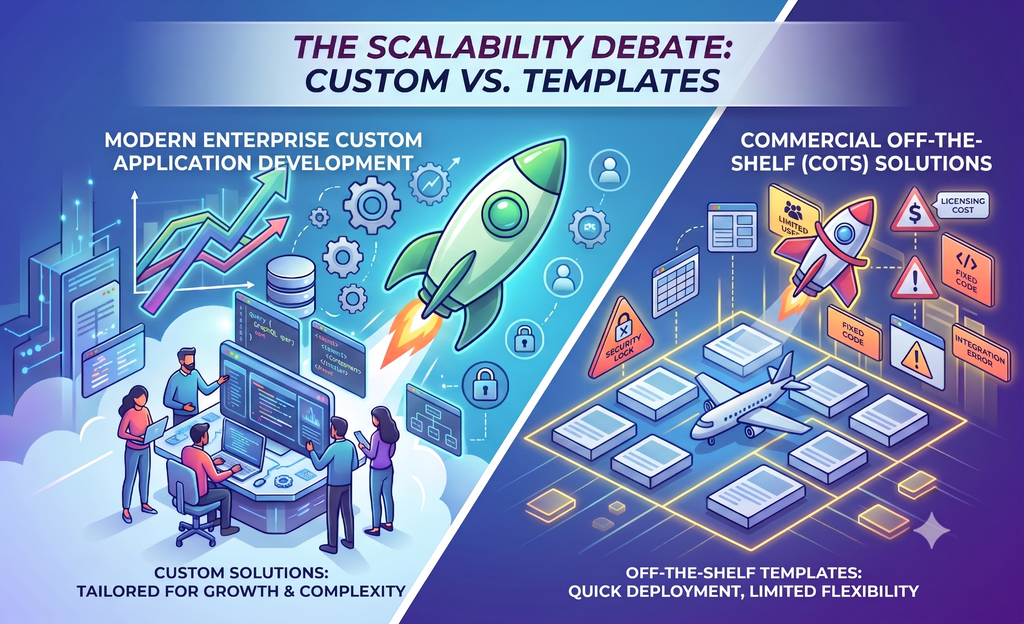
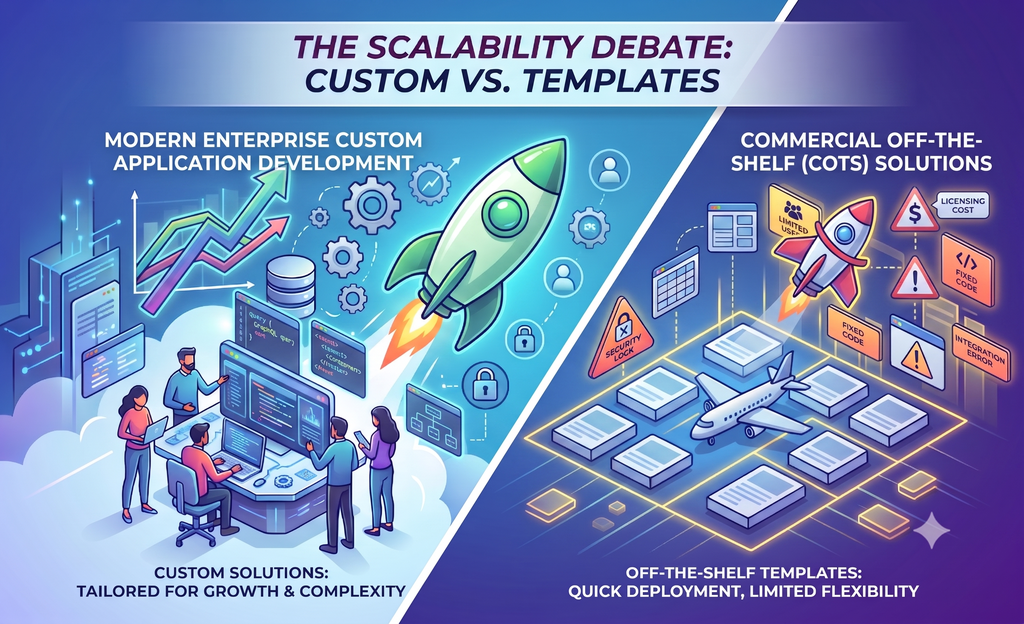
Custom Web Application Development Company vs. Off-the-Shelf

Custom Web Application Development Company vs. Off-the-Shelf Templates: The Scalability Debate

Custom Web Application Development Company vs. Off-the-Shelf

Custom web application development means building software from scratch around your business’s exact workflows, rather than adapting a pre-built template. It costs more upfront, but it scales without a rebuild — which is the whole reason this debate exists in the first place.

Here’s a scenario we see all the time. A business launches on a template, everything looks great for the first few months, and then growth happens, more products, more users, a new feature the business actually needs, and suddenly the template can’t keep up. That’s usually the point where people start looking for a custom web application development company, often after they’ve already sunk months into something they now have to unwind.

So let’s just answer the question up front: if you want something online this week and your needs are simple, a template will do the job. But if you’re planning to grow, or you already know your business doesn’t run like everyone else’s, custom development is going to save you a lot of pain later. Here’s why, in plain terms.

What’s Actually Different Between the Two

A template is built to work reasonably well for thousands of unrelated businesses. That’s the entire business model behind WordPress themes, Shopify layouts, and drag-and-drop builders, one product, sold to everyone. Which is exactly why it rarely fits any one business perfectly.

Custom development works the opposite way. Nobody’s starting with a pre-made shell and squeezing their business into it. The build starts with how your business actually operates, and the code follows from there.

A few things worth knowing before you pick a side:

  • Templates are simple to modify until you encounter an issue that falls outside the builder’s boundaries, at which point you have to either pay for a remedy or put up with the restriction.
  • Bloat is the root cause of many template performance problems. Everything slows down because you’re carrying code for features you’ll never use.
  • You don’t truly own your setup when you use a template. Since you are renting space on someone else’s platform, you will have to deal with any price changes or feature terminations.
  • It is typically more difficult than necessary to connect a template to the actual technologies your company uses, such as a CRM, inventory system, or regional payment gateway. Those relationships are taken into consideration when creating custom apps.
  • Once a business outgrows a template, it usually requires a complete rebuild. The purpose of custom applications is to expand, not to replace them.

None of this makes templates a bad choice, to be clear. They’re built for a certain job, and for a lot of small sites, that job is done well. The problem shows up when a business grows past what the template can handle, and by then, switching usually costs more than building custom would have in the first place.

Where Templates Actually Fall Apart

“Scalability” gets used loosely, so let’s be precise. It’s not just about handling more site visitors. The real question is whether the underlying system — database, logic, code — can handle your business’s growing complexity over time.

This is usually where templates start to show cracks:

  • The database structure and layout are predetermined. You’re not developing it correctly when you need a functionality that the template was not designed for; instead, you’re avoiding the restriction.
  • Plugin dependency increases quickly, particularly with WordPress. Every plugin you add increases the likelihood that it will malfunction, interfere with other programs, or reveal a security flaw you were unaware of.
  • Your data was not the focus of the database’s design. By definition, it’s general. At low volume, that’s acceptable, but as your catalog, users, or transactions start to accumulate, it becomes a serious issue.
  • Role-based access, approval chains, tiered pricing, and other custom business logic simply don’t fit well in a template. The workarounds are often brittle and break over time.
  • The platform you are working on is not under your control. You have no control over the firm that makes your template if they change the price or remove a feature that you rely on. It has previously occurred multiple times with popular page builders.

The majority of this is avoided by a well-designed custom application since scale is built in from the beginning rather than being added after things start to slow down. Because of this, many expanding companies and even smaller startups with genuine aspirations end up contacting a custom web application development company rather than attempting to push a template farther than it was intended to go.

What You’re Actually Paying For With Custom Development

Custom building involves more than just “code instead of a template.” It’s a completely different approach, and to be honest, the difference is evident even before a single line of code is produced.

A development partner worth working with will usually:

  • Before creating your feature list, inquire about your company. In the beginning, it’s more important to consider what you’re building, who it’s for, and where it’s going than what buttons you want on the homepage.
  • Create an architecture that accommodates expansion from the start, including the appropriate tech stack, a planned database rather than a generic one, and hosting that won’t collapse under future traffic increases.
  • Instead of introducing security after something goes wrong, incorporate it from the beginning. This entails encryption, access controls, and checks that are tailored to your industry’s real needs.
  • Take proper care of integrations. Payment gateways, ERPs, and CRMs whichever platform your business currently uses connect without requiring several fragile plugins.
  • Stay after the launch. Templates are set up once and then forgotten. As your organization evolves, custom builds typically include continuous support, monitoring, and updates.

Working with individuals who are familiar with your market has advantages as well. If your company is headquartered in the United Arab Emirates, one of the leading web development companies in Dubai will already be familiar with local payment preferences, compliance regulations, bilingual Arabic-English requirements, and the pace of work here. This really reduces the amount of back-and-forth that you would otherwise have to deal with.

Template or Custom, How Do You Actually Decide?

Here, there isn’t just one correct response. It actually depends on where your company is at the moment and, more importantly, where it is headed. Before making a decision, consider these sincere questions:

  • Is your business model likely to shift much over the next year or two? If there’s a real chance it will, a template’s probably going to need a rebuild sooner than you’d like.
  • Do you need to connect with specialized systems, logistics, local payment providers, or tools your team already relies on? Custom handles this far more cleanly.
  • Are you expecting meaningful growth in users or traffic? Templates tend to hit a wall that custom-built systems are made to avoid entirely.
  • Does your business run on processes a standard template just wasn’t built for, multi-step approvals, custom dashboards, unusual pricing tiers?
  • Is getting online fast your main priority right now, without big plans beyond that? If so, a template might genuinely be the smarter move for the moment.

If most of your answers lean toward growth or complexity, it’s worth having a conversation with a development team early, before you’ve spent time and money on something you’ll likely outgrow anyway.

Picking the Right Team in Dubai

Not every agency that says they can build for scale actually can, no matter how good their portfolio looks. If you’re comparing options for the best web development company in Dubai, skip the case studies for a second and ask about how they actually work:

  • Do they inquire about your long-term objectives, or do they simply start constructing based on your feature list?
  • Are they able to identify applications that they have contributed to growing over time, rather than just projects they started but abandoned?
  • Do they actually have backend, security, and design expertise in-house, or is a significant portion of it contracted out?
  • Are they honest about expenses, schedules, and the nature of assistance after the site goes live?
  • Do they actually comprehend the local market, including how people pay, what is controlled, and what UAE users expect from a website?

Those answers tell you far more than any polished portfolio will.

Wrapping This Up

You can get online quickly using a template, and sometimes that’s precisely what you need. However, it rarely expands alongside your company as you would like. Even while it may be more expensive initially, working with an experienced custom web application development business is typically the better option if scalability, security, and long-term flexibility truly matter to you.

Wantik Technologies has built web applications for UAE-based companies that are designed to grow with them rather than get replaced in a year or two. If you’re torn between a quick template and a proper custom build, let’s talk about what fits your situation — get in touch for a free consultation.

Frequently Asked Questions

1. Is custom development actually worth the extra cost over a template? 

Yes, it is more expensive up front. However, many companies wind up spending just as much, if not more, on resolving plugin conflicts, managing slowdowns, or ultimately rebuilding an outgrown template. Custom tends to even out or come out ahead over time.

2. How long does a custom web application usually take to build? 

The duration of most projects, which include exploration, design, development, testing, and launch, ranges from six to more than twenty weeks, depending on what you’re building. Once they know what you really need, anyone worth employing will give you a reasonable schedule.

3. Can I just move my template site over to a custom platform later? 

You can, but it usually requires more effort than beginning from scratch. Rather than just copying over, your data, integrations, and workflows frequently need to be rebuilt. If you anticipate growth, it’s better to prepare for it now rather than deal with it later.

4. What’s the real benefit of choosing a Dubai-based team over an international one? 

Mostly experience with UAE legislation, bilingual support requirements, local payment channels, and how quickly things move here. During development, that local context typically eliminates a lot of back-and-forth that you would otherwise have to deal with.

5. How do I know if my business needs custom development, or if a template’s fine? 

A template can really help you if your workflows are generally conventional and you don’t anticipate significant change. However, custom is typically the better option in the long run if you have special procedures, intend to grow, or require integrations that templates can’t manage well.