What Are the Typical Stages of a Custom Software Project Lifecycle?

What Are the Typical Stages of a Custom Software Project Lifecycle?

What Are the Typical Stages of a Custom Software Project Lifecycle?

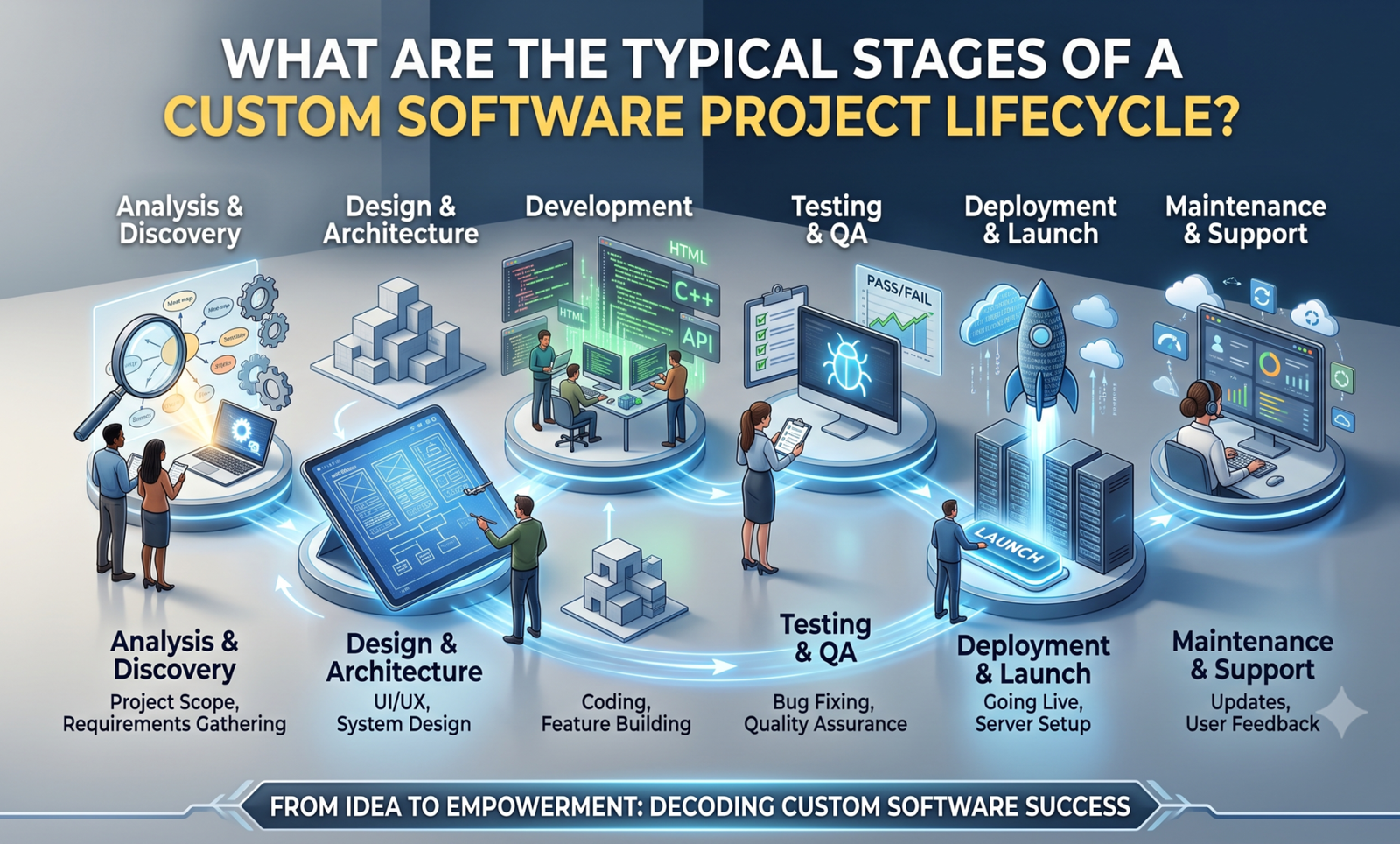
You’ve decided off-the-shelf tools aren’t cutting it anymore, and you’re ready to talk to a custom software development company. Okay, but it’s important to understand what you’re really signing up for before you sign anything. A custom build goes through a predetermined series of steps, each with its own choices, risks, and checkpoints where things frequently go wrong. It is not a single deliverable that arrives in your inbox one day.

We’ve gone through this process enough times at Wantik Technologies to know where projects typically stall: unclear requirements, a hurried design phase to “save time,” or a launch that forgoes adequate testing due to an impending deadline. The seven steps that any custom software project actually goes through are described in this article, along with what to look out for at each level.

Stage 1: Discovery and Requirements Gathering

People are more tempted to hurry at this phase, which also decides whether or not everything proceeds as planned.

Discovery is more than just one meeting where you pitch your idea to a developer and get their approval. When done correctly, it entails multiple meetings with the real users of the program, not simply the executive who approved the budget.  A logistics company we worked with in Jebel Ali thought they needed a simple dispatch tracker; three discovery sessions later, it turned out the real bottleneck was how dispatchers reconciled fuel receipts against trip logs by hand. The program they ultimately developed was different from what they had first requested, and it resolved the issue that had really cost them money.

At this point, a capable team is enquiring:

    • What issue is this resolving, and how is it currently being addressed (using spreadsheets, a legacy system, or manual processes)?

    • Who are the real end users and how comfortable are they with technology?

    • Which current systems, your accounting program, a payment gateway, or a CRM, does this need to communicate with?

    • What distinguishes nice-to-haves from non-negotiables?

Instead of a verbal understanding, the outcome should be a written requirements document. It is worthwhile to enquire if a vendor wishes to proceed directly to a proposal without doing this.

Stage 2: Planning, Scoping, and Choosing an Approach

Once you know what you’re building, the next question is how, and how much it’ll cost and take.

This is where scope gets defined properly, usually broken into a minimum viable product (MVP) and a longer list of features for later phases. It’s tempting to want everything in version one, but a phased approach gets something usable in front of real users faster, and lets you course-correct before you’ve spent the full budget on features nobody ends up needing.

The development methodology is also settled at this stage. Instead of using a strict Waterfall model where nothing is visible until the very end, the majority of teams in modern custom software development companies operate in Agile sprints, working in two-to four-week cycles with frequent check-ins. Agile is more than just a catchphrase in this context; it implies you won’t have to wait four months to see if the final result is what you had in mind. A more organised Waterfall or hybrid approach may still be appropriate for projects with highly specific, well-defined objectives (certain compliance-driven systems, for example). How much the requirements are likely to change after actual users become engaged will determine the appropriate decision.

You should walk away from this stage with a project timeline, a cost estimate broken down by phase, and a clear list of what’s in the MVP versus what’s deferred.

Stage 3: UI/UX Design and Technical Architecture

Two things happen in parallel here, and both matter more than most clients expect.

Before creating a single line of production code, we develop wireframes, higher-fidelity prototypes, and test them with actual users. This insurance is less expensive than it might seem because it just takes a few days to rewrite a complicated workflow in a clickable prototype, but it takes weeks to do so once development is complete. This is also where local user expectations and multilingual interface requirements (Arabic and English, including right-to-left layout compatibility) are integrated from the beginning rather than added after the fact for any company operating in the United Arab Emirates.

Technically speaking, architects make the fundamental decisions that are difficult to undo later, such as which programming languages and frameworks are appropriate for the task, how the database is organised, whether it is built on-premises or in the cloud, and how it will expand if usage triples in the second year. This is also where security architecture and data protection regulations, such as UAE PDPL compliance, are incorporated, rather than added after a launch, for companies that handle consumer data.

One of the more costly errors we observe is skipping or hurrying this step. When the system needs to grow, and the underlying structure is unable to support it without an expensive rebuild, a weak architecture typically breaks the software eighteen months later.

Stage 4: Development

This is the stage most people picture when they think of “building software”, and it’s usually the longest one, though not necessarily the riskiest, if the earlier stages were done properly.

Developers work through the sprint cycles defined in planning, building features incrementally rather than disappearing for months and reappearing with a finished product. You should be seeing working increments regularly: a functioning login flow, then a working dashboard, then integrated reporting, not just status updates in a meeting. This regular visibility is what actually lets you catch a misunderstanding early, while it’s a small fix, instead of at the end, when it’s a rebuild.

Good practice here also includes code reviews, version control, and documentation as the product is built, not retrofitted at the end because a client asked for it. If you ever need to bring in a different developer or team later, undocumented code makes that far more expensive than it needs to be.

Stage 5: Testing and Quality Assurance

Testing isn’t a single pass at the end, it should be happening throughout development, but it intensifies into its own dedicated phase before launch.

This typically covers several layers: functional testing (does each feature do what it’s supposed to), integration testing (do the pieces work together, your new system talking to your existing payment processor or accounting platform, for example), performance testing (does it hold up under real load, not just a demo with three users), security testing, and finally user acceptance testing (UAT), where the actual people who’ll use the software daily try to break it before it goes live.

UAT is the step that gets compressed most often when timelines slip, and it’s the one that shouldn’t be. A bug caught by your QA team costs a fix. The same bug caught by a customer after launch costs a fix, an apology, and sometimes a lost customer.

Stage 6: Deployment and Go-Live

Launch day looks simple from the outside, the software goes live, but there’s real groundwork behind it: setting up production infrastructure, migrating existing data without losing or corrupting it, configuring backups, and often running a soft launch with a small user group before a full rollout.

If you’re replacing an existing system, data migration needs special consideration. Accurately transferring years’ worth of customer records, transaction history, or inventory data is often underestimated in terms of both time and complexity. One of the most frequent reasons for a difficult launch week is a hurried relocation.

Stage 7: Post-Launch Support, Maintenance, and Growth

Here’s what a lot of first-time buyers get wrong: they treat launch as the finish line. It isn’t. It’s closer to the starting line for the software’s actual working life.

Once real users are in the system, you’ll get feedback that no amount of discovery work could have predicted, plus bugs that only surface under real-world conditions. There are security patches to apply, operating system and dependency updates to keep pace with, and, if the software is doing its job, new feature requests as your business grows and the software needs to grow with it.

This is also the point at which picking an experienced partner truly pays off. A team that built your system and is familiar with its architecture can resolve problems and deliver improvements far more quickly than someone who is just viewing your codebase for the first time. Rather than re-tendering the work every time something needs to be updated, it’s one of the more obvious reasons why companies typically keep with the same development partner throughout the software’s lifetime.

Conclusion

A custom software project goes through several stages, including discovery, planning, design and architecture, development, testing, deployment, and ongoing support. If any of these steps are skipped or rushed, it usually results in costs later on, such as a missed requirement, a security flaw, or a system that isn’t scalable when you need it to.

When assessing a custom software development company in Dubai for a future project, find out exactly how they manage each of these phases, not just what they’ll create, but how they’ll get there. Because software that truly fits your business requires more than just good code, it requires a methodology designed to identify issues before they become costly ones, we at Wantik Technologies guide each client through this process from the initial discovery meeting to long beyond launch.

Are you considering a custom software project and would like a better idea of its scope and cost before committing? Get in contact with the Wantik Technologies team for a straightforward discussion about what your project will truly entail. There is no commitment.

Related Reading: Custom Web Application Development Company vs. Off-the-Shelf Templates: The Scalability Debate

Top AI App Development Services Available in the UAE

Here’s something nobody tells you before you start shopping for an AI development partner: almost every agency in Dubai will tell you they “do AI.” Half of them mean they can bolt a `chatbot onto your existing app. The other half genuinely build models trained on your data. Figuring out which is which, before you sign anything, is the whole game.

So let’s get right to it. In summary, the market for AI app development in UAE is more developed than it appears from the outside. Real teams, such as those at companies like Wantik Technologies, are creating truly unique AI products for regional companies rather than merely reselling an API wrapper with a lovely user interface. The secret is to know what to ask before committing to a budget because, in most cases, the difference between an excellent and mediocre partner doesn’t become apparent until the fourth month.

This blog explains what AI app development really entails in practice, why the UAE has developed into a respectable location for this kind of project, and how to distinguish between a serious team and one that is just riding the buzz.

What People Actually Mean by “AI App Development”

These days, the term is used to refer to nearly everything, so let’s be clear about that first.

When someone in the UAE says they need an AI app developed, they typically mean one of the following:

    • An assistant or chatbot integrated into an existing app.

    • A predictive tool that makes predictions based on historical data.

    • Computer vision, for tasks like warehouse logistics and retail shelf monitoring.

    • An engine that makes recommendations for things you might like to watch or purchase.

    • Features of generative AI, such as document summarisation and content creation.

    • A complete AI platform designed with an organization’s own data in mind.

Before proposing, a team that truly knows what it’s doing will find out which of these best suits your circumstances. You should continue searching if a salesperson says, “We’ll just plug in ChatGPT,” without even enquiring about your data or users. That isn’t progress. A reseller with a slide deck is that.

Why the UAE Has Quietly Become a Good Place to Build This

This was not an accident, nor did it happen overnight. The UAE’s National AI Strategy forced several public sector projects to be abandoned, which led to a pool of engineers who had to develop and deliver AI features under actual deadlines rather than just in a sandbox.

This is important if you’re hiring locally for a couple of reasons:

    • Teams here have worked on government, healthcare, banking, and retail initiatives, so they’ve seen more than just the demo version of AI, they’ve seen its messy, regulated side.

    • Local staff typically already understand the region’s data residency regulations, which are taken seriously.

    • There is a fair amount of time zone overlap between Europe and Asia, which is helpful when you require continuous assistance rather than just a launch.

    • Several companies, including Wantik Technologies, retain AI engineering in-house rather than contracting it out to a subcontractor once “real” development begins.

It’s worth taking a moment to consider that final one. Many companies develop the software themselves, then covertly contract out the machine learning component to another party. It is precisely at that handoff that things go wrong: deadlines are missed, no one takes responsibility for the defects, and you wind up pursuing two vendors rather than just one.

How to Actually Evaluate a Partner (Not Just Their Pitch)

Once you’ve got a shortlist, don’t get pulled in by the deck. Ask a few blunt questions instead.

What’s actually running under the hood?

Are they integrating third-party APIs, refining an already existing large language model, or training their own models? On their own, none of these are incorrect, but the response reveals a lot about the price, who will eventually hold your data, and the extent of your future customisation options.

Who’s watching the model after launch?

This one is frequently overlooked. Artificial intelligence models stray. When user behaviour changes over the next few months, a model that functions flawlessly on launch day may subtly deteriorate. Find out how much it costs and who is in charge of catching that.

Where does your data actually live?

Particularly relevant here, given how strict UAE regulations are for banking, healthcare, and government work. A partner worth hiring will walk you through storage, access, and whether your data is being reused to train anything else.

Can they show you something real?

Case studies that claim to have “improved efficiency by 40” without explaining are of very low value. Get details on the app, including what it does, what data it uses, and what changed since it was released. Instead of showing you a slide with a fictitious percentage on it, if they are confident, they will show you a functional demo.

Does your project even need what they’re selling?

A custom-trained model is not necessary for everything. Developing diagnostic support for a clinic is entirely different from making product recommendations based on browsing behaviour. An agency has most likely not adequately scoped either one if they provide the same approximate pricing for both.

Where Wantik Technologies Fits In

Wantik Technologies works in the majority of this range; at times, it’s a fully AI-native product created from start, and at other times it’s a single AI feature carefully added to an already functional software. It’s usually the discovery stage rather than the technology itself that stands out. The team determines what data is truly available, what a model actually requires to be helpful, and how much it will cost to maintain in the future before writing a single line of code.

It may not seem important, but being honest up front is crucial. Many AI initiatives create an impressive demo that silently collapses when messy real-world data and actual users appear. The main cost difference is typically found in the space between “looks good in the demo” and “actually holds up in production” for businesses in the UAE comparing a custom AI build to something templated off the shelf.

Mistakes Businesses Keep Making With AI Projects

A handful of patterns show up over and over in delayed or failed AI builds in this region:

    • Picking an agency on price alone, without checking if they’ve actually worked on AI before.

    • Skipping a proper data audit before agreeing on a timeline.

    • Treating an AI feature as “done” once it launches, instead of something that needs upkeep.

    • Underestimating how much compliance work regulated industries actually require.

    • Never nailing down, in writing, who owns the trained model and the data behind it.

None of this is complicated to avoid. It just means asking the uncomfortable questions before the contract is signed, not after.

Conclusion

Choosing the best partner for AI app development in the UAE really comes down to this: look for a team that can demonstrate something tangible, explain what they’re doing in simple terms, and stick around after launch rather than leaving once the invoice clears. This market has developed to the point where you shouldn’t have to take a chance on an unreliable vendor.

The most beneficial thing you can do if you’re actually developing an AI app is to have a comprehensive scoping conversation before any development begins. This talk should encompass your data, your users, and what success actually looks like six months from now. Get a straight response from Wantik Technologies on the requirements of your project.

Frequently Asked Questions

How much does AI app development cost in the UAE?

It depends heavily on scope. A custom-trained model with continuous support costs much more than a basic chatbot integration, which might begin in the low tens of thousands of dirhams. Any figure you hear before a formal scoping call should be treated as an estimate rather than a price.

How long does it actually take to build an AI app?

It can take two to four months to add a single AI function to an existing app. A complete AI-native solution typically takes six to twelve months, including data preparation and model training.

Do I need my own data to build an AI app?

Not necessarily. Certain functionalities are compatible with pre-trained models or third-party APIs. However, your personal data is crucial if you want the app to accurately represent your company and your clients.

Is my data actually safe with a UAE-based AI company?

That ultimately depends on the vendor’s policies rather than where they are located. Enquire directly about who has access to the data, where it is kept, and whether it is used to develop models for different clients.

Can I add AI to an app I already have, or do I need to rebuild it?

Most of the time, you can add AI features without a full rebuild, as long as the existing architecture can handle the extra data processing. A technical audit will tell you for sure before you commit to anything.

Custom Web Application Development Company vs. Off-the-Shelf

Custom Web Application Development Company vs. Off-the-Shelf Templates: The Scalability Debate
Custom Web Application Development Company vs. Off-the-Shelf

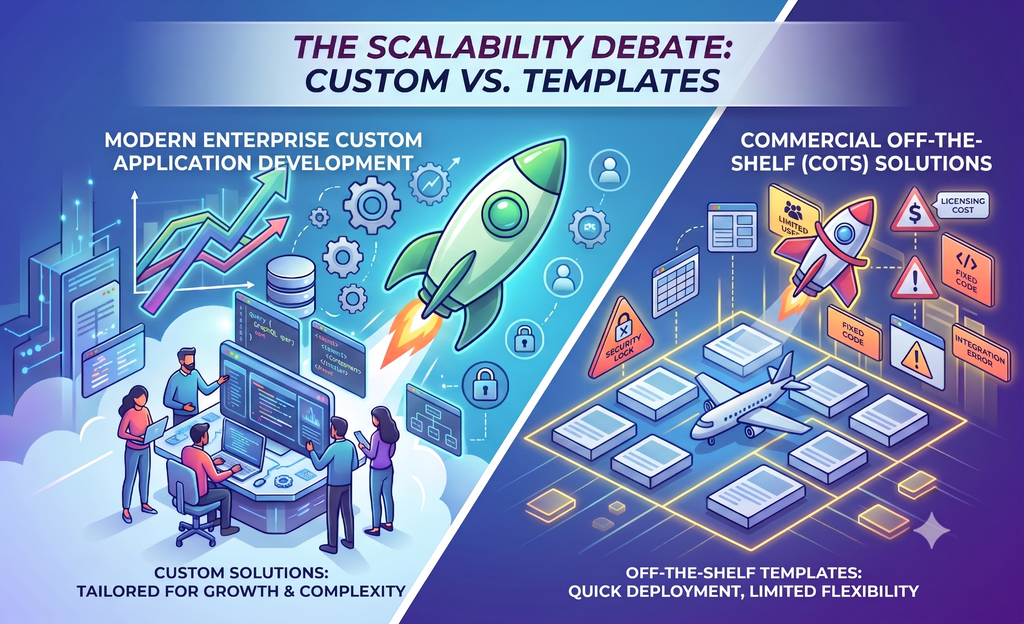
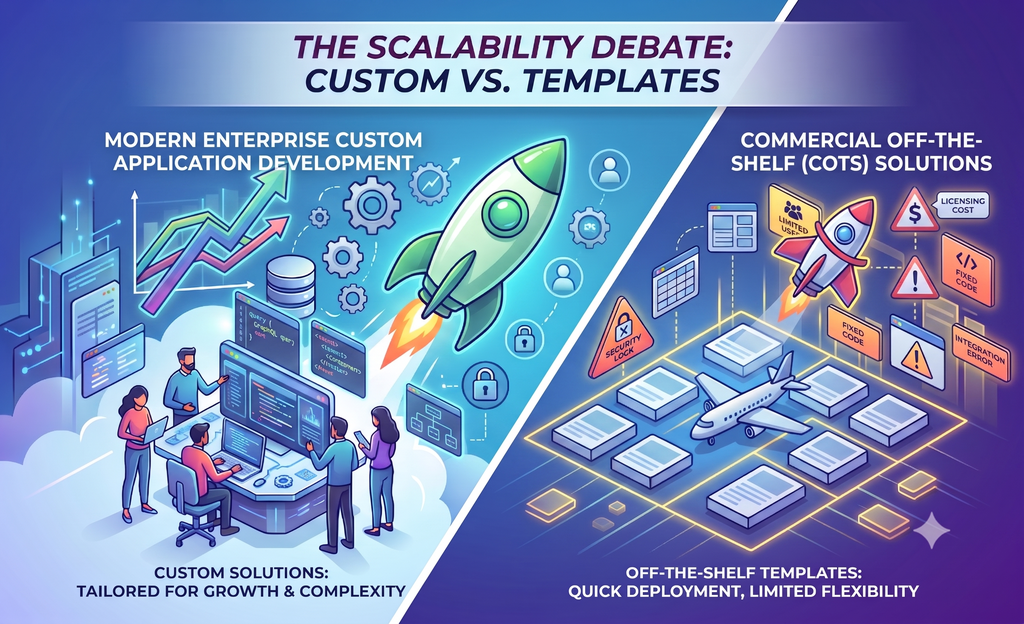
Custom web application development means building software from scratch around your business’s exact workflows, rather than adapting a pre-built template. It costs more upfront, but it scales without a rebuild — which is the whole reason this debate exists in the first place.

Here’s a scenario we see all the time. A business launches on a template, everything looks great for the first few months, and then growth happens, more products, more users, a new feature the business actually needs, and suddenly the template can’t keep up. That’s usually the point where people start looking for a custom web application development company, often after they’ve already sunk months into something they now have to unwind.

So let’s just answer the question up front: if you want something online this week and your needs are simple, a template will do the job. But if you’re planning to grow, or you already know your business doesn’t run like everyone else’s, custom development is going to save you a lot of pain later. Here’s why, in plain terms.

What’s Actually Different Between the Two

A template is built to work reasonably well for thousands of unrelated businesses. That’s the entire business model behind WordPress themes, Shopify layouts, and drag-and-drop builders, one product, sold to everyone. Which is exactly why it rarely fits any one business perfectly.

Custom development works the opposite way. Nobody’s starting with a pre-made shell and squeezing their business into it. The build starts with how your business actually operates, and the code follows from there.

A few things worth knowing before you pick a side:

  • Templates are simple to modify until you encounter an issue that falls outside the builder’s boundaries, at which point you have to either pay for a remedy or put up with the restriction.
  • Bloat is the root cause of many template performance problems. Everything slows down because you’re carrying code for features you’ll never use.
  • You don’t truly own your setup when you use a template. Since you are renting space on someone else’s platform, you will have to deal with any price changes or feature terminations.
  • It is typically more difficult than necessary to connect a template to the actual technologies your company uses, such as a CRM, inventory system, or regional payment gateway. Those relationships are taken into consideration when creating custom apps.
  • Once a business outgrows a template, it usually requires a complete rebuild. The purpose of custom applications is to expand, not to replace them.

None of this makes templates a bad choice, to be clear. They’re built for a certain job, and for a lot of small sites, that job is done well. The problem shows up when a business grows past what the template can handle, and by then, switching usually costs more than building custom would have in the first place.

Where Templates Actually Fall Apart

“Scalability” gets used loosely, so let’s be precise. It’s not just about handling more site visitors. The real question is whether the underlying system — database, logic, code — can handle your business’s growing complexity over time.

This is usually where templates start to show cracks:

  • The database structure and layout are predetermined. You’re not developing it correctly when you need a functionality that the template was not designed for; instead, you’re avoiding the restriction.
  • Plugin dependency increases quickly, particularly with WordPress. Every plugin you add increases the likelihood that it will malfunction, interfere with other programs, or reveal a security flaw you were unaware of.
  • Your data was not the focus of the database’s design. By definition, it’s general. At low volume, that’s acceptable, but as your catalog, users, or transactions start to accumulate, it becomes a serious issue.
  • Role-based access, approval chains, tiered pricing, and other custom business logic simply don’t fit well in a template. The workarounds are often brittle and break over time.
  • The platform you are working on is not under your control. You have no control over the firm that makes your template if they change the price or remove a feature that you rely on. It has previously occurred multiple times with popular page builders.

The majority of this is avoided by a well-designed custom application since scale is built in from the beginning rather than being added after things start to slow down. Because of this, many expanding companies and even smaller startups with genuine aspirations end up contacting a custom web application development company rather than attempting to push a template farther than it was intended to go.

What You’re Actually Paying For With Custom Development

Custom building involves more than just “code instead of a template.” It’s a completely different approach, and to be honest, the difference is evident even before a single line of code is produced.

A development partner worth working with will usually:

  • Before creating your feature list, inquire about your company. In the beginning, it’s more important to consider what you’re building, who it’s for, and where it’s going than what buttons you want on the homepage.
  • Create an architecture that accommodates expansion from the start, including the appropriate tech stack, a planned database rather than a generic one, and hosting that won’t collapse under future traffic increases.
  • Instead of introducing security after something goes wrong, incorporate it from the beginning. This entails encryption, access controls, and checks that are tailored to your industry’s real needs.
  • Take proper care of integrations. Payment gateways, ERPs, and CRMs whichever platform your business currently uses connect without requiring several fragile plugins.
  • Stay after the launch. Templates are set up once and then forgotten. As your organization evolves, custom builds typically include continuous support, monitoring, and updates.

Working with individuals who are familiar with your market has advantages as well. If your company is headquartered in the United Arab Emirates, one of the leading web development companies in Dubai will already be familiar with local payment preferences, compliance regulations, bilingual Arabic-English requirements, and the pace of work here. This really reduces the amount of back-and-forth that you would otherwise have to deal with.

Template or Custom, How Do You Actually Decide?

Here, there isn’t just one correct response. It actually depends on where your company is at the moment and, more importantly, where it is headed. Before making a decision, consider these sincere questions:

  • Is your business model likely to shift much over the next year or two? If there’s a real chance it will, a template’s probably going to need a rebuild sooner than you’d like.
  • Do you need to connect with specialized systems, logistics, local payment providers, or tools your team already relies on? Custom handles this far more cleanly.
  • Are you expecting meaningful growth in users or traffic? Templates tend to hit a wall that custom-built systems are made to avoid entirely.
  • Does your business run on processes a standard template just wasn’t built for, multi-step approvals, custom dashboards, unusual pricing tiers?
  • Is getting online fast your main priority right now, without big plans beyond that? If so, a template might genuinely be the smarter move for the moment.

If most of your answers lean toward growth or complexity, it’s worth having a conversation with a development team early, before you’ve spent time and money on something you’ll likely outgrow anyway.

Picking the Right Team in Dubai

Not every agency that says they can build for scale actually can, no matter how good their portfolio looks. If you’re comparing options for the best web development company in Dubai, skip the case studies for a second and ask about how they actually work:

  • Do they inquire about your long-term objectives, or do they simply start constructing based on your feature list?
  • Are they able to identify applications that they have contributed to growing over time, rather than just projects they started but abandoned?
  • Do they actually have backend, security, and design expertise in-house, or is a significant portion of it contracted out?
  • Are they honest about expenses, schedules, and the nature of assistance after the site goes live?
  • Do they actually comprehend the local market, including how people pay, what is controlled, and what UAE users expect from a website?

Those answers tell you far more than any polished portfolio will.

Wrapping This Up

You can get online quickly using a template, and sometimes that’s precisely what you need. However, it rarely expands alongside your company as you would like. Even while it may be more expensive initially, working with an experienced custom web application development business is typically the better option if scalability, security, and long-term flexibility truly matter to you.

Wantik Technologies has built web applications for UAE-based companies that are designed to grow with them rather than get replaced in a year or two. If you’re torn between a quick template and a proper custom build, let’s talk about what fits your situation — get in touch for a free consultation.

Frequently Asked Questions

1. Is custom development actually worth the extra cost over a template? 

Yes, it is more expensive up front. However, many companies wind up spending just as much, if not more, on resolving plugin conflicts, managing slowdowns, or ultimately rebuilding an outgrown template. Custom tends to even out or come out ahead over time.

2. How long does a custom web application usually take to build? 

The duration of most projects, which include exploration, design, development, testing, and launch, ranges from six to more than twenty weeks, depending on what you’re building. Once they know what you really need, anyone worth employing will give you a reasonable schedule.

3. Can I just move my template site over to a custom platform later? 

You can, but it usually requires more effort than beginning from scratch. Rather than just copying over, your data, integrations, and workflows frequently need to be rebuilt. If you anticipate growth, it’s better to prepare for it now rather than deal with it later.

4. What’s the real benefit of choosing a Dubai-based team over an international one? 

Mostly experience with UAE legislation, bilingual support requirements, local payment channels, and how quickly things move here. During development, that local context typically eliminates a lot of back-and-forth that you would otherwise have to deal with.

5. How do I know if my business needs custom development, or if a template’s fine? 

A template can really help you if your workflows are generally conventional and you don’t anticipate significant change. However, custom is typically the better option in the long run if you have special procedures, intend to grow, or require integrations that templates can’t manage well.

Hiring the Best Mobile App Development Agency in Dubai

Checklist for Hiring the Best Mobile App Development Agency in Dubai

Let’s be honest, in 2026, not having a mobile app is like not having a website a decade ago. It’s not optional anymore. Whether you’re a startup trying to bring a fresh idea to life, a retail business trying to keep customers engaged, or a company simply trying to make operations less of a headache, the right app can completely change how your business runs.

Dubai has quietly become one of the biggest tech hubs in the Middle East, and you can see it in how many businesses, across every industry, are investing heavily in mobile apps right now. But here’s where it gets tricky. With so many agencies all saying basically the same thing, actually finding the best mobile app development agency in Dubai can feel way harder than it should be.

And that’s the real issue, building an app isn’t just a technical task you check off a list. It’s a genuine investment in your business, your customers, and the growth you’re chasing. Which is exactly why picking the right partner deserves more than five minutes of Googling and a gut call. This checklist is here to help you cut through all the noise, ask the questions that actually matter, and steer clear of the kind of expensive mistakes that come from teaming up with the wrong agency.

Why Choosing the Right Mobile App Development Agency Matters

So many companies fall into the same trap, they choose based on price alone. And look, it makes sense at first. Cheaper quote, smaller upfront cost, why not? But then poor planning kicks in, communication starts breaking down, technical issues pop up out of nowhere… and before you know it, you’re spending way more fixing delays and mistakes than you ever would’ve spent hiring the right team from day one.

A good development partner does so much more than just write code. They help you:

  • Turn your idea into something that actually works in the real world
  • Build an experience users genuinely enjoy, not just tolerate
  • Set your app up to grow as your business does
  • Keep things secure and compliant, without you having to think about it
  • Stick around for the long haul, updates, support, the whole journey

Instead of merely offering services, the appropriate agency becomes a technological partner.

Checklist for Hiring a Mobile App Development Company in Dubai

1. Review Their Portfolio Carefully

The first sign of a company’s potential is frequently its portfolio. Look past eye-catching visuals and concentrate on the real functionality and intricacy of the apps they have created. An agency with experience should be able to showcase projects in a variety of business types and industries.

Be mindful of:

  • The range of applications they have created for various sectors.
  • The user experience and interface quality.
  • The intricacy of the features they have effectively incorporated.
  • If their prior work meets the needs of your project.

If at all feasible, download and try a few of their apps to assess their usability and performance.

2. Check Their Industry Experience

Every app development project is unique. The needs of a logistics system or an e-commerce platform are considerably different from those of a healthcare app. Agencies with pertinent industry experience are able to spot problems early and offer helpful advice.

Think about asking:

  • Have they collaborated with companies that are similar to yours?
  • Do they understand who your target market is? 
  • Are they able to give case studies that are pertinent to your sector?
  • What obstacles did they get past in related projects?

Experience frequently leads to improved results and quicker progress.

3. Evaluate Their Technical Expertise

Your development partner should keep up with market trends because technology is changing quickly.

A reputable mobile app development company in Dubai ought to be knowledgeable about a variety of platforms and technologies.

Their team ought to be knowledgeable about:

  • Development of native Android apps.
  • Development of native iOS apps.
  • Cross-platform frameworks like React Native and Flutter.
  • Backend development and cloud integration.
  • Third-party services and API interfaces.
  • Data-driven and AI-powered applications.

Your app will be scalable and relevant for many years to come if it has a solid technical base.

4. Understand Their Development Process

Knowing how an agency handles projects is one of the most neglected aspects of choosing them. Throughout the course of a project, an organized development process lowers risks and enhances communication.

Inquire about:

  • Planning and discovery stages.
  • Workflows for UI/UX design.
  • Methods of development.
  • Procedures for testing and quality control.
  • Procedures for deployment.
  • Maintenance assistance after launch.

A professional and well-organized team is typically indicated by a transparent workflow.

5. Look at Client Reviews and Testimonials

Feedback from clients frequently provides insight into the real experience of working with an agency. Look for trends in customer feedback, even though every business emphasizes favorable ratings.

Don’t just glance at the star rating; actually read what people are saying.

  • Did clients mention they were easy to reach and clear when explaining things?
  • Did they deliver on time, or were there constant delays?
  • How did they handle it when something inevitably went wrong?
  • Did the support stop the moment the project ended, or did they actually stick around?

Google reviews, Clutch profiles, even a quick scroll through LinkedIn recommendations, these tell you far more about an agency than anything on their website ever will.

6. Assess Communication and Responsiveness

Even the most talented developers can derail a project if communication breaks down. That’s just how it goes.

Your development partner should be easy to reach and willing to explain technical stuff in plain language, not jargon that leaves you more confused than before. Look for agencies that:

  • Get back to you quickly, not days later
  • Keep you in the loop with regular progress updates
  • Give you a dedicated project manager instead of bouncing you around
  • Are upfront about timelines and what you’ll actually get, and when

Honestly, communication breaks more projects than bad code ever does. Talent gets you in the door, but how well a team talks to you is usually what decides whether the whole thing actually works out.

7. Verify Their Design Capabilities

In a matter of seconds, users choose whether or not they enjoy an app. No matter how strong an app’s features are, it can soon lose users if it appears old or is hard to use.

Examine an agency’s design work and inquire about:

  • Research techniques used by users.
  • Prototyping and wireframing.
  • Mapping the user journey.
  • The issue of accessibility.
  • Procedures for user testing.

Excellent design boosts user retention and enhances client satisfaction.

8. Prioritize Security and Data Protection

Cybersecurity should never be neglected.

Sensitive consumer data, payment information, and business-critical data are frequently handled by mobile applications.

Verify that the organization adheres to security best practices, such as:

  • Standards for secure coding.
  • Data encryption techniques.
  • Authorization and authentication controls.
  • Adherence to privacy laws.
  • Frequent testing for security.

Both your consumers and the reputation of your brand are safeguarded by a secure app.

9. Understand Post-Launch Support

App launches are just the first step. As operating systems change, apps need to be updated with bug patches, performance enhancements, and compatibility changes.

Inquire with prospective agencies about:

  • Packages for maintenance.
  • Turnaround times for bug fixes.
  • Services for improving features.
  • Performance tuning and monitoring.
  • Access to technical assistance.

In the long run, a long-term support strategy can save a lot of time and money.

10. Compare Pricing Transparently

Although cost is a factor, the least expensive solution is rarely the best one. Consider the value provided rather than just the price.

A thorough proposal should specify:

  • The extent of the task.
  • Phases of development.
  • Design expenses.
  • The cost of testing.
  • The cost of maintenance.
  • Extra fees for services.

Transparency aids in avoiding future unforeseen costs.

Red Flags to Watch Out For

Not all agencies fulfill their commitments. If you notice any of the following, be cautious:

  • Unreasonably low prices in comparison to rivals.
  • The project timeline is unclear.
  • There are no documented procedures.
  • Inadequate communication in the early talks.
  • No client references or portfolio that can be verified.
  • Uncertain deliverables and vague proposals.

Budget overruns and project delays are frequently caused by these warning indicators.

Frequently Asked Questions:

Q: How much does it cost to develop a mobile app in Dubai?
The cost of mobile app development in Dubai typically ranges from AED 15,000 to AED 150,000+, depending on complexity, features, platforms (iOS/Android), and the agency you choose. A basic app costs less, while enterprise-grade apps with AI features cost significantly more.

Q: How long does it take to build a mobile app in Dubai?
A simple mobile app takes 2–4 months. A medium-complexity app typically takes 4–6 months. Complex enterprise apps can take 6–12 months. Timeline depends on your feature set, design requirements, and revision cycles.

Q: Should I choose a local Dubai agency or an offshore team?
A local Dubai agency offers face-to-face meetings, better understanding of the UAE market, local business compliance knowledge, and easier communication. Offshore teams may be cheaper but come with timezone gaps and cultural communication challenges.

Q: What is the difference between native and cross-platform app development?
Native apps are built separately for iOS and Android, offering better performance. Cross-platform apps (built with Flutter or React Native) work on both systems from one codebase, reducing cost and development time. Most Dubai SMEs start with cross-platform.

Final Thoughts

Finding the best mobile app development agency in Dubai takes more than comparing price quotes and skimming a handful of reviews. The right partner genuinely gets what your business is trying to achieve, brings real technical depth, communicates like an actual partner (not just a vendor), and stays involved long after the app goes live.

Stick to this checklist, and you’ll walk into those conversations with agencies feeling much more confident and much less likely to second-guess your decision down the line, because a well-built app isn’t just an app. It’s a real driver of customer engagement, business growth, and day-to-day efficiency.

At the end of the day, choosing the right mobile app development company in Dubai isn’t just about hiring developers. It’s about investing in a partner who can actually help turn your vision into something real.

Related: How to Create a Mobile App MVP from Idea to Launch

Top 10 AI & Chatbot Development Trends in Dubai for 2026

Top 10 AI & Chatbot Development Trends in Dubai for 2026: A Guide for Scaling Businesses

Instead of “adopting” AI, Dubai is constructing its future around it. Artificial intelligence is already important to how organizations function and expand, from intelligent government services to highly customized consumer experiences. Because of this, more businesses are actively searching for the best chatbot development company to create solutions that not only automate processes but also drive growth.

Knowing where AI and chatbot technology are headed is a competitive advantage if you intend to grow in 2026. Understanding these patterns will enable you to make more informed investment choices, whether you’re working with a custom software development company in Dubai.

Why AI & Chatbots Are Becoming Non-Negotiable

A few years ago, chatbots were a “nice to have.” Now? They’re becoming essential.

Businesses are using them to:

  • Respond instantly to customers
  • Handle hundreds of conversations at once
  • Reduce workload on teams

And the largest change? AI is already helping businesses operate more effectively rather than just supporting them.

For this reason, rather than employing generic tools, more businesses are now collaborating with the best chatbot development company or a custom software development company in Dubai to create something customized.

1. Chatbots Are Turning Into Smart Assistants (Not Just Reply Machines)

Chatbots were simple in the past. They respond when you ask them a question. That’s all.
Right now? They are genuinely capable of doing things.

We are discussing systems that are capable of:

  • Process orders
  • Book appointments
  • Handle complaints from start to finish

Thus, the chatbot addresses the issue rather than only responding to a query.

2. Businesses Are Starting Conversations First

This is a significant one.

In 2026, chatbots will actively seek out customers rather than waiting for them to do so.

For example:

  • Reminding someone about an abandoned cart
  • Sending a follow-up after a service
  • Notifying about offers based on past behavior

It feels more like an intelligent assistant who understands your needs than “customer support.”

3. Personalization Is Becoming the Standard

Generic responses are irritating.

“Hello user, how can I help you?” doesn’t cut it anymore.

Modern AI systems are now:

  • Remembering user preferences
  • Suggesting relevant products or services
  • Adapting tone and responses

As a result, every encounter feels more intimate, directly affecting conversions.

4. WhatsApp Is Leading the Way

If your company isn’t using WhatsApp in Dubai, you’re already behind.

Because it’s quick, simple, and familiar, customers prefer it.

That’s why businesses are now building chatbots that:

  • Work directly on WhatsApp
  • Sync with Instagram and websites
  • Keep conversations consistent everywhere

Meeting customers where they are is the key.

5. AI That Understands Arabic (Properly)

Despite Dubai’s diversity, Arabic is still widely used for communication.

AI has had trouble with this in the past. It’s improving significantly now.

Chatbots in 2026 can:

  • Understand Arabic dialects
  • Switch between languages smoothly
  • Even handle voice interactions

For local users, this results in a much more natural experience.

6. Smarter Answers With Real Data (No Guessing)

One concern that people had about AI? incorrect responses.

Businesses are now addressing this by directly integrating chatbots with their data.

So instead of “guessing,” the chatbot:

  • Pulls real information from systems
  • Gives accurate, up-to-date responses
  • Reduces confusion for customers

This is especially important in fields where precision is crucial.

7. Chatbots Are Helping Teams Make Decisions

Interestingly, chatbots are no longer limited to consumers.

Additionally, they support internal teams.

Imagine asking:

  • “What were our sales last week?”
  • “Which product is performing best?”

And getting an instant answer.

AI is moving in the direction of making data simpler, not harder, to access.

8. AI Is Becoming Easier to Build

Building AI systems used to be costly and difficult.
It’s getting easier to access now.

With newer tools:

  • Development is faster
  • Costs are lower
  • Updates are easier

This is great news for startups and growing businesses in Dubai who want to scale without huge upfront investments.

9. Humans + AI = Better Together

A widespread concern is that people will be replaced by AI.

The finest solutions actually incorporate both.

Chatbots handle:

  • FAQs
  • Basic support
  • Repetitive tasks

Humans step in for:

  • Complex issues
  • Sensitive conversations
  • Decision-making

This balance actually improves both efficiency and customer satisfaction.

10. Businesses Are Taking AI Ethics Seriously

Businesses are growing increasingly cautious as AI gains strength.

A greater emphasis is placed on:

  • Data privacy
  • Transparent systems
  • Fair and unbiased responses

Particularly in Dubai, businesses are using technology to establish trust and comply with rules.

What This Means for Your Business

Let’s simplify all of this.

If you’re planning to scale, AI and chatbots can help you:

Save Time

Automate repetitive duties so that your staff can concentrate on more important tasks.

Reduce Costs

Manage more clients without adding additional staff.

Improve Customer Experience

Faster responses, better personalization.

Grow Without Limits

Serve 10,000 clients or just 10 without overloading your system.

For this reason, instead of using simple, off-the-shelf solutions, companies are now investing in a custom software development company in Dubai.

How to Choose the Right Chatbot Partner

If you’re thinking about getting started, choosing the right partner matters a lot.

Here’s what you should look for:

  • Someone who understands your business (not just tech)
  • Ability to customize the solution
  • Experience with integrations (CRM, website, apps)
  • Ongoing support after launch

The best chatbot development company doesn’t just build your bot, they help your business grow with it.

Where AI Chatbots Are Already Making an Impact

Across Dubai, businesses are already seeing results.

  • Retail → Better product recommendations & faster support
  • Restaurants & Cafes → Order automation & quick responses
  • Healthcare → Appointment booking & patient queries
  • Real Estate → Instant property inquiries

It’s not limited to one industry anymore; AI is everywhere.

Final Thoughts

In Dubai, AI is accelerating rather than slowing down.

Additionally, the difference between companies that use AI effectively and those that don’t will only widen.

The good news? You don’t have to do everything at once.

Begin modestly. Pay attention to how AI can genuinely impact your company. and proceed from there.

Because in 2026, scaling means working smarter rather than just harder.

Web Development Companies in Dubai

Scaling Your Vision: What to Look for in Web Development Companies in Dubai

The objective is rarely “having a website” when a company chooses to develop or update its website. The majority of businesses seek a platform that fosters expansion, draws clients, and changes as the company grows. Because of this, picking the best partner from numerous web development companies in Dubai is more important than most people realize.

The business environment in Dubai is dynamic. Customers expect seamless online experiences, existing businesses are digitizing their services, and new startups are emerging every day. A website that functions well now can require performance enhancements, additional features, or integrations in the future. A competent development partner is crucial in this situation.

The top development teams do more than just write code. They assist companies in considering user experience, scalability, and digital strategy. Working with the appropriate custom application development company might mean the difference between a temporary fix and a digital asset that expands with your company, whether you’re going to launch a new platform or modernize an old one.

The key factors to consider while selecting a web development partner in Dubai are broken down in this guide.

Why Businesses in Dubai Are Investing More in Web Development

One of the world’s most digitally linked markets is now Dubai. Consumers expect quick, mobile-friendly experiences, use websites to book services, and conduct online business research.

As a result, websites have developed into effective commercial tools from basic online brochures. These days, businesses use their platforms to:

  • Generate leads
  • Sell products
  • Manage bookings
  • Connect internal systems
  • Improve customer experience

These days, the core of many businesses’ activities is their website or web application. The growth of web development firms in Dubai nowadays can be linked to the increasing demand for digital services. But picking the appropriate partner requires considerable thought because there are so many alternatives

Think Beyond a Website, Think About Scalability

Focusing solely on the launch is one of the biggest mistakes made by businesses.

When a website launches, it may look fantastic, but what happens if your company expands?

You might need to:

  • Add new services
  • Handle more website visitors
  • Integrate new tools
  • Expand to new markets
  • Launch mobile applications

These modifications may become costly and complex if the initial system wasn’t built to scale.

From the beginning, a strong development partner makes strategies for expansion. They create platforms that can change as your company does.

What a Modern Development Partner Actually Does

A common misconception is that developers only create pages and link them to a server. Modern web development actually entails a lot more.

A reliable custom application development company helps businesses with:

  • Platform architecture planning
  • User experience design
  • Backend system development
  • API integrations
  • Performance optimization
  • Security implementation
  • Ongoing improvements

In other words, they assist in transforming business concepts into effective digital systems.

Key Things to Look for in a Web Development Company

Timeliness and cost are not the only considerations when selecting a development partner. It’s about finding a team that can create a platform that supports your objectives.

Here are the most important things to consider.

1. A Clear Understanding of Your Business Goals

The best development teams start by asking questions.

They want to understand:

  • What problem does your platform solve?
  • Who are your customers?
  • How will the website generate value?
  • What growth do you expect in the future?

It’s always a warning sign if a business starts pricing without first talking about your objectives.

Instead of thinking like a contractor, a competent developer thinks like a partner.

2. Strong Portfolio and Real Project Experience

Look over a development company’s prior work before hiring them.

Look for projects that show:

  • Different types of platforms
  • Complex functionality
  • Clean and modern design
  • Fast loading speeds

A diverse portfolio frequently demonstrates that the team has expertise in resolving actual business issues rather than merely building simple websites.

3. Custom Development Capabilities

Simple websites can benefit from templates, but most expanding companies eventually want greater flexibility.

Working with a custom application development company becomes beneficial in this situation.

Custom solutions allow businesses to:

  • Build unique user experiences
  • Automate internal workflows
  • Integrate multiple business systems
  • Launch specialized digital services

Instead of adapting your business to fit a platform, custom development allows the platform to fit your business.

4. Focus on User Experience

A website might look visually impressive but still frustrate users.

Excellent development teams prioritize usability. They consider how users engage with the platform and how simple it is for them to accomplish their objectives.

Strong user experience includes:

  • Clear navigation
  • Fast loading times
  • Mobile-friendly design
  • Simple forms and checkout processes

When websites are easy to use, customers are more likely to stay, engage, and convert.

5. Mobile-First Thinking

In Dubai, most users browse the internet through their phones. If a website doesn’t work well on mobile devices, it will quickly lose visitors.

Top web development companies in Dubai prioritize mobile performance from the start.

This includes:

  • Responsive layouts
  • Optimized images
  • Fast mobile loading speeds
  • Touch-friendly navigation

Mobile-first design ensures your platform performs well across all devices.

6. Integration Capabilities

Most businesses use multiple tools to run their operations.

These might include:

  • CRM systems
  • Payment gateways
  • Marketing platforms
  • Inventory management software
  • Customer support tools

These systems must frequently interface with your website.

To keep your digital ecosystem connected, a skilled development team makes sure these integrations function properly.

7. Security and Data Protection

One area where taking shortcuts can be quite expensive is security.

Security is built right into the platform by a professional development team.

Important security features include:

  • Secure authentication systems
  • Data encryption
  • Regular updates and monitoring
  • Protection against common cyber threats

This is particularly crucial for websites that handle sensitive corporate information, payments, or personal data.

8. Transparent Communication

Clear and regular communication is essential to the success of technology projects.

A good development partner will:

  • Explain technical decisions in simple terms
  • Provide regular project updates
  • Set realistic timelines
  • Involve you in key decisions

This collaborative approach guarantees that the finished product reflects your vision.

9. Long-Term Support

A website launch is not the end of the journey.

Over time, you will likely need:

  • Security updates
  • Performance improvements
  • New features
  • Bug fixes
  • System upgrades

Reliable web development companies in Dubai offer long-term support to keep platforms running smoothly as technology evolves.

Common Mistakes Businesses Make When Hiring Developers

Selecting a development partner can be difficult, particularly for companies creating their first digital platform.

Some common mistakes include:

Making a decision solely on price

Higher long-term expenditures are frequently the result of less expensive alternatives.

Rushing the decision

Considering your alternatives carefully will help you avoid serious problems down the road.

Ignoring scalability

Platforms designed solely for temporary use frequently need to be rebuilt at great expense.

Overlooking communication

Project delays can nevertheless result from a technically proficient team that communicates poorly.

Businesses can save a lot of time and money by avoiding these errors.

The Real Value of the Right Development Partner

The benefit of working with the right team goes well beyond the launch of a website.

Experienced web development companies in Dubai help businesses:

  • Improve customer experiences
  • Streamline internal operations
  • Launch new digital services
  • Expand into new markets

A strong custom application development company develops into a long-term technological partner that supports companies’ expansion and adaptation in a quickly evolving digital environment.

Final Thoughts

For any business, creating a digital platform is an important first step. A well-designed website or application can enhance client connections, boost productivity, and open up new business prospects.

However, the platform’s development staff plays a major role in its success.

The top partners among the numerous web development companies in Dubai concentrate on comprehending your objectives, developing scalable systems, and developing platforms that provide genuine value over time.

Spend some time assessing technical proficiency, communication style, experience, and long-term support skills. When you find the right custom application development company, you’re not just hiring developers, you’re building a partnership that helps bring your digital vision to life.